Tuesday, October 30, 2007

Defining Virtual Worlds, a Redux

The "harness a virtual world definition for the mainstream" meme has been revived, so I thought I'd dust off my April post and breath some new life into it and into the conversation.

Much of the recent discussion revolves around defining "social" virtual worlds and building a list of those that met a certain criteria. I'm not a list maker. I try to use lists for grocery shopping, but once I get to the market that list may be outdated or usurped by evolving conditions, which is why I prefer that more time be spent on a definition or context.

But before we get too far off in the Webster weeds, I personally think it's important to know why it's important to define something. Definition is important in a context toward understanding, and the context in which I've chosen is to understand or draw some insights is: What makes these largely ill-defined social spaces successful? You may not agree with that context, in which case you may want to stop reading here, but my intent is certainly not to build a list but rather learn something in the process of the definition exercise.

I found Onder's post on this topic particularly compelling in which his definition was within a context of comparing Second Life to alternatives. I was somewhat surprised that he did not throw in on the Metaversed post about the topic, but perhaps we share the same disdain for lists. Nonetheless, I want to highlight a superset definition which I've pulled from Raph's post:
A Social Virtual World has game-like immersion and social media functionality without narrative driven goals. At its core is a sense of presence with others at the same time and place.
[UPDATE: One correction/clarification to be made here. This was not Raph's definition, rather one which he pulled from the referenced Metaversed.com post. Thanks Raph]

This is lacking a key element from my perspective. It may be in hope to be a succinct as possible, but to me there are at least three critically important elements to a virtual world.
1) Socialization - There are adequate means by which people socialize, form and maintain affinity groups, communities and even whole new societies. Socialization is overwhelmingly the reason people are online and the enablement of such cannot be over-emphasized, over-supported or over-maintained.
SIDEBAR: I'll take out a brief moment and smack LL over the head with their product management road map. This is where all things start and end, and if you cannot get socialization right, you have failed. If group communications do not work efficiently, you've failed. If profiles fail to load, guess what? If my friends don't show on line and I can't teleport someone I just met ... do not collect $200, go directly to jail.
2) Immersive and Participatory Media - There is underlying dialogue and interaction with assets - whatever that may be - ranging from full scale user creations to game play and event to simple utterances of the Twitterdom type. Users must be able to create, but there is equal part to play in consumption and evolution of someone else's creation so that in the end, there is something to do.
Mediated or otherwise, creation and consumption is not one-way, but rather it depends upon both the immersiveness and synchronicity of the platform. I think these two are covered by Raph's definition but there is at least one critical element missing.
3) Marketplace - There is a marketplace that provides the ability for people to a) define value and b) transact on items of value in the world on many levels up to and including RMT. Currency can be defined and influenced by the world's culture and subcultures. In virtual worlds, there are two forms of currency - one that is only usable in world, and the other that can be traded outside of the world .
One non-trivial form of social virtual world currency is social currency. Social currency is earned according to the cultural rules defined by #1 Socialization; it is often of higher value inside the world in which it was earned and it is the fabric that ties points #1-3 together. It can inflate or recess, depending on cultural factors and it's value it entirely subjective, the market can shift and your ability to "cash out" is entirely dependent upon your ability to socialize, your participation and a market against which to trade.

Marketplace is a lynch pin of social virtual worlds - it is not only critical to the definition - it is largely the element of success or failure. Without some form of marketplace, a social virtual world will fade into oblivion for there must be some economy supporting the weight of those that choose the equivalent of "welfare", and it provides a foundation for those that are goal-oriented and motivated by whatever currency is defined, be it real money, celebrity, stars, trinkets, or spotted puppy dog tails.
Share Some Grace:

Wednesday, October 24, 2007

CSI In Second Life The Onslaught Begins


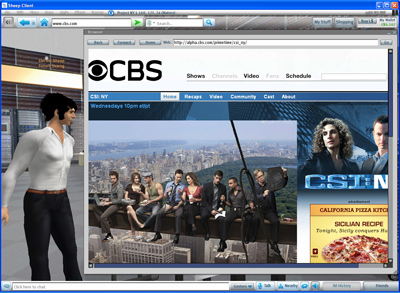
The CSI episode just aired, and the Second Life homepage now boasts a subtle indicator that drives people to a CSI Orientation Island.

It looks like uptake is starting, I just crashed but twitrumors are that the sign ups are around 200 every five minutes and another report is 13,000 per hour.

I have an arguably fashionable new hat, thanks to my superior sleuthing ability and subsequent nabbing of two notorious members of the Dobreff Family.

If you'd prefer a guided tour, STA Travel sponsored a Landmark Travel CSI Tour.
Share Some Grace:

CSI Invades Second Life - New Viewer Is Released

I had an entire post about the viewer, but it looks like it was lost between the publish and the post. Nonetheless, Tateru wrote a nice piece at Second Life Insider, and Prokofy proclaims "I'm right" about previously expressed concerns regarding search, but I need more time to digest that entire train of thought.
Share Some Grace:

CSI Invades Second Life T- 12 hours


I'm still surprised that so many people (even avid Second Lifers) are unaware of the CSI "Down the Rabbit Hole" episode airing tonight.

Check out yesterday's post for my opening foray. I'm going to try to keep posting updates and links out with relevant and hopefully interesting information as this event unfolds.

The first thing you'll want to check out is the dedicated site. Find it here. Also read some details extracted reportedly from a Glen Linden notecard.
Share Some Grace:

Monday, October 22, 2007

CSI Comes To Second Life - Are You Ready?

[ The people who watch CSI are idiots. .. ]
- Nick Wilson (aka 57 Miles), excerpt from Metaversed.com Second Rant #12
By now you've likely read about the transmedia collaboration between Anthony Zuiker, creator of the CSI franchise and The Electric Sheep Company (ESC) in the upcoming CSI episode entitled "Down the Rabbit Hole". This was the highlight announcement at the Virtual Worlds Conference and Expo 2007 for me; I am passionate about the potential of transmedia storytelling. You can hear the keynote with ESC CEO Sibley Verbeck and Anthony Zuiker in total here, thanks to the conference team.

The big event starts Wednesday Oct24, and instead of just telling you it's happening, speculating about what might happen, or complaining about the opportunity ESC seized by optimizing the Second Life open source viewer, I thought I'd go ahead and start my Monday morning quarter back routine one week early and outline what I would have done or would be doing if I were either Anthony and his Sheep or a Second life business owner.

Let's start by considering a few grounding points:
  • CSI is reportedly a $6B franchise, airing in every country in the world except for six which are: North Korea, Iraq, Iran, Afghanistan, Pakistan, Uzbekistan.
  • On October 24th, 16 million viewers will be exposed to two 30-second spots to call people to action to join Second Life and the CBS virtual presence.
  • The ESC is releasing a new Second Life viewer as part of their OnRez suite in conjunction with the episode.
  • The CSI entry into Second Life is of massive scale, encompassing numerous (over 400?) private estates that include orientation islands and the destination of virtual Manhattan that will host reenactments of the crime scene as well as a host of interactive elements such as casual games, an online tie in to a blog game called Murder by Zuiker, and a murder of the month game in which Anthony himself will participate.
  • The Oct24 episode narrative will continue to unfold after the TV airing across the virtual space, on the web and with mobile updates. The episode will repeat in December. The story will culminate with the closing episode on February 6th in which Venus (the female assassin) will be caught and jailed, along with the other killers she's dispatched in world over the holiday season.
  • The February 6th episode will feature a rock star as part of the episode, after which they will perform a live virtual concert in Second Life. On February 7th, the jail will explode in world and the narrative will continue.
If I was Anthony Zuiker and the Sheep I would have started the buzz train earlier and with more vigor (at the time of this post, the promo machinima on YouTube still had but 19,495 views). Pitching the concept at CES in January, and again at the Virtual Worlds conference is necessary but not sufficient. You need to capture the imagination of the non-believers, the uninformed, the 16 million unsuspecting viewers. My experience tells me that empirically it takes about four explanations before the concept of Second Life sets in, and this is for people that are interested. You cannot hope to capture the attention and imagination of the CSI audience in fifteen minutes of machinima.

I know Anthony believes in the concurrent viewing model, but every SL resident knows that getting in world isn't as easy as flocking the The Suicide Girls website for a quick hit, despite the ESC best efforts to produce the perfect blue or red pill. Anthony knows that too, which is why he focused on streamlining the indoctrination all the way to building a custom viewer. However, that is simply not enough, no matter how easy you make it there will be questions that should be answered by people in world. Therefore, I would have had an update last week explaining the upcoming episode, encouraging early adopter viewers to get in world to become CSI mentors or guides and not rely wholly on post show enthusiasm.

I would not rely on the existing CBS CSI web properties to provide information and dialog, but seed it with information and pointers to a fully branded site. I did a quick search for "second life" on the CSI NY message board that yielded two (2) relevant results; this tells me that there are insufficient efforts to generate buzz among the viewing community rather than talking to the preexisting virtual world residents. I'd also solicit my advertising partners to do the same among their net promoters.

And finally, if I were the ESC, I would have released the OnRez viewer outside of my closest business partners for objective review and feedback, and most importantly I would have trained a non-trivial number of current SLers on the new viewer (I don't know if ESC has done this or not). Fundamentally, my primary concern as the ESC would be supportability because the *entire* success of this project depends upon two things: 1) the ability to get in world relatively smoothly and 2) the ability to keep people there once they've taken the blue pill.

If I was a Second Life hopeful entrepreneur, what would I be doing? For starters, I would figure out what type of people might be flocking in world this week. I'd scrounge the CBS CSI web property message boards and fan sites to answer a few questions about CSI passionates - who are they, what do they like, what motivates them, how do they relate to the show? I'd use this information to help shape new products or offerings.

If I were an existing business owner, I would update my classified ads so that they contain key words relevant to the new user base (so that they serendipitously show up in search). I'd offer freebies that cater to forensic freaks. I would make sure my product and/or service is listed as part of the OnRez shopping service.

As an event organizer and estate owner, I would start a Forensic Science or Crime Lab group and pack it with activities such as themed welcoming parties and crime solving "raids" to provide alternative entertainment to the beleaguered newbies, and I'd be planning a major in-world post viewing party for December.

That's a few things I would consider. Alternatively, you might simply choose to ignore the entire project and the bunch of idiots.
Share Some Grace:

Wednesday, October 10, 2007

Virtual Worlds Conference and Expo 2007


I'm at the Virtual Worlds Conference this week and I'll be focusing my attention in two primary areas: the use of virtual worlds as a transmedia platform and new business models afforded by the attendant emerging markets and technologies.

If you have a question or want me to try to track down some information, drop me a comment.

Selected Updates
I usually skip keynotes unless I know the speaker and they often feel like eating dry toast, but I am really glad I did not miss Anthony Zuiker. In addition to being the perfect personification of "tram tour guide makes it good", Anthony is the consummate showman. None of this distracted from his unveiling of the upcoming CSI episode on October 24th as a significant step toward transmedia story telling in conjunction with The Electric Sheep Company.

Unlike the Law and Order debacle, Anthony is using Second Life to extend the story and the viewer's experience not just that night, but in an on going unfolding arc that will wrap on February 6th. I had the chance to talk to Anthony last night at an after-party, and he really does get it. I encouraged him to talk to Henry Jenkins which I hope he does, he has the energy and resources to take this concept far beyond Henry's musings.

The Electric Sheep have been busy bees, in conjunction with the CSI release, they unveiled their new Second Life viewer, touted as the first commercially licensed viewer since the client was open sourced by Linden Lab. I think this deserves it's own post which I'll write later.


In an interesting partnership, IBM and Linden Lab are teaming up to create a new set of standards to increase interoperability between worlds. From the IBM press release:
IBM and Linden Labs today announced they will work with a broad community of partners to drive open standards and interoperability to enable avatars -- the online persona of visitors to these online worlds -- to move from one virtual world to another with ease, much like you can move from one website to another on the Internet today. The companies see many applications of virtual world technology for business and society in commerce, collaboration, education, training and more.
This is definitely something I will blog more about later.

More Updates:
Thursday was mostly a meet and greet day for me. As for the Day-2 keynote, Christian Renaud is a finely tuned speaker, but his powers of ten introduction and a near-forensic analysis of how we get to the future via standards, committees, and councils (oh my) left me a bit cold. I'm not arguing for rah-rah and pom-poms, just a bit more insight into what's actually working in virtual worlds before we dive head first into a morass of standards.

Suffice it to say that "interoperability" was the buzz word of day 2, and I was surprised not to hear more buzz about the InDuality multi-platform viewer developed by Clive Jackson, CEO and Founder of Pelican Crossing. You may recall, Clive helped me escape the prison of defining "virtual world" with a great paper entitled The Metaverse 2.0 in this previous post. I completely missed meeting Clive and the InDuality demo so if anyone was lucky enough to see it, drop in a comment with your impressions.

I was lucky enough to spend some quality time with Raph Koster and Jason Hable from Areae to get an under the hood tour of Metaplace. On a side note, if you've not had a chance to hear Raph speak, you want to put that on your life list and in the mean time, you can find a lot of what he thinks out loud on his blog. Metaplace is still in a closed alpha, but by the grace of the virtual goddesses, I will get a chance to kick the tires before year end and the only thing I will tell you is you might want to tune up your Lua skillz. (No, I don't know where the auto references came from; perhaps I'm traveling too much).
Share Some Grace:

Friday, October 05, 2007

Identity Verification = Trust ?

I took a brief hiatus from Second Life and blogging in general, and the next time I will follow blogger etiquette and post a "gone fishing" sign. It was kind of everyone who inquired politely about my well being, but when I got a worried email from my dad today saying in part ".. and there's no activity on the web. You OK?" I decided it was well past time to return. (And by the way, Dad - you've got mail.)

I had planned a detailed post about my experience with Burning Life, but as that event unfolded I lost most of my enthusiasm for it and all of what I wanted to say which was largely unfavorable. Instead, there have been a few things lingering in my head and they are more relevant as we approach the Virtual Worlds 2007 Conference and Expo. The first is Identity Verification and what it means. I know it's a relatively old topic in Second Life time, but it's weighed heavily on my mind since a recent interaction, so out it comes.

When Linden Lab first introduced the intent to deploy an identity verification system (IDV), I skimmed over it thinking it was akin to establishing a MPAA-like ratings system for content. If you have a rating system and intend to enforce it, you have to have some form of verification and that made sense. In fact, large portions of the initial Linden Lab reasoning in the first, second and third blog posts alluded to segmentation of and access to rated content.

I largely ignored the system and the beta trial as I have no need, desire or intent to explore the vastness of the Second Life Adult Content (defined as explicitly sexual or excessively violent). However, Robin Linden's blog post and a personal experience has made me rethink the true intent and extent of "verification".

Robin starts her post with an interesting statement:
Trust is the foundation of any community. And one cornerstone of trust is identity. You’ve got to know something about the person you are dealing with before you can trust them. Knowing who to trust in an online environment presents unique challenges. Traditionally Second Life users have based their trust on relationships built over time, and often on some basic verification such as ‘Payment Info on File’.
This is a subtle introduction to the underlying message, which is that the focus of the verification system to that of a "trust", not simply age identity.

The IDV system aims to deliver two things. First, for Residents, it gives them the chance to independently verify certain aspects of their identity (their name, age, location and sex for instance) if they choose to. This will help establish trust by removing a layer of anonymity for those they interact with. It’s much easier to trust someone who puts their name behind their words and actions.

The second benefit of the IDV system is to help land owners and content publishers be sure that minors do not get access to inappropriate material. ... ]

What is so interesting about these statements? It is an attempt to suggest that the institution of IDV will somehow introduce a new layer of "trust" into the community.

Anyone that has spent any reasonable amount of time participating in on line communities knows that trust has to be earned over time, it is not merely a factor of your name, age, sex, or location; it's about who you are and what you contribute in the context of the community. I would argue that if you start with a person's age, sex, location as a basis for trust you are more apt to be fooled or lulled into some false sense of security by a "verification" tag. Even worse, the methods by which Linden intends to execute this verification are weak, based on publicly available information and are fraught with opportunities to be scammed. If you want a good treatise on IDV and how it really translates to liability transfer and culpable deniability rather than trust, read Gwyn's post "I am who I am". I will summarize the key point: IDV does not assure your avatar is who you say you are, it merely indicates that the data you provide to Integrity matches data that is publicly available.

The impact of IDV hit me more directly in a recent group event. In the context of the group discussion, the leader suggested that it would be "of benefit" to the group if everyone introduced themselves, telling everyone what they do in Second Life and who they are and what they do in real life, over the voice system. It was the first time I'd seen such a request, and it was not a heavy handed "tell us or you're out", but it was presented in the context of the discussion as a perfectly reasonable request and expectation.

I shared my information, after which I was mildly amused that I was presented with five new friend requests. This was in balance with the sixth interaction which was a private IM from someone I had not met before. This person wanted me to restate my real name. I obliged and the reply was loosely "I don't trust people here and I fully endorse Linden's Identity Verification system. I need to know you are who you say you are. Here's my blog link, you can read it and friend me afterward if you think that is worthwhile." I wasn't sure how to respond, other than "Are you KIDDING me?" so thanks to me mum, I replied that I understood and have a nice day.

Of course I checked the individual's blog, which was actually a web site (when did every form of rendered html become a blog?) and from there I deduced that this was most likely this person's first online community experience. The trouble is, this person and many other "newbies" that read the Linden Lab posts on IDV believes that "verification" in the IDV acronym equates to trust and a new business utopia as described by Benjamin Duranske in this post . I can assure you, it does not.

Trust is critically important, but it is based on community interactions. If you are reading this, you are probably aware that for enterprise systems such as eBay and Amazon and even news and information sites, rating systems implemented to work within the community norms are successful. Ratings serve as their own form of verification. I don't know the eBay seller i_can_has_cheeseburger (fictional example) but they have executed 2,000 transactions over the last 12 months and have zero negative comments from buyers. Therefore, within the eBay community I *trust* them and will do business with them. Do I care about their age, sex, location?

Do the community norms of the Second Life population endorse anonymous third party systems even if they *promise* not to store any personally identifiable information? No, not so much. Second Lifers build trusted networks by participating in communities of practice (CoP). Without a generalized and publicly viewable rating system, an individual's contributions are locked within the confines of that CoP trusted network and cannot be exposed as an indicator of reputation and therefore implied trust.

In a short-sighted decision this spring, Linden Lab removed the rating system this year because "the ratings system has become less and less useful" when in fact it was merely poorly designed from both a technical architectural and a social architecture perspective. This decision to dump the rating system left the community without this critical tool. Linden suggested adopting other community systems - RatePoint, TrustNet, Ban Link, Sloog.org, Real Reputations, and SLicr - but not surprisingly, none have risen to the challenge because the community looks to Linden Lab to provide the basic tools to function as a community. Once the IDV system is in place, the community will have to keep looking.
Share Some Grace: