Monday, May 26, 2008

The Sojourner

soj

At some point, someone you've never met in person will have a profound impact on you - spiritually, intellectually, emotionally.  And as it is so often, you may not fully recognize the impact of that person until the point at which you must consider they are gone.

The Sojourner taught me the real meaning of this journey.

Travel safely, Soj. 


Share Some Grace:

Saturday, May 24, 2008

Solving Second Life® User Interface and Churn Dilemmas

This is my first post from Windows Live Writer and it's an important post, so I am throwing caution to the wind.

For some time I have been thinking about the Second Life user interface and the loosely linked (perhaps?) churn problem. By thinking, I mean I haven't been in my usual "lean forward" mode, but rather in a more casual lean back, read, stare off into space and ultimately get distracted by something shiny mode. This is a good mode to consider seemingly simple but actually subtlety complex issues, and it allows my mind to wander off into open spaces and into more systems thinking. Lean back thinking is a luxury that we are rarely afforded in the current market of rush to publish micro-bursts of information and ideas. You also have to call your mind back occasionally and ask "What have you done for me lately?" and hope you aren't met with a blank stare.

So much for the frightening imagery of how I think, what's important is today my mind brought back an "aha!" (no, not that Aha).

I've been trained to go ahead and give you my answer right now, here before you go away leaving me with a tl:dr and a pat on the head. So I will, but you won't like it and some of you won't even read past my proposal except to skitter down to the comments and declare your outrage. Nonetheless, here goes:

The Second Life interface and attendant new resident churn problems can be solved using Artificial Intelligence and bots.

Yes, that's what I meant. Two of the most recently hated and feared parts of the Second Life experience can, in fact, improve not only the interface but reduce the new resident churn rate.

Despite the din of outcry across the Second Life resident blogosphere about the client, I have yet to run across a well-formed proposal for redesign. But, what my wandering mind did find was some correlation among sundry bits, explained in the following paragraphs.

At least once a week I mill about looking for the latest discussions, rants and otherwise about the Second Life interface. Honestly, I was looking for a "fix" - a miracle client release - but none were found. Instead I found Nicholaz Edition fanatics, the Linden Lab Viewer roadmap complete with the ability to skin your own (or rather, skin at your own risk), and reams of discourse some of which Digado summarized in his post about Second Life's New User Experience.

But for me, the most thought-provoking discussion arose on Dusan Writer's post about killing sacred cows. From Dusan:

….well, here’s the thing, I ended up wondering if some of the things I take for granted are errors of conception.

Call them the Sacred Cows of Second Life. And maybe it’s time for me to kill one or two of them. For myself in any case.

And the first is that the Second Life interface sucks. Which will lead to the next sacred cow, which is that the newbie orientation experience sucks. And the sacred cow isn’t necessarily that these things aren’t true, but that we should actually do something about it.

Dusan highlights his personal experience and frustrations with the complexity of the interface and ends up asking an important question. (emphasis mine)

All of which is to say that the interface is NOT user friendly, at least for someone like myself who’s unfamiliar with half the terms and look, it took me an hour to learn how to talk when I first got to SL, and it must be even harder now - do I click that little chat balloon or the other button and what’s the difference between “Communicate” and “Talk” or whatever the buttons say, all you really want to do is ask someone where the fun is.

But here’s the question - so what?

...

So the SL viewer seemed insanely difficult to me - so many buttons, so much to learn, and this on TOP of learning where to go, how to talk, who to talk to, and what the culture was all about, the norms, the attitudes, the list of things to see or places to go.

The answers to Dusan's inquiries change regularly, such is the dynamic nature of Second Life. This leads me to believe that the user interface will never be static, but rather will and must organically evolve with the Platform. It's important to note that this is a Platform that includes the technology, features, services as well as people, places and things to do.

Furthermore, the tasks and questions that Dusan is asking are all answerable (at least at the first order) using structured knowledge-based information. However, it's much easier to just ask someone how to do something than to have a priori knowledge that such information exists, find it, then read and understand it.

Those ideas were some of the trinkets that my wandering mind gathered up and placed into the leather bag of cognitive gathering.

Still more seemingly unrelated tidbits included the recent Linden Lab blog post regarding the removal of popular places and the implications of traffic. Many have speculated that these changes were implemented to discourage the use of compute intensive camping bots, that artificially raised the traffic results for parcels within the world. The argument is that removing the incentive of camping bots thereby removes the behavior. Note that is does not, however disallow the use of bots, it merely discourages the use of camping bots for purposes of gaming traffic measures.

Finally, two bits of video crystallized for me what I believe to be the only real solution to the evolution of a user interface against an evolving platform. The first was a video of over a year ago of Hamlet Au's conversation with Social Autopoiesis, a fully formed interactive non-player avatar (a bot). You need to see this full screen, and the YouTube version is blurry, but you can get a Windows Media version here (wait for WMP to launch). NOTE: Includes a few not safe for work words/language.

The second and most compelling video was this one from the research group at Rensselaer Polytechnic Institute in Troy, New York highlighting the work they are doing in Artificial Intelligence (AI) . The researchers are using Second Life because it's a controllable environment, which is both conducive to AI testing and development. One might assume that the Second Life Orientation Islands are a similarly controlled environment, with the advantage of a common set of goals and objectives.

Are you still with me? Are you still in lean back mode, or are you now leaning forward? Before I throw out a Q.E.D., let's review the key points:

The user interface is perceived to be complex and "broken" because the learning curve is steep for even basic tasks including finding people, places and things to do. However, the Platform (technology, services, features, people, places and things) is still evolving rapidly and a moving target is difficult for even the best Human-Computer Interaction (HCI) designers to hit. Furthermore, the diversity of residents and attendant needs in Second Life complicates the use cases for the interface development beyond that which is productive. Customization (skinning) like that which is offered by World of Warcraft interface will allow users to adapt the features that they need, assuming they escape the initial vortex of Orientation Island.

Bots have not been eliminated from the Second Life landscape, and the use of bots for fraudulent reasons is on the Linden Lab radar. Residents and researchers alike have demonstrated the most basic and fundamental uses of chat bots and AI in Second Life. The application of chat bots and simple AI for the first hour in Second Life is perfectly aligned with what new residents need. Some way to ask and be told the answers to basic questions is a logical way to present knowledge based information and possibly more important, is a way for the Linden Lab team to gather data on what tasks are most difficult to grasp, or what information is unclear, and what gets asks most often. Prokofy outlined a few of these most basic knowledge needs in "The First Hour in Second Life". These simple new resident questions are not outside the ability of Pandorabots (maybe you'd like to try your own to test me?), but real value can be derived from early AI such as that presented by Rensselaer.

We have assumed we must "fix" the interface, I am suggesting that is an exercise in futility given the above. You don't "fix" it, you teach it and evolve both the teaching and the interface using actual feedback based on experiential application. So allow me to repeat:

The Second Life interface and attendant new resident churn problems can be solved using Artificial Intelligence and bots.

These bots can be called upon at anytime to answer questions about how to do something in Second Life. They can be stationed at common areas and Help Island, and most importantly they shape the first hour of a resident's existence.

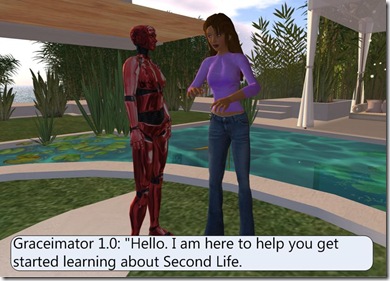
So what does the new Orientation experience the eyes of Grace look like? It goes something like this:

1) Pick your name, your starting "look" AND a serene place of your choosing: such as tropical, forest, desert, city park.

2) You rez and are greeted by your personal artificially intelligent tour guide, the lovely Graceimator.
newb

Graceimator 1.0: "Hello, avatar_name. I am here to help you get started learning about Second Life. We are going to walk about this (serene_place) and learn a few basic tricks at learning stations. Along the way, you can ask me anything, and I will answer the best I can. Do you have any questions before we walk over to the first learning station? Talk to me by typing in the white space at the bottom of your screen, then hit Enter or press the "Say" button at the end of the white space."

Avimator 1.5: "Yes, will I ever get out of this Orientation and meet some people or am I stuck with you until I get frustrated and leave?"

Graceimator 1.0: "You will leave Orientation a happy new resident."

[Insert your personal view on amazing new resident indoctrination here]

One last note, the picture above was taken at the serene but unfinished "Organic" build in Second Life. Unfortunately I didn't see M Linden hanging out there.


Share Some Grace:
Wednesday, May 14, 2008

Upholding Social Norms - Part 2

I didn't intend for Upholding Social Norms to be a multi-part post, but the conversation has become compelling and widespread. It's a subject that has reached a certain resonance around the Second Life resident blogs, and the comments on this blog alone have been thought provoking and highlight the complexity of the topic.

Here are a few other perspectives from the personal blogs of fellow Second Life residents:
There may be more, if so please let us know in the comments.

Coincidentally, the Berkman Center for Internet and Society launched the Publius Project today. From the announcement :

Publius brings together a distinguished collection of Internet observers, scholars, innovators, entrepreneurs, activists, technologists, and still other experts to write short essays, foster a public dialogue, and create a durable record of how the rules of cyberspace are being formed -- with a view to affecting their future incarnations.

The first essays are now live:

We take our inspiration and mode from the Federalist Papers, but our goal is to highlight a variety of perspectives on the evolutionary process of rule-making in cyberspace. The early American context and perspective is supplanted by our modern, global, and diverse experience. The notion of a singular constitutional moment is replaced by a vision of multiple forces shaping the structures that both open and constrict online spaces. Participants will reflect on the various elements of this loosely-joined architecture and consider how traditional understandings of regulation, control, and governance are manifested and constructed anew in cyberspace.

Berkman can tap industry leaders across a wide display of disciplines. The first three articles are worthy reads, but I noticed the one important element. They are touching on the same points as the rest of us "non subject matter experts".

John Palfrey, Executive Director of the Berkman Center for Internet and Society sets the context for the discussion:
The ability to govern activities online is not the exclusive province of the state, and the line between public and private action is getting blurrier, not clearer, as more of life moves into the networked public sphere.
Lines are indeed blurring, but how those lines blur do matter and I believe that without conscious and deliberate discourse, things will merely evolve to a point of the lowest common denominator. How else can we positively shape social norms in spaces in which there is a permeable membrane between the real and the virtual?

Some (removed ref to Chestnut Rau based on clarification in comments) argue that the Second Life Terms of Service are necessary and sufficient means by which we can regulate, but Prokofy Neva argues strongly that the Terms of Service are arbitrary, abusive and over broad and in turn residents cede too much power to the private corporations that sponsor them.

One might argue that *any* rules in the form of a Terms of Service or otherwise could be interpreted as too stringent and therefore stifle social interaction and the subsequent norms that emerge out of it. Quoting from David Weinberger's article:
The fuzziness of norms is their strength. We need the looseness of norms to enable us to be with one another in surprising ways. The narrower, more explicit, and less ambiguous the norms, often the deader the social interaction: “Come now, Marjorie, you know that we raise our hands before speaking.” Norms are not rules that have yet to mature. Rules are norms that have failed.
If you believe Weinberger, then the Terms of Service will fail us, just as Prokofy claims. However, that does mean that there must exist some tacit governance to keep the community healthy and alive. How then, does tacit governance evolve, thrive and be effective in a large, growing, and diverse community like that of Second Life?

Esther Dyson provides an interesting perspective on that issue as she provides the following illustration of her experience at a seminar with a group of Russians.
In Russia, there’s a proliferation of laws, but the overall system of governance is mostly tacit in practice. (That’s not to say that there is not a lot of excruciatingly explicit paperwork, but most of it is irrelevant.) This tacit system – of connections, unspoken rules, shadowy powers - leads to all kinds of maladies. Those in power can act as they like almost with impunity. Those without power but with an understanding of the rules can mostly stay out of trouble.

But those who don’t understand the rules, or who question them, can lose their freedom or even their lives. (As Russian politician Boris Nemtsov once pointed out [in paraphrase], “Yes, there is freedom of speech. But that does not necessarily mean freedom after speech.”

Tacit laws are difficult to understand, to share with newcomers and to spread across a large population. Tacit laws are also more prone to unfair balances in power and influence, which serve as particularly bad influences on new and emerging markets as those afforded by virtual worlds.

Now I don't know about you, but I feel stuck. Outright written rules fail us, and tacit governance is nearly impossible if not unbalanced at scale. Where does that leave us?

I think it leaves us at the root, the elephant in the room, with that which is so ill defined that while we write laws around it, socially we embrace a tacit governance that allow us to rationalize our circumvention of legality in a case by case way.

That root, is trust.

I thought Kevin Werbach may have nailed it with his article entitled "Steering to the Edge of Trust", but sadly he presents a largely technocentric "Abundance trumps governance" argument which is a necessary part of the discussion but leaves me cold. I personally keep coming back to simple human trust which is often mediated (at least partially) by well designed technology.

Like many fellow residents, I don't have answers. I have still more questions.

Do the Second Life Community Standards and Terms of Service establish some baseline for defining the expectations of a "trusted" environment in the world of Second Life?

What makes the Terms of Service, as Prokofy suggests, over broad?

The Terms of Service and Community Standards are written rules to which we all agreed to abide; are they failing us?

Are there more powerful tacit governance structures within Second Life?

If so, what are they and how are they adopted, reinforced, spread, and modified?

What else am I missing in this discussion?


Share Some Grace:

Friday, May 09, 2008

Upholding Social Norms

Recently, I've been observing what I consider to be an erosion of social norms within the growing resident population within the virtual world of Second Life (SL). I think to some extent, this was to be expected simply due to the explosive growth but I do think there is something a little more "meta" going on and I wanted to share a few observations. Before I go much further, I should say that the following represents my personal world view and is not intended to extrapolate to the general populous. It may simply speak volumes about the Second Life residents I encounter, and have little to do with the average population but at the least, it may provide food for thought and discussion in a larger context.

When Grace entered Second Life in Feb. 2006 the feel of the community was akin to Mayberry, USA. By that I mean, the population was less than 150,000 and residents were generally neighborly, helpful and glad to see you. I was fortunate enough to stumble into the tranquil community of Mill Pond as a home base but I spent most of my time traversing the grid, trying to get my head around the world as it were. Nearly every day of my first few months in world I heard "Welcome to Second Life" as I met new people and visited new places. There were leagues of well organized groups and individuals whose focus was to help acclimate new comers, from NCI to the Shelter and educational groups that taught basic skills. Inherent in these exchanges, beyond just building skills, were simple reinforcements of social norms and acceptable behaviors. It wasn't overt, it was kind and gentle and in the spirit of keeping the world of Second Life a place of community and collaboration.

Beyond the new resident centers, object lessons in de facto social norms were consistently reinforced by my fellow residents. This included simple things such as: greet and welcome people, be kind to newbies, excuse yourself when you left a group conversation, etc. It also included more subtle practices, such as waiting until you've established a bit of a relationship before you offered friendship - at that time calling cards were helpful without the implied social contract of a friendship. This was reinforced somewhat by the feature set because then your friends could not only see if you were online, they could also map you by default. This single point, beyond common courtesy, was a good deterrent to quick friends.

I realize I sound like some old geezer sipping a glass of sweet tea and reminiscing about "the good old days", but really I do have a point beyond simple nostalgia.

Reflecting upon my early Second Life social experiences and those today I see dramatic changes, especially related to social privacy. For example, part of the subtle but consistent reinforcement from the early community was that the separation between one's Second Life (SL) and real life (RL) was assumed, and the merger of those two was the decision of each individual to be exposed, discussed, etc. at their discretion and without prompting and if shared, certainly held in the utmost of confidence. I am not talking about the philosophical arguments related to immersion versus augmentation here, I am referring to simple courtesy and what was then a seemingly set of shared values and social contract terms that embraced the construct and consequences of what it meant to have social privacy.

Social privacy wasn't cast as "hiding behind your avatar" nor were the Second Life Terms of Service waved about by town criers, it was woven into the culture of the early era community and it was reinforced accordingly. Sharing someone's real life information and private chat logs with a third party was not only frowned upon, there was almost a scarlet, maybe crimson, letter cast upon those residents that were careless in that regard. Social privacy was considered paramount, and unfortunately I see that particular aspect of the Second Life culture eroding every day without obvious consequence.

In the material world there are forces that shape our social behavior such as fear of legal and social consequences and attendant regulation, which are largely choreographed by immediate and appropriate feedback. Often in the real world the law often becomes the lowest common denominator to constraint and social decorum.

However without feedback methods, those same consequences in online communities including Second Life are often missing, especially with a Laissiez-faire approach to oversight even in light of the Big Six. The "law" here in Second Life boils down to the Terms of Service, which clearly most people don't read or are otherwise immune simply due to the lack of obvious consequence. Without the means of consequence we know humans will push until there is some edge, and we are left with an eroding and destructive community.

Real world law is not the answer. Real world law doesn't solve destructive social behavior in communities and just to be clear, anonymity is not the problem. The arguments about identity verification and trust, while tuned to the real world, are inherently flawed in a space where new ways of thinking availed because of anonymity and the constraints it imposes. Additionally, no legal system is going to dirty itself by trying to moderate "Don't be a dick".

So what is the answer, or maybe what are the questions?

Are there different moral codes and norms that we are willing to adopt in online spaces to accommodate this new medium? If so, does self-moderation work in large and diverse social spaces to reinforce social norms? For example, are *you* willing to ...
  • gently remind that new friend that just said something like "obtw ABC XYZ is rly a dude irl" that sharing or even discussing another person's real life is not acceptable?
  • delete the notecard someone just dropped on you that contains a private conversation and kindly remind them not to do it again?
  • even if you think you've "fallen in love" with another resident upon first sight, are you willing to give that resident the social privacy they rightly deserve?
  • speak up in a public forum when a resident is being mistreated?
  • defend a fellow resident's right to anonymity?
  • remind the resident that disrupts an event with repeated transmissions of advertisements, sounds or even chat spam, that they might find a better outlet?
  • write a blog post reinforcing your view of social norms?


Well, are you?

Share Some Grace: