 |
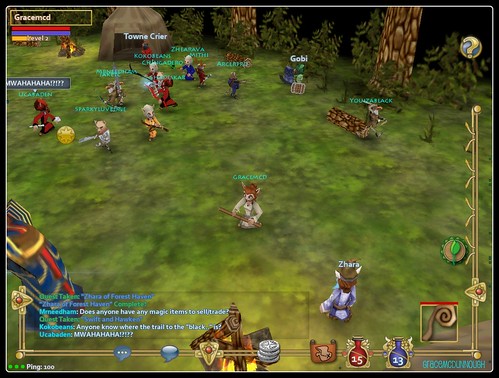
| Pocket Legends - A MMOG in your pocket |
Blue Mars - We'll Get Your Second Life Right
Lauded as a premium 3D social virtual world, the breath-taking imagery released in the early phases of Blue Mars was hard to resist. It was 2008 and the eye candy driven by the CryTEK engine was making Second Life look like a virtual slum. But Blue Mars promised more; in fact the Avatar Reality team poked at some of the most pernicious Second Life flaws and thorns - content protection, content creator relationships, event scale, and a revenue shared marketplace.
Even with all of this, Blue Mars seemed more like Mars - generally absent of people and without significant growth either as a platform or as a world. I didn't spend much time in Blue Mars - as much as there was to see, there wasn't much to do. In my mind, it was doomed to become an enormous 3D museum.
Time to Pivot
Steven Gary Blank's book The Four Steps to the Epiphany opens with a classic quote from Joseph Campell and Hero with a Thousand Faces:
A legendary hero is usually the founder of something—the founder of a new age, the founder of a new religion, the founder of a new city, the founder of a new way of life. In order to found something new, one has to leave the old and go on a quest of the seed idea, a germinal idea that will have the potential of bringing forth that new thing.
If on a Hero's journey, the Blue Mars team may have set out on the course of the old - but perhaps they've realized it's time to pivot to a new path.
Eric Reis introduced the concept of the pivot - "the idea that successful startups change directions but stay grounded in what they've learned. They keep one foot in the past and place one foot in a new possible future. Over time, this pivoting may lead them far afield from their original vision, but if you look carefully, you'll be able to detect common threads that link each iteration."
The thing about a pivot is that you have to take a very deliberate step in a direction that's informed by what you've learned so far while maintaining your balance and leveraging your existing customer base. Who are the Blue Mars customers in this case? They are the content creators and by all accounts, the Blue Mars-creator relationship is a strong one - contrary to that of Second Life - and they are taking that relationship with them toward the next pivot, to the exploding mobile market.
At this point, it may be folly to predict what Blue Mars Mobile will become in the next few years, but it could be nothing like a "premium 3D social virtual world". That's the beauty of a successful pivot, you go in one door looking like s step sister and come out the other end looking like a princess.
Pivotal Princess flickr
Pivoting is hard - you've got to kiss a lot of frogs - but the outcome can be magical. Some of the most predominant businesses of our time made successful pivots. My favorite is flickr.
Flickr was launched by Ludicorp in 2002 as a massively multiplayer online game called Game Neverending which sadly I never had the chance to play. GNE was cancelled in 2004, but by historical accounts it was a quirky and fun game focused on social interactions and object manipulation that had no end game for success (sort of sounds like Second Life), but the founders saw an opportunity to pivot.
In an interview with Jesse James Garrett (JJG), flickr developer Eric Costello (EC) explains the flickr pivot (emphasis mine):
JJG: Do you feel like you had to sacrifice something to make the transition from the Flash application to a more traditional Web application?
EC: I think we did, but really what motivated the changes was what we had the most success with. Although the Flash application was, I think, a really innovative interface, and really fun to use, and a lot of people enjoyed it, I think it was a little too off the beaten path to really get a wide audience.
As we started adding features to the site itself, like pages that hosted the photos so that people could visit them at a unique URL, we had a lot more success with that. People responded to it, and the site began to grow. So our energies tended to be dedicated toward enhancing that aspect of the site.
We kept the Flash application, which we later came to call Flickr Live, around for a while. But eventually we took it down because there were some security issues with it, and we felt our development time was better spent on other things rather than fixing those. So we sacrificed something, but we ended up with something better than what we had before with Flickr Live. So you lose some things, you gain other things.
JJG: You mentioned that the changes in Flickr were driven by the areas where you saw the most user interest…
EC: Yeah, user interest, and also just comprehensibility. People understand a website full of photos better than they understand an innovative chat interface with photo sharing. Power users got what we were doing with Flickr Live and learned to swim pretty quickly, but people like my mom weren’t quite as quick to figure it out.
I encourage you to read the entire interview, but notice those two key points that Eric makes: GNE was too off the beaten path to get a mass audience and they needed to focus on what people understand. These are still stumbling blocks for Second Life.
Speaking of Second Life, flickr is a popular service for Second Life residents, with a growing number of groups - it is a great resource to get a sense of styles, new trends and places.
Old Ideas Can Grow in New Places
Yahoo! acquired Ludicorp and flickr in 2005 and the original founders Stewart Butterfield and Caterina Fake left the company in 2008. Ironically, Stewart Butterfield is launching a new browser-based MMOG called Glitch - now in Beta - to which I am personally craving early access.
Don't discount massively multiple games or worlds on browsers and mobile as not viable - they are quite viable, just different. I've spent far too many hours playing "Pocket Legends - an MMOG in your pocket". It's really not so much "just like WoW but on your iPad" but it sure does feel like it.
My guess is the Blue Mars team is taking what Mary Meeker said very seriously - Rapid Ramp of Mobile Internet Usage Will be a Boon to Consumers and Some Companies Will Likely Win Big (Potentially Very Big) While Many Will Wonder What Just Happened - and escorting their customers and what they've learned to this new place. It's hard to imagine the existing Blue Mars on a mobile device, so I suggest you don't - it's not likely to be the same at all.
And oh, one more thing about pivots - Nokia used to sell rubber boots - it might be time to get some.
.
Speaking of Second Life, flickr is a popular service for Second Life residents, with a growing number of groups - it is a great resource to get a sense of styles, new trends and places.
Old Ideas Can Grow in New Places
Yahoo! acquired Ludicorp and flickr in 2005 and the original founders Stewart Butterfield and Caterina Fake left the company in 2008. Ironically, Stewart Butterfield is launching a new browser-based MMOG called Glitch - now in Beta - to which I am personally craving early access.
Don't discount massively multiple games or worlds on browsers and mobile as not viable - they are quite viable, just different. I've spent far too many hours playing "Pocket Legends - an MMOG in your pocket". It's really not so much "just like WoW but on your iPad" but it sure does feel like it.
My guess is the Blue Mars team is taking what Mary Meeker said very seriously - Rapid Ramp of Mobile Internet Usage Will be a Boon to Consumers and Some Companies Will Likely Win Big (Potentially Very Big) While Many Will Wonder What Just Happened - and escorting their customers and what they've learned to this new place. It's hard to imagine the existing Blue Mars on a mobile device, so I suggest you don't - it's not likely to be the same at all.
And oh, one more thing about pivots - Nokia used to sell rubber boots - it might be time to get some.
.
Share Some Grace:


