Showing posts with label Mark Kingdon. Show all posts

Friday, April 02, 2010

Linden Lab - Please Raise Your Grok Factor


In October 2008 I wrote a post about the Linden Lab changes to the Open Space sim policies and pricing.  At that time there was JIRA fury (this remains the most-voted issue on JIRA by an order of magnitude), blog posts, open letters, flickr groups, berets, protests and micro-hysteria about the changes to the Second Life Ecosystem.  The post was about how closely Linden Lab was emulating John Sutter and his fateful demise.

Based on my observations at the time, I was convinced that the highest risk to Second Life was a rampant and deep misunderstanding of the cultural tenants of Second Life and a wholesale disregard for the gifts the Lab had been bestowed - a healthy, passionate, engaged consumer base the likes of which most "beta" companies only dream about.

Since then, my time in Second Life has moved from blissful experiential to ethnographic in nature.  I find myself acutely aware of things such as policy changes, customer support, as well as search and affiliate marketing.  There are nuggets of insight buried within each of these.

I think a lot about strategy and entertain my gray matter with Gedanken exercises to see if I can understand what Linden Lab might be thinking but I also pay equal attention to their direct actions and interactions with current Residents.

Based on recent observations - the development of Viewer 2.0 with its epically failed search, the events unfolding with the open source community and third party developers, the poor customer support,  the unannounced release of a new Terms of Service combined with the Policy on Third-Party Viewers and the recently outspoken T Linden, I am equally convinced of what I wrote over a year ago.
This in fact, is the crux of Linden's on-going problem. They are grokless, generally lacking so much of an inkling of their resident base, their passions, their normally predictably irrational behavior. They continue to miss the obvious, launching missiles at unarmed nations, killing off their own tin soldiers in an on-going series of blundering friendly fire.

This general lack of awareness will be the demise of the virtual world of Second Life, not some up-and-comer in the virtual world space, but Linden Lab will in fact run themselves out of business because they have not, or can not, tap into the richness of their standing army of residents.
The challenge of crossing the chasm and cashing in on a gold rush is having actionable insights.

Actionable insight has two parts:
1) tangible data of which I believe the Lab has more than plenty,
and what's equally if not more important:
2) the SL Resident "Grok Factor" (from Oxford grok: "to understand intuitively or by empathy; to establish rapport with" ) of which they appear to have so little.

I emphasized the word appear because of all people I would have guessed that Mark Kingdon, (M Linden) might understand this very notion because in 2005 he wrote this for ClickZ:

When a company thinks about how to present its brand online (whatever interactive medium it chooses), it must start with a clear understanding of the problem it's solving. Then it needs to dig into its target user's needs, wants, desires, and behaviors. They'll move beyond understanding the customer to having empathy for her.

Dictionary.com defines empathy as the "identification with and understanding of another's situation, feelings, and motives." Understanding is a rational activity; empathy is an emotional one. It's not just about listening or seeing, it's about touching, feeling, and experiencing. With empathy, an experience designer can create something truly exceptional. True empathy is what separates ordinary experiences from exceptional ones.
The $17 billion spent globally on getting smart about customers doesn't buy empathy. Sure, it provides critical facts, figures, and insights about the target. It's a very necessary starting point. But true empathy is earned. How can you build empathy for your target?
  • Live their lives. Visit their homes, read their magazines, eat their food, and drive their cars.
  • Feel their feelings. Imagine their challenges in life; figure out what gives them joy.
  • Find their motives. Understand their online behaviors and actions: What motivates them? What are they looking for in the experience?
Let me repeat and emphasize one part of that extract.
But true empathy is earned.
Mark, I agree with you completely.  But this is precisely where I am stuck with the Lab. You seem to have no grok factor; your earnings are low.

You don't grok by analyzing numbers, or from an academic treatment, or from exchanging rafts of email.  You grok by living, feeling and finding via appreciative inquiry.   Appreciative Inquiry is a particular way of asking questions and envisioning the future that fosters positive relationships and builds on the basic goodness in a person, a situation, or an organization. In so doing, it enhances a system's capacity for collaboration and change.  Appreciative inquiry would have been a great way to pursue the recent Terms of Service and Third Party Viewer Policy changes.

I believe Residents of your Second Life ecosystem are ready for change despite the "no one likes change" mantra, but critical collaboration and change requires understanding where you are (data) as well as understanding and appreciating who and how you are (the Grok Factor) in order to move forward.

John Sutter, despite being a brilliant business man, didn't understand this and his fate is well documented. You know it; right now is the time to start living it.

Please raise your Grok Factor. 


The following is the rest of my initial 2008 post about John Sutter, much of which stands today.

Linden has (had?) captured that which most fledgling businesses only dream. No, it's not Electric Sheep. I'm referring to a passionate consumer base that is willing to pay shockingly large sums of real cash on a regular basis. We used to call those "subscriptions" but since that's become a forbidden word in the new media vernacular, we pretend like paying tier for virtual land is somehow akin to an investment. In some cases it is an investment, but for the most part it's a payment for the privilege of access to content.

So let's review what Linden has at their disposal: paying, passionate and prolific content consumers and creators.
Isn't that the equivalent of Social Media Nirvana?

What is that you say? Linden Lab is a virtual world builder, not a Social Media company! Oh, that would explain it. Everyone knows there are few easy and vibrant Social Media business models; there's far more gold in those virtual hills!

But we know the end-game here, it is the very same that plagued the California gold rushers intent to find fortune among limited resources. But who profited from the gold rush? Anyone that could leverage the irrationality of those seeking fortune profited mightily. Prostitutes made a healthy wage, as did general store owners, saloons and bankers. However, very few of the one(s) that discovered gold.

I liken Linden Lab to John Sutter. You remember Sutter, right? John Sutter was a wealthy land developer and it was at his mill where James Marshall first discovered gold in 1848. Now Sutter could not immediately profit from the discovery, since he didn't own the mineral rights on the land on which the gold was found. Those rights still belonged to the Culluma Indians and while Sutter fought a losing battle to keep interloping miners off his mill site and obtain the mineral rights, the gold rush boomed and busted and the once wealthy land developer died a poor man. To summarize:
Instead of becoming a wealthy man from the precious gold that was discovered at his mill, Sutter's domain was ruined when the Gold Rush hit. His employees deserted the Fort for riches in the foothills, leaving crops to rot in the field and abandoning businesses. He was swindled by unscrupulous partners. His cattle wandered off or were slaughtered by hungry miners, and squatters took over much of his land. He went broke and ended up near Washington, D.C., trying to convince the government to reimburse him for his losses caused by the Gold Rush. His attempts for compensation failed, and he ironically died a poor man in Pennsylvania. Source
Does this sound vaguely familiar? John Sutter - a man of resources, wealth and business savvy - missed the largest opportunity afforded to him because he lost sight of what was right in front of him. Why? Because he tried to protect his current thinking, his ownership, his existing business model instead of adapting to the situation that was rather difficult to ignore.

Sutter was a real estate developer. Did he erect the boom towns? No.
He had farms, cattle and labor. Did he feed or supply the miners? No.

John Sutter put his time, attention and wealth of resources into that which he was comfortable, and as a result he missed the gold rush, quite possibly the largest financial opportunity for which he was uniquely qualified to leverage.

Ironic, isn't it?

M Linden, meet John Sutter.
Share Some Grace:

Monday, March 15, 2010

Linden Lab Leaping the Chasm?

cc photo courtesy: globevisions

This last week I read the Harvard Business School case study entitled: Linden Lab: Crossing the Chasm Rev. August 3, 2009.  If you'd like to follow along, the pdf will cost you $6.95 USD and if you have anything more than a passing fancy about the virtual world of Second Life and/or start ups in this space it's almost worth it.  I say almost because despite the report page count of 26, there are 14 pages of endnotes and poorly formed exhibits of incomplete data extracted from sources such as blog posts. That leaves you with about 6 pages of historical stage setting and 6 pages of useful information and insights into the new Linden leadership and their dilemma.

M is for Marketing
The phrase "crossing the chasm" in the HBS case study is in reference to the marketing strategy set forth by Geoffrey Moore in his book "Crossing the Chasm" published in 1991Moore's strategy is closely tied to a technology adoption model wherein a chasm appears as a discontinuity in adoption between the early adopters (visionaries) and the early majority (pragmatists) on the way to mainstream.  

This is the same chasm that Mitch Kapor described in his 2006 SLCC address when he said:
“In particular, in the short term, right now there’s still a chasm between the power users and the clueless newbies. Those are slightly provcative terms, they’re not the best, it is just a fact, there’s still a significant number of people who come in, try it and leave. It’s not ready for prime time. I don’t believe it’s going to change overnight. It’s going to change in stages. It’s hard to know how long it’s going to take, and how long before it’s mainstream. It’s not tomorrow, it’s not next year, but it’s coming.”
This chasm as described by Mitch is the point of departure for the case study.  I decided to see if I could use it to develop a better understanding of what Linden Lab might be doing under the leadership of a long standing member of the digital marketing industry Mark Kingdon, aka M Linden.

M is for Markets
Let's go back to Moore for a minute and his marketing strategy. Moore lays out a prescribed formula for crossing the chasm that is relatively straightforward:

  1. Target a specific niche market within the early majority
  2. Develop a whole-product solution that addresses that market segment's specific needs 
  3. Flood the market segment with an intensive marketing campaign

So the challenge for the Lab was/is to find that target market and hit them with everything, or they could at most hit two markets if they managed resources and priorities religiously. According to the HBS case study, the markets available to Linden Lab are: enterprise customers, educators, adult consumers or teens.

The release of Second Life Viewer 2.0 seems to fit the Moore model - it's being sold as an entirely new solution and we are certainly in the midst of a wholesale marketing campaign.  The question is, which niche target market(s) have they selected?

In mid 2009, Kingdon sounded convinced that Second Life was the killer app for business meetings, and in May the Lab rolled out Second Life Enterprise Beta, a full service behind the firewall solution for enterprise customers.  As a market segment, it's clear that a hand full of large companies have sufficient discretionary funding (solutions start at $55,000 USD) to at least sample, but I don't have details on the success of the SL Enterprise Beta to date.  The initial release was undoubtedly crippled by the lack of Shared Media recently introduced in Viewer 2.0. As an "embedded practitioner" I know first hand how difficult it is to get people to download and install simple plugins for WebEx or AdobeConnect, much less go through the standard Second Life download and orientation so it's really hard for me to imagine that this is the "beachhead" Moore suggested.

I ruled out the educators, even after the VWPBE conference and the collective "hooray" about Shared Media. I'm convinced the education market is saturated (a @fleep tweet indicated there were currently over 600 institutions in world), and the introduction of land pricing model changes combined the recent departure of John Lester / Pathfinder Linden seem to indicate that the Lab's past love affair with the edurati is in that "old married couple" stage - safe, secure, not really growing wildly and with a lot less sex.

Speaking of sex, the Lab has bent over backwards (so to speak) to isolate, cordon off and squelch any inferences that Second Life is "all about the sex" so I'm confident that the "adult -adult" niche market is out of the question.

That leaves the non- adult adult market, and teens.  I think, for now, we can rule out teens.  When asked about merging the teen grid at the VWBPE conference M Linden confirmed that a combined adult/teen was a distant future dream, but would emerge slowly through "thoughtful evolution".

We've ruled out three of the four, leaving us this ill-formed "adult market" at which Viewer 2.0 is aimed. Who, then, is that?  I like the process of elimination, so let's go there again.

The new viewer does not appear optimized for anyone wanting to host, perform or attend events of any kind.  Part of this is tied to the delay(s) of improving the overall Search experience, but that aside there is nothing in the shape of Viewer 2.0 that lends itself to finding or promoting things to do.

Viewer 2.0 brings nothing to the revenue support base, land owners and the new Linden Homes are a shot in the arm to the rental owners. Currently, land sales and ownership contributes 79% of the LL revenue - which is enormously unbalanced, ripe with risk and likely the largest motivation to find new markets.

An opportunity for growth might be the $L conversion which means new content but the new viewer does not appear to be for content creators, arguably the second most important Second Life resident behind land owners. Content creators are feeling particularly unloved these days due to continuing challenges with copyright and content theft.  Perhaps that's why we saw the heavy promotion of the SL Pro conference, with backing from Linden Lab that far exceeded any previously expressed interest in SLCC.

Is 3D Chat and Shopping Our Future?
So if Viewer 2.0 is not for finding things to do and it's not for content creators or land owners, then what's left?  Maybe I'm using the Moore model too rigidly, but is there a niche adult market out there that would serve as a suitable beachhead and give the Lab a leg up for the next wave?

My best guess is what a friend of mine likes to call "playing house with paper dolls".

This is the 3D chat or IMVU model of virtual worlds (at this moment, IMVU has 83,819 people online).  IMVU is nothing to scoff at - according to a Virtual World News post IMVU has over 35 million registered users and 100,000 registered developers - so about twice the size of Second Life and a comparable concurrency.  I even noticed the strange similarities between the IMVU and Second Life landing pages, and oddly enough the viewers.

Could "3D chat with super easy shopping" be the new beachhead to serve adult and teen markets?  If you've tried Viewer 2.0, what's your guess?

If so, it's a far cry from “connect everyone to an online world that advances the human condition.”
Share Some Grace:

Tuesday, May 19, 2009

Second Life Killer Apps and Weak Ties


When I was in school we used to sneak out, drive down to the coast and go surfing. (yes Dad, I know I never told you) When we got back our friends would almost always ask "How was the surf?" and most of the time it was "Alright". But there were those rare times that the surf was really, really good - take your breath away good - and we'd answer: "It was -------- killer."

Fast forward to my land-locked career life and the word killer reappears, this time as a modifier, ala "killer app" or "killer application". This phrase means very little to most people; I could not find a standard definition so I lifted this from The Jargon File:
The application that actually makes a sustaining market for a promising but under-utilized technology. First used in the mid-1980s to describe Lotus 1-2-3 once it became evident that demand for that product had been the major driver of the early business market for IBM PCs.
For those of you new to Second Life, you should note that the founder of Lotus Development and the developer of Lotus 1-2-3 is Mitch Kapor. Mitch Kapor is also the co-founder of the EFF, founding Board Chair of the Mozilla Foundation and is a founding investor in Linden Lab.

Mitch is no stranger to "killer apps" so it's not unusual to me that Mark Kingdon / M Linden, now CEO of Linden Lab, has found fascination with the phrase.

But, like that killer wave that you catch once in your life, it seems that Mark's having a hard time really nailing down what constitutes the "killer app" for Second Life. I've seen/heard him use the word several times in the past year or so as follows.

M Linden quoted from his posts on the Second Life blog:
Apr 2008: Second Life has many magical properties, but one killer app is Second Life for work. It can’t be beat. 
May 2008: Inworld collaboration is going to be a killer application
Jul 2008: I’ve come to see a couple of use cases as future killer apps – namely virtual meetings and education
Jul 2008: Even though the initial novelty has worn off for me, I am blown away by how effective Second Life is for meetings. I am fully convinced this will be a killer app
Jul 2008: Using the virtual meeting environment for education is an even more exciting killer app. Dozens of universities are buying land from us or working with other inworld providers every week and the pace is accelerating. Seventeen of the top twenty universities in the US have land in Second Life.
M Linden quoted in interview with Second Places:
Oct 2008: Mr Kingdon says his company is still looking for the “killer application” that will draw in the casual consumer. He suggests “it could be live music, learning a new language, visiting a virtual landmark. It could be connecting with friends to go out for a night of dancing.” But arguably, those things will always be available in a richer form in the real world.
M Linden quoted, Agence France-Presse"
Mar 2009: The array of things people do in Second Life has blossomed. One thing that has popped out as a killer application is business meetings.
What I hear Mark saying for the past year is that somewhere there is a breakout, ass-kicking application of Second life for work, and mostly for meetings - meetings for business, meetings for education, meetings for collaborating.

Take all the imaginative power, creativity, persuasion, immersion, community and passion that is Second Life, do you think the transformational application for Second Life will be about meetings?

For me that answer is just a "meh", not because I don't appreciate a good meeting, but because I think Mark is missing something more fundamental about the strength of weak ties.

We have meetings primarily to sustain or maintain our strong ties, not our weak ties. And because they are strong ties, our preferred choice for interaction is "in person" and secondarily via phone, VOIP or video conferencing but not virtual worlds. Mark et al hold meetings in Second Life because it is their job - drinking their own bathwater - but you, Mark, are not your audience.

Strong ties reinforce homogeneity and don't spurn organic growth. The leverage toward mass adoption and transformation within virtual worlds and social spaces resides within the weak ties and the ability to navigate the paths of our connectedness over which we would normally be stymied in the real world. Weak ties help us build bridges that help us solve problems, find information and unfamiliar ideas. Weak ties further innovation - that is the target of a killer app. NOTE: For a lesson in weak ties, please read Mark Granovetter: 1973. "The Strength of Weak Ties." American Journal of Sociology, 78 (May): 1360-1380.

The killer app within Second Life is that which allows for rich fields of weak ties, that which affords relatively easy access to other people, other art forms, other spaces, ideas, cultures, music, and all within the context and dynamic immersiveness of Second Life.

More recently, Mark spoke of another "killer app". M Linden follow up to Metanomics talk:
May 2009: We absolutely have to make it easier for musicians and other performers to perform meaningfully in Second Life. We’ve looked at the challenges extensively and have a good idea of what we need to do but we won’t be able to get to it in 2009. We see live performance as a “killer app” in Second Life.
Furthermore, at the opening of the MacArthur sim yesterday, Cory Ondrejka indicated that it was watching live music emerge in Second Life that "led directly" to him to taking the position he holds at EMI. He even says:
Music became this killer app in Second Life years ago.
As a live musician in Second Life, I might be standing on a chair applauding - but I'm not.

Why? Because live performance cannot be a killer app unless it can adequately leverage the strength of weak ties and currently the infrastructure, poor performance and design limitations of Second Life social systems - groups, chat, messaging, and events - does not provide us the ability to do so.

How many groups can you join? 25
How many live musicians are there in Second Life? Hundreds

How many group notices fail to deliver? Too many.
How often does group chat fail? Too often.

Where is the messaging system that allows for casual conversation that doesn't result in social harassment, banning or group expulsion because you were chatting in the group IM?

Where is an event system that has a robust search capability, one that you can put on a calendar, one where you can see who else is attending, or one that allows comments, that allows you to share with others?

I could go on and on, but I'd like to hear your ideas about how Second Life might change so that weak ties become the killer app.


Reblog this post [with Zemanta]

Share Some Grace:

Friday, January 23, 2009

Linden Lab Acquires Virtual Goods Marketplaces: Shop OnRex and XStreet in Second Life


I was working on a post about the most recent Linden Lab acquisition of virtual goods marketplaces Shop OnRez (an Electric Sheep Company property) and XStreet which has now had sufficient time to sink in (here is the FAQ), but this morning as I was doing a bit more research I read Ordinal Malaprop's post on the subject.

It's so well written I think for now I will link there, and simply say that I believe Linden Lab made the only decision it could to ensure the viability of it's business. The virtual goods market is exploding, explosive and we have yet to understand the magnitude or impacts to our existing economy.

I know there is community disdain for another perceived Lab flim-flam - say one thing and do another - but I think we have to accept that the Lab as we once knew it, with Philip at the helm of the Utopia and Corey bailing water feverishly below deck, is gone. Don't hold fast to the old "truths" and mantras, work hard to discover who is now behind the curtain. With that, let's look at the acquisition.


There are a couple of important points in Ordinal's post to note. First, XStreet (formerly known as SL Exchange before Linden Lab's trademark policy rouse) had far more users than OnRez, despite the fact that OnRez by most accounts "looked better" and was "easier to use". I don't know if more users simply means more merchants, vendors, site vistirs or both. If someone has that data, please share.

XStreet did not enforce any type of copright infringement policy and it will be interesting to see how the Lab manages this problem moving forward. As Ordinal puts it:

It is well known that SLXstreet contains items which are Copyright Infringing, either directly or via Businesses In A Box. However, the “piratebay defence” was available previously, in other words, “we are not hosting infringing content, we are just providing links to it, please contact the host of the content i.e. Linden Lab”.
Now, Linden Lab are both advertiser and host and can no longer say that. This is in many ways an improvement for those whose products are being improperly duplicated, but is an issue that I am not entirely sure that the Laboratory were fully aware of when acquiring SLXstreet.
There are other marketplace offerings, two of note include Hippo Technologies and apex.biz.
Prokofy Neva speculates that Hippo may be next on the list, but I suspect that the Lab has reached it's acquisition capacity for now, and will settle back into focusing on it's top priorities.

What are those top priorities? According to the January 20, 2009 Linden Lab press release about the acquisitions, they are thus (emphasis and numbering is mine):


"Linden Lab is expanding its footprint in the virtual world industry through four major initiatives – localizing the Second Life experience (1) in key markets around the world, simplifying the 'first hour experience'(2) to broaden consumer adoption, enhancing the platform for enterprise users (3) and building our virtual goods marketplace (4)," said Mark Kingdon, CEO of Linden Lab.

"Content creators and merchants are pillars of the strong Second Life economy. With these e-commerce acquisitions, we will now be able to offer content creators and merchants an opportunity to substantially improve their businesses, while enhancing the Second Life experience for all of our Residents."

These have moved slightly from the December 29th, 2008 post by M Linden (aka Mark Kingdon):

Moving ahead into 2009, we at Linden Lab are continuing to pursue our world-changing mission. We are working hard to create a virtual world that “…advances the capabilities of the many people that use it, and by doing so affects and transforms them in a positive way.”
To make real progress, we’re continuing to focus on a small set of strategic initiatives:
* Ensuring the platform is stable (1) and able to scale with the growth
ahead

* Improving the first-hour experience (2) (on the web, in the viewer and
inworld) for all Residents and especially for new users so that we
can continue to expand our active user base

* Making the mainland experience more attractive (3) and fulfilling for Residents
* Localizing our content and experience (4) in key international markets
* Developing new products (e.g., land products as well as new social and commerce tools) (5) that offer Residents more opportunities to
create, connect, socialize and transact

While the majority of our resources are focused on our core market (content creators and consumers), we are also focused on building the business and education markets. Second Life is a powerful platform for doing business, collaborating, teaching and learning and we want to ensure we remain a vital platform for businesses and educators worldwide.
A lot can change in a month. Did two priorities miss the bus to 2009?

  • Ensuring the platform is stable
  • Making the mainland experience more attractive
We all know Stability took January off to visit relatives for the month in the far away lands of Scalability, but I thought Mainland Beautification would attend the Inauguration ball.


Reblog this post [with Zemanta]

Share Some Grace:

Wednesday, July 09, 2008

What's Phasing Grace?

UPDATE: A few hours (literally) after I published this post, M Linden (mentioned below) posted"A Letter to Second Life Residents" to the Second Life blog. It provides some insight into the Linden lab short term priorities including another redesign of the interface:

.. recognizing that new users don’t need such a dizzying array of features, and experienced users, land and business owners and content creators need better tools that are more thoughtfully designed and organized for their needs. Everyone needs better inventory management and search is due for an overhaul. We hear you. We’re on it.

Original post follows.

I took a hiatus; I admit it. The last time I said I'd hang a "Gone Fishing" sign, but this time I didn't really intend to be gone for more than a few days. I have been blogging elsewhere which has consumed a good part of my time, but ultimately a few things in world "phased" me and I've found it's at those moments that it's best to spend more time looking inwardly than speaking outwardly. So here is a summary, in order of my recent phase transitions.

So long, Soj

The first was the loss of The Sojourner - a Second Life friend, a true leader and role model. If you didn't know Soj, there's really nothing I can write here that will help you understand or appreciate her any more than what you can find at the memorial wiki for her. Losing Soj made me realize that while in the midst of strife, stress and attendant turmoil something brews inside these spaces far more important than inventory loss, a failed teleport request or a temporary outage. This is a place to make a difference, but that requires less bark and more wag. No technology - no matter how perfect - can deliver us from our own shortcomings as humans, nor can it raise it above our limitations of geography, financial, physical or mental constraints, and/or religious or political views without the people who have the selflessness, passion and determination to take a chance and make a difference, like Soj did every day.

Call me M, short for Missing

The next thing that tweaked me was the Second Life 5th Birthday (SL5B) celebration. I had my own set of frustrations with the leadership and execution of this event, but it was something more subtle and admittedly less spiritual - I have come to call it "Call me M, short for Missing".

On April 22, I read Philip's "Announcing our New CEO" post on the Second Life blog with some enthusiasm.

"I said a month ago that I was looking for a new CEO to lead Linden Lab, and we’ve found one! His name is Mark Kingdon, and his Second Life name is “M Linden”.
...He is a well-loved people leader who is fearless and can weather challenges and change."

I often take things far too literally, so naturally I hung on the promise of that last sentence. The phrase "people leader" rang in my ears with resonance of community, communication and engagement. I know I promised to give M Linden some time, but in the eleven (11) weeks since the announcement and I had not seen or heard much from him so I made sure to go to the opening keynote for SL5B.

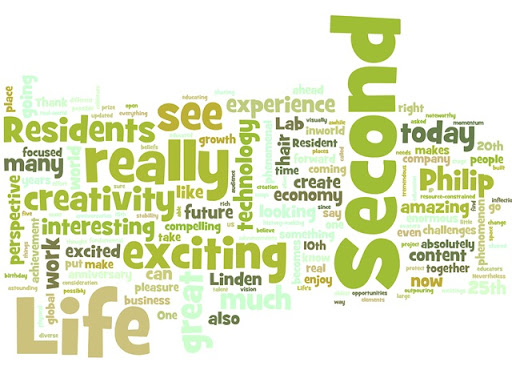
Admittedly I crashed 2-3 times but despite that normality, M's comments left me listless. I wasn't sure why so I took M's keynote transcript and pushed it through the delightful tool called "Wordle" to retrieve a word cloud.

mlindenSuddenly, my listlessness became clear. In 891 words, the new CEO tells us he thinks things are REALLY CREATIVE INTERESTING GREAT and EXCITING. I wanted to write one of those "open letters" to M.

Dear M Linden,

Welcome to your world, our imagination. We are glad you are here, and wanted to point out that in your new role we're going to need you to be really CREATIVE, and do something INTERESTING that makes us say things like "whoa, this is GREAT" and "OMG, that is REALLY EXCITING." and we need that pretty soon given the trough of disillusionment we might find ourselves in shortly. Like totally, dude.

kthxbai.

We're on a mission, Charlie ...

Mitch Kapor, entrepreneur and Linden Lab board member, provided the closing keynote address for SL5B and again I made sure I could attend. Arriving early, I had the pleasure of meeting Dusan Writer in the pixel. An odd thing really, as we had only previously met in person at the last VW conference and online via the occasional blog banter, but I digress.

I'm not going to talk about Mitch's keynote word cloud. There were 4,452 words but Mitch had one primary point to make, echoing the altruistic vision for the platform. In summary, to "improve the human condition", but in Mitch's words:

My first point, you know when we experience, when we create and participate in a new technology ecosystem like Second Life, we bring all of ourselves to it. We bring the good, the bad, and the ugly. And so what we choose to do with the possibilities is extremely important. <lots of words>

And what do we do with all this power to imagine and actually create a world. For all the fascination we have with the power of technology, I have come to believe ultimately it is what is in our hearts that determines the uses and the impact. And so this is my point, it is really a choice to work to make things better, just as it is a choice to do things which have a negative impact. And so I want to encourage all of us to see the opportunities and to raise above kind of pettiness and personal complaint and to reach for the best and highest within ourselves in making what we can of this opportunity, which brings me to my next point.

If you have not recently read Philip's 2006 post entitled "The Mission of Linden Lab" I encourage you to grab a hot beverage and do that .. go ahead, I'll wait while I refresh my own memory.

.. my best definition of our mission is that we are working to create an online world having the exceptional property that it advances the capabilities of the many people that use it, and by doing so affects and transforms them in a positive way. More specifically, since there are so many possible definitions of ‘online world’, we are trying to create a close reproduction of the actual physical world we live in – one that will be easily comprehensible and useful to us because it will so closely resemble ours. The ability to simulate our world on computers means that we can make it different in ways that empower us, allowing us to do things that in the physical world we can imagine but are incapable of. Largest among the new capabilities we seek to create through this simulation are: Improvements to our ability to communicate quickly and accurately with each other, and the ability to rapidly express our thoughts or intentions as shared artifacts within this new world.

Welcome back. We left off right as Mitch Kapor was making the highly anticipated "big announcement", the institution of The Linden Prize. From the transcript (which by the way, does not match Mitch's spoken words, you can listen to the keynote here):

Linden is going to establish an annual award for superlative achievement that exemplifies the mission of any human condition to using Second Life. And any Resident or institution or organization using Second Life as an innovative disruptive technology is going to be eligible. This is going to be an annual prize. The prize amount is going to be US$10,000 paid in Linden dollars and the judges are going to come from a broad cross-section of participants including Residents and there will be lots of details coming out about this in the blog and the website.

So that was it, the climatic announcement was a monetary prize paid in non-recognized currency for improving the public image of the platform?

I am disappointed that Linden Lab used a big announcement hype machine to generate buzz for SL5B at a time the Residents really just need to hear a clear plan of action toward meaningful improvements, and to be reassured that what Philip said in 2006 in the context of "the mission" (emphasis mine) is really true:

Beyond the details of financial performance, we will have been successful in this mission if we, in the smallest amount of time and capital, make Second Life work as well as possible given the limits of the underlying computer technology, and reach the largest number of people. You should expect to see the great majority of our efforts directed toward a balance of those two goals.

Balance, now there's a mission worth pursuing.

Zemanta Pixie

Share Some Grace:

Thursday, April 24, 2008

What about Linden Lab's new CEO?

Several people have asked me to comment on Linden Lab's new CEO, Mark Kingdon but the fact is, I don't have a lengthy analysis or random speculation based on Mark's background or experience. Rather I will spend my time, just like I do with any Second Life resident less than six months old, and watch his actions as a leader for a few months. One of the first things I noticed is that he called Philip and asked for the job, that to me is a very positive sign (and apparently the phone is still more reliable than twitter).

It's been my experience that the best leaders utilize their past as a way to become more aware, flexible and adaptable to the next new leadership challenge. Despite what HBR might desire, there are no magic recipes, sidebars or otherwise that prove effective in every situation. Each challenge is unique, and while we residents see a certain face of Second Life based on our own experience and level of participation, Mark will likely see things differently from his vantage. Watching his actions often provide some insight into what that might be, and how he can turn his past experience lessons toward the new job. It's likely that at least we all agree that the problem is complex and infinitely fascinating.

Given the change of leadership, what type of leadership model might emerge?

There is a model I was taught long ago called "Mister Inside and Mister Outside" (sorry, I didn't pick the term Mister, but we are still living in the day where that is 98% accurate in the largest organizations.) The concept is simple, Mister Outside is the outward facing leader shaping the thoughts, behaviors and actions of those "outside" the organization. Mister Outside may take many forms such as a visionary, a spin master, a business developer, or a lobbyist; they can be someone that keeps the wolves at bay or someone that shapes the face of the company to make it attractive to others.

It's Mister Inside, however, that runs the day to day of the business. Let's call him the redshirt; the one that is spending inordinate hours in the details - sometimes in sync with Mister Outside, and sometimes in spite of him and likely to meet a tragic end over time. Looking back, the Philip-Corey pairing leaned toward this model although I suspect Philip had a heavier hand in the day to day operations than a classic Mister Outside.

Organizations that exist under this model with a weak Mister Inside, or one that is not well aligned with Mister Outside are often fraught with a personality or identity disorder. You will often find them choosing "sides" or developing factions of thought and progress is haphazard. This is the downside of the model, but there is an upside if a) there are positive benefits to having strong external partnerships for growth and b) there is significant upheaval on the inside that Mister Outside acts as a shield until order can be restored.

Without jumping to conclusions, will someone let me know if they see M Linden wearing a red shirt?


Share Some Grace: