Tuesday, January 27, 2009

Fun With the Linden Lab Family Tree


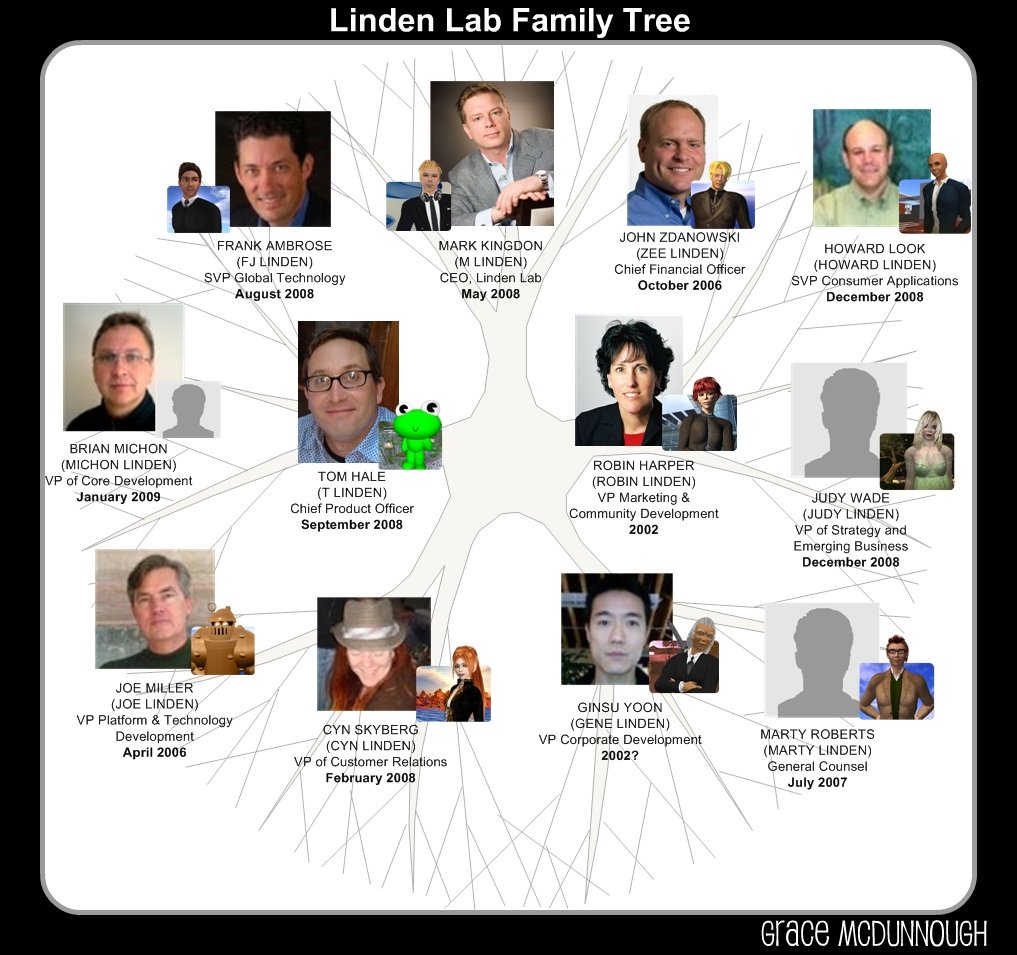
Today, Linden Lab announced the latest round of Executives to the family.

M Linden reports from the Second Life blog:
As those of you who follow Linden Lab have probably noticed, I’ve been expanding the executive team since I joined in May, 2008. Each hire has been focused on major initiatives within the Lab designed to make Second Life more reliable, more relevant and more usable.

The latest Linden additions include Brian Michon (Michon Linden) from Intuit as VP of Core Development, and Judy Wade (Judy Linden) as VP of Strategy and Emerging Business, from Kapor Enterprises. Both notably abandoned the Alphabet Linden naming convention that was so trendy in 2008 and are adopting more creative names.

As you can see, I mapped out a Linden Lab Executive family tree of sorts, and had some fun reviewing various bits of data. Let's take a look at some interesting tidbits.

There are now twelve disciples of Philip, I mean Executives, that comprise the Linden Lab leadership team.

That's 12 Executives for just over 200 employees (say 250 to be fair) which means roughly an allocation of 21 employees per Executive. (President Obama will have roughly 15 cabinet leaders give or take a few [update: deleting tongue-in-cheek "to run the United States" to avoid confusion per Prokofy's comment.])

The Executive team has a combined years of experience with the Lab of 248 months (assuming Yoon started in 2002 with Harper), that yields on average just about 20.66 months of experience per Executive.

The team is derived from diverse backgrounds and the following companies:
Organic Inc. - Kingdon
AOL - Ambrose
Adobe - Hale
Electronic Arts (EA) - Harper
Intuit - Michon
Pixar Animation Studios - Look
eBay Inc. - Roberts
San Jose Museum of Art - Skyberg
McKinsey & Company - Wade
Airespace - Yoon
HouseValues - Zdanowski


I posted earlier this week that this Linden Lab is not the same one Second Life Residents bonded with over the years.

This Lab is vastly different with arguably very little experience in the virtual world and/or gaming space and/or online space, so we'll need to start changing our assumptions and presumptions about everything.

This is not your father's Second Life.


Share Some Grace:

Sunday, January 25, 2009

Do You Manage Your Virtual Identity Value?


CC image courtesy of flickr.com/photos/dramaqueennorma

A while ago I was talking to a friend of mine and they called me "Grace". We stopped talking and just stared at each other for a moment, bemused and bewildered because this conversation was taking place face-to-face in the real world, in meat space, in my OP, in the atomic world ... you get the idea.

I asked, almost afraid of the answer, "Why did you call me Grace?". They replied, "Because in that moment I was talking to Grace, you were Grace."

That incident stuck in my mind, leaving me with a lot of questions, mostly unanswered. What did it mean to be "Grace" at that moment? How was the line between my real life identity and Grace blurring? When did people see me as Grace, and how did they make that transition in their minds? If Grace were a male avatar, would they make that connection as easily? What characteristics of Grace, good and bad, carry over to my personal day-to-day interactions?


We need to recognize that identity is a construct. Beyond the formal academic and clinical treatise of identity, there are emergent and complex ramifications from that which recent technologies have afforded us to define and redefine our "identity". We should be both safeguarding and leveraging the investments we make toward that construct.

Tom Peters taught us long ago about personal branding ala "Brand You" and we know how important Online Reputation Management can be in the real world, but are you adopting those same principles to your virtual identity and/or are you recognizing the blurring between the real life reputation you've established and that of your virtual self?

It's fairly easy to track the evolution of online identity constructs from screen name, to iconic avatar, to personal profiles and ultimately to fully immersive representations of our "identity" in spaces such as MMOGs and virtual worlds. What we may be missing in that evolution, however, is the economic value emerging from our virtual reputations.

The Yale Law Journal recently released a great paper called Reputation as Property in Virtual Economies by Joseph Blocher. In this article, Blocher explores the notion of reputation as currency, with value, just as we think of property. As Blocher puts it:


Having defined status as a kind of property, it is possible to further subdivide the virtual reputational economies: social networking platforms like Facebook and MySpace present one model; anonymous blogging and commentary another. In at least one important way, the former are more like online economies than they are like virtual world economies—the status they create and destroy exists both online and in the real-world reputational economy. Individuals use their real identities in these forums and often interact with people with whom they also have off-line relationships. Thus someone whose reputation is ruined in the online reputational economy likely loses it in the real world as well.

Anonymous blogging and commentary, on the other hand, correspond to the virtual world economies describe above. The reputational property this type of activity generates exists only online, associated with virtual identities that generally are not connected to any real-world identities. What enables this division from the real-world reputational economy is anonymity, which permits bloggers—or even blog commenters—to gain online status, often at the expense of others, without risking their own real-world status. And as with the online and virtual world economies, challenging problems arise when the two reputational economies meet, as happens when anonymous posters (members of the virtual-world-style reputational economy) attack nonanonymous online profiles (members of the online reputational economy). From a practical standpoint, it is difficult, though not impossible, to identify anonymous online attackers, making redress rare. But from a more theoretical standpoint, it is difficult to replace, with currency or any other kind of “old” property, the reputational property they have lost.


This leads me yet again to more questions.

What would you do differently in your day to day lives online if there were a legally recognized reputation economy?

What sort of value are you creating or destroying every day?

How will these things (some say predictable eventualities) change the way we see virtual worlds where arguably your identity is more pervasive as it is presented in the context of activity, discussions, etc?

Furthermore, this is becomes even more complex and compelling when you think about the pursuit of interoperability in virtual worlds, and Linden Lab's pursuit of Identity Verification.

These are interesting things to think about for me and I'd love to hear your perspectives.

Share Some Grace:

Friday, January 23, 2009

Linden Lab Acquires Virtual Goods Marketplaces: Shop OnRex and XStreet in Second Life


I was working on a post about the most recent Linden Lab acquisition of virtual goods marketplaces Shop OnRez (an Electric Sheep Company property) and XStreet which has now had sufficient time to sink in (here is the FAQ), but this morning as I was doing a bit more research I read Ordinal Malaprop's post on the subject.

It's so well written I think for now I will link there, and simply say that I believe Linden Lab made the only decision it could to ensure the viability of it's business. The virtual goods market is exploding, explosive and we have yet to understand the magnitude or impacts to our existing economy.

I know there is community disdain for another perceived Lab flim-flam - say one thing and do another - but I think we have to accept that the Lab as we once knew it, with Philip at the helm of the Utopia and Corey bailing water feverishly below deck, is gone. Don't hold fast to the old "truths" and mantras, work hard to discover who is now behind the curtain. With that, let's look at the acquisition.


There are a couple of important points in Ordinal's post to note. First, XStreet (formerly known as SL Exchange before Linden Lab's trademark policy rouse) had far more users than OnRez, despite the fact that OnRez by most accounts "looked better" and was "easier to use". I don't know if more users simply means more merchants, vendors, site vistirs or both. If someone has that data, please share.

XStreet did not enforce any type of copright infringement policy and it will be interesting to see how the Lab manages this problem moving forward. As Ordinal puts it:

It is well known that SLXstreet contains items which are Copyright Infringing, either directly or via Businesses In A Box. However, the “piratebay defence” was available previously, in other words, “we are not hosting infringing content, we are just providing links to it, please contact the host of the content i.e. Linden Lab”.
Now, Linden Lab are both advertiser and host and can no longer say that. This is in many ways an improvement for those whose products are being improperly duplicated, but is an issue that I am not entirely sure that the Laboratory were fully aware of when acquiring SLXstreet.
There are other marketplace offerings, two of note include Hippo Technologies and apex.biz.
Prokofy Neva speculates that Hippo may be next on the list, but I suspect that the Lab has reached it's acquisition capacity for now, and will settle back into focusing on it's top priorities.

What are those top priorities? According to the January 20, 2009 Linden Lab press release about the acquisitions, they are thus (emphasis and numbering is mine):


"Linden Lab is expanding its footprint in the virtual world industry through four major initiatives – localizing the Second Life experience (1) in key markets around the world, simplifying the 'first hour experience'(2) to broaden consumer adoption, enhancing the platform for enterprise users (3) and building our virtual goods marketplace (4)," said Mark Kingdon, CEO of Linden Lab.

"Content creators and merchants are pillars of the strong Second Life economy. With these e-commerce acquisitions, we will now be able to offer content creators and merchants an opportunity to substantially improve their businesses, while enhancing the Second Life experience for all of our Residents."

These have moved slightly from the December 29th, 2008 post by M Linden (aka Mark Kingdon):

Moving ahead into 2009, we at Linden Lab are continuing to pursue our world-changing mission. We are working hard to create a virtual world that “…advances the capabilities of the many people that use it, and by doing so affects and transforms them in a positive way.”
To make real progress, we’re continuing to focus on a small set of strategic initiatives:
* Ensuring the platform is stable (1) and able to scale with the growth
ahead

* Improving the first-hour experience (2) (on the web, in the viewer and
inworld) for all Residents and especially for new users so that we
can continue to expand our active user base

* Making the mainland experience more attractive (3) and fulfilling for Residents
* Localizing our content and experience (4) in key international markets
* Developing new products (e.g., land products as well as new social and commerce tools) (5) that offer Residents more opportunities to
create, connect, socialize and transact

While the majority of our resources are focused on our core market (content creators and consumers), we are also focused on building the business and education markets. Second Life is a powerful platform for doing business, collaborating, teaching and learning and we want to ensure we remain a vital platform for businesses and educators worldwide.
A lot can change in a month. Did two priorities miss the bus to 2009?

  • Ensuring the platform is stable
  • Making the mainland experience more attractive
We all know Stability took January off to visit relatives for the month in the far away lands of Scalability, but I thought Mainland Beautification would attend the Inauguration ball.


Reblog this post [with Zemanta]

Share Some Grace:

Apture