Friday, April 30, 2010

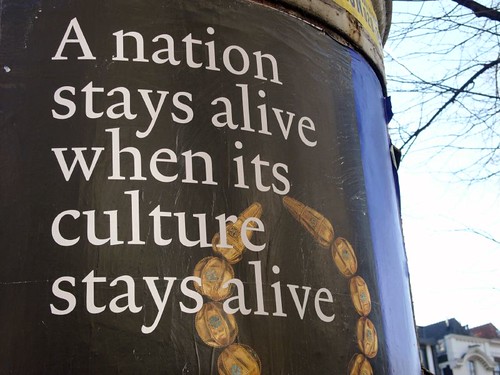
The Search for A Second Life Culture - Part 0


"Culture consists of patterns, explicit and implicit, of and for behavior acquired and transmitted by symbols, constituting the distinctive achievement of human groups, including their embodiment artifacts; the essential core of culture consists of tradition (i.e., historically derived and selected) ideas and especially their attached values; cultural systems may on the one hand, be considered as products of action, on the other as conditioning elements of further action." [1]

In 1952, Kroeber and Kluckhohn [1] compiled a list of no less than 164 definitions of culture; it's not surprising that the question "If Second Life® has a culture, what is it?" becomes as unwieldy as a broadsword.

Kluckhohn suggested that "culture is to society what memory is to individuals" which leads me to believe that culture is not absolute but rather like a collective hunch, or a recollection based on certain characteristics. Culture is then, as Eric Champion explains, "impossible to clearly demarcate" and is not a single thing but a "connection and rejection of threads over space and time". [2]

I really liked Tateru Nino's perspective: "Culture is an aggregate appearance of many entities, just as your skin is an aggregate of many types of cells." To which I'd add: And therefore, there are no right or wrong answers, just shared insights.


Share Some Grace:

Saturday, April 24, 2010

Is There A Culture in the Virtual World Second Life?


My fourth rez day was February 6th, and I feel like I've spent the entire time getting ready to write this next series of posts. In some ways I am no more ready to start than the day I found my way off that dreaded little island in a purple t-shirt, faded jeans and really bad auburn hair, but now is certainly the right time to take the first step.

I recently wrote I am convinced that Second Life® is facing a Tipping Point and some people have asked me how I know. There is no way to articulate precisely how I know, I just do. What I cannot say is if tipping in this case is a good thing or a bad thing; good and bad are relative to your point of view. However, I do know that this type of event can result in a seismic shift in what one might call a cultural base - a commonly held set of beliefs, a set of rules and practice, forms of governance, etc. This assumes that there is a "culture" upon which these systems were built.


Share Some Grace:

Tuesday, April 20, 2010

Virtual World or Virtual Playground? More Real Court for Linden Lab

cc image courtesy flickr.com/photos/soaptrail


I started writing another comment in the thread of my last post The Second Life Tipping Point, but it grew to a length that better served as a post. Then, as Monday morning fate would have it, I deleted the entire thing in a moment of compounded user error and erroneous system settings.

I thought I'd wait until the weekend and start reconstructing from my notes and memory until today when by some creepy coincidence, a court case came to my attention (Evans et al v. Linden Research and Phlip Rosedale which I will cover at the end) and now I've stopped everything to finish this post. It's sketchy and off the top of my head and from coffee stained Moleskine pages, normal cautionary warnings apply.

First and foremost, I am not a lawyer (IANAL); I am a part time virtual world resident, observer, researcher, musician and bard. Since my initial foray into this space, I have developed a deeply held conviction that virtual worlds can transform us in ways that we have not yet imagined. I believe that the "world that Philip built" while wildly idealistic, is actually achievable and arguably necessary in the next cycle of our evolution as a society.

This world vision is not a mirror world, an escape pod, or a new theme park, but rather a means by which we can overcome the shortcomings, trappings and ill fate of the systems we have constructed in the physical world that are by any measure stifling development and innovation on many levels. I for one do believe that there is a means by which a virtual world like Second Life™ can improve the human condition, but only if we allow it.

That said, these are the things that are phasing Grace.

Terms of Service (ToS) Mysteries
One day, you sit down to log in to a virtual world in which you reside and you are faced with a simple decision: either you accept the terms and proceed to log in, or you don't and can't.  Depending upon the circumstances, most people simply click "accept" and move along despite the unknown implications, liabilities or otherwise.

Most people pay attention to the words on the site, to public discussion that Linden Lab have, and to the blogs, etc far more than they read or understand the ToS. This is just human behavior. Don't believe me?

Recently, thousands of people transferred their immortal souls to gamestation.co.uk.  The company released a new terms of service that included an "immortal soul" clause through which 88% of people clicked through (at least 7,500 individuals).

By placing an order via this web site on the first day of the fourth month of the year 2010 Anno Domini, you agree to grant Us a non transferable option to claim, for now and for ever more, your immortal soul. Should We wish to exercise this option, you agree to surrender your immortal soul, and any claim you may have on it, within 5 (five) working days of receiving written notification from gamesation.co.uk or one of its duly authorised minions. We reserve the right to serve such notice in 6 (six) foot high letters of fire, however we can accept no liability for any loss or damage caused by such an act. If you a) do not believe you have an immortal soul, b) have already given it to another party, or c) do not wish to grant Us such a license, please click the link below to nullify this sub-clause and proceed with your transaction. Click here to nulify your soul transfer.

Changing the terms of service is a normal course of business, but I'm not sure that springing them on people is the best approach, particularly when there are no easily accessible ways to evaluate the scope and/or the nature of the changes and most especially when people are deriving tangible value (i.e. income) based on a previous agreement.

Duality or Schizophrenia?
As many people pointed out on the comments of my Tipping Point post, Second Life has been previously defined as a service.   On one hand, there has always been a service as described in the ToS but one the other (more visible) hand in the marketing, public speeches, etc. it has been presented as a "world" where  attendant property rights exist in order to support the very basis of the service - the economy.

For me the most confusing part of the evolution of the ToS has been, as Lalo Telling pointed out in comment, and as Juliet M . Moringiello outlines so eloquently in her treastise, the duality and implications of the words in the ToS versus everywhere else.  Here's an excerpt from pp 45-46 of Moringiello's paper "What Virtual Worlds Can Do For Property Law" (emphasis mine):

"As noted above, the term “license” in itself does not communicate any property interest, as a license is a contract. Earlier in this article, I described scripted and non-scripted virtual worlds. In both types of these worlds, the virtual world operators describe the rights they convey as license rights. A comparison of the Second Life and World of Warcraft licenses, however, show that the rights that licensors attempt to convey are very different. To some, the rights conveyed by Blizzard and Linden might appear to be similar. After all, they both convey some kind of intangible asset in a virtual world. Blizzard, however intends that World of Warcraft members use in-world items for one purpose, the progression of a scripted game. Linden intends that its members will develop a vibrant world in which business should thrive. [232]

232 The Second Life website tells the world that “one of the most exciting aspects of Second Life is its vibrant marketplace for virtual goods and services.” http://secondlife.com/whatis/marketplace.php (last visited March 21, 2009).

Joshua Fairfield also echoed this concern or as he describes it schizophrenia in the most recent Terms of Service in his Metanomics discussion (emphasis mine):

"What's interesting is that other parts of the change, especially those that talk about Machinima and snapshots, those are actually a lot more like what we experience in everyday life. You can't take a video camera and stick it up to somebody's window. Well, why not? Because you're on their land, right? You're in a real place where you're not supposed to be. And so in that way I find the new changes are almost schizophrenic.

In the one direction, they want to say, "Okay, all of this is just intellectual property." In the other sense, they want to say, "Well, actually we're taking this very real. We're taking people's privacy considerations very seriously. We're taking their land ownership very seriously."

And so I think they need to make a decision about which way they want to go. Is this just a special show in a box, or this a real place where people really care about stuff?"

I think that is the core issue, not whether it's one way or the other, but that it's both, and it's both in a way that is arguably unbalanced and one-sided - also a contract validity concern and to me, a concern about the viability of a "virtual world" for anything other than pure entertainment.

Virtual Playgrounds
Perhaps it is actually be beyond our (human) capability at this time to carve out a synthetic space owned by game gods that can be transformative. Kevin Deenihan argues in his essay "Leave Those Orcs Alone: Property Rights in Virtual Worlds" that worlds are in fact just forms of entertainment and should not be burdened with legalities as he writes:

"Players and their characters earn virtual property to socialize, for fun, or for status, not for protection or investment. Shoehorning in a legal system that protects investment and ignores the value of fun and communality would do terrible violence to these societies. Far better utility results from allowing users and developers to continue elaborating on their quasi-legal systems in peace."

So for Kevin (and possibly many others), we should be embracing the 3D "playing house with paper dolls" service like the  one I outlined in Linden Lab Leaping the Chasm.

That's a virtual playground and not my vision for virtual worlds. That's not what I signed up for when I clicked "accept".

But then ... someone called a Lawyer 
The posting discovered today on Courthouse News Service is entitled "Players Want Real Money From Virtual World" and by the account, it appears that there is now a class action suit filed by Jason A. Archinaco of Pribanic, Pribanic & Archinaco in the matter of "Carl Evans, Donald Spencer, Valerie Spencer, Cindy Carter, individuals, on Behalf of themselves and for the Benefit of all with the Common or General Interests, Any Persons Injured, and All Others Similarly Situated v. Linden Research, Inc., and Philip Rosedale", dated April 15, 2010 in the Eastern District of Pennsylvania U.S. Federal District Court.

The plaintiffs are seeking declaratory and injunctive relief, compensatory and punitive damages on claims of fraud, conversion, intentional interference with contractual relations, unjust enrichment, wrongful expulsion, and violations of California's Consumer Legal Remedies Act, False Advertising Law and Unfair Competition Law.  And in case you were wondering, Jason A. Archinaco does appear to be a lawyer, and has published a virtual law treatise entitled "Virtual Worlds, Real Damages: The Odd Case of American Hero, the Greatest Horse that May Have Lived"; that is left an exercise for the reader.

Oddly enough, the filing lifts many of Morningiello's and Fairfield's arguments quoted above as well as case studies, though not as eloquently stated.  In summary the plaintiffs alledge that they were "duped" into buying land by false promises made by Rosedale and others. From the submission:

The representations of ownership were a profitable lie designed to induce consumers to purchase land that they truly do not own under the false premise of ownership.

The Plaintiffs allege that they their accounts were unlawfully frozen and terminated, their virtual goods and land taken and then resold without compensation.

Incidentally, I found it curious that much of the background hinges on the so called "liquidity event" (open source of the client) and the recent Terms Of Service changes, but the Plaintiffs were relieved of their accounts and assets in March 2008, and two in April-May 2006. (Note: Bragg v. Linden was filed in 2006 and settled in 2007)

I don't know how this case will play out.  While I understand and appreciate the significance, I find myself wary of the consequences and sympathetic with the Lab given the stated circumstances.  I also have my own personal "gut feelings" about this filing which I will keep to myself.


Share Some Grace:

Friday, April 16, 2010

The Second Life Tipping Point

cc image courtesy flickr.com/photos/atomicity

Have you read The Tipping Point:  How Little Things Can Make a Big Difference by Malcolm Gladwell? If not, I do recommend it if you can tolerate Gladwellianisms, and if so I'd ask that you think about the release of the Second Life® Terms of Service as a tipping point.

Yes, I know it's audacious to predict a tipping point but I think it's safe to assume that we've already toppled over the crest, we just haven't recognized it yet. The world we used to know as  "Your World. Your Imagination." is about to undergo a transition as radical as when Linden Lab announced in a 2003 Press Release:
Linden Lab, creator of online world Second Life , today announced a significant breakthrough in digital property rights for its customers and for users of online worlds. Changes to Second Life's Terms of Service now recognize the ownership of in-world content by the subscribers who make it. The revised TOS allows subscribers to retain full intellectual property protection for the digital content they create, including characters, clothing, scripts, textures, objects and designs. ... "Until now, any content created by users for persistent state worlds, such as EverQuest® or Star Wars Galaxies™, has essentially become the property of the company developing and hosting the world," said Rosedale. "We believe our new policy recognizes the fact that persistent world users are making significant contributions to building these worlds and should be able to both own the content they create and share in the value that is created. The preservation of users' property rights is a necessary step toward the emergence of genuinely real online worlds."
I'm going to leave this as an open-ended post, and share just two points that have helped frame my prediction. I'd appreciate your thoughts and insights.

Please note that I am neither judging nor evaluating these elements as good or bad, they are merely informing my perspective that we are witnessing the "tip". This is also not a "ZOMG the sky is falling" pronouncement; it's just my thoughts out loud and without warranty.


Volunteer's Dilemma and the Policy on Third Party Viewers (TPV)
"Facing Major Major Major Major's rebuke for not wishing to fly any more bombing missions over Italy, Yossarian contends that the bombs he could drop would make little or no difference to his eventual well-being, while the risks involved in dropping them might make an enormous difference to him."  - Russell Hardin commenting on Heller's Catch-22 in his book, Collective Action
I think that there is genuine and shared concern within the development community regarding the potential of theft, violation of social contracts, and security holes that third party viewers may present.

However, the new TPV policy is sufficiently ambiguous to a non-lawyer that there is an overwhelming perception that developers of TPV now assume an unbearable weight of risk.  The intentions of Linden Lab or the policy is immaterial because what has been framed is essentially a Volunteer's Dilemma.  A developer "could" produce a TPV for the "good of everyone", however in doing so there is a non-zero chance that they could face huge personal risk.

The Volunteer's dilemma hinges on an individual's perception of their personal risk; nothing short of removing the risk unequivocally will change that perception. This means that the TPV as conceived cannot meet the intended goal unless someone (in this case several) falls on the grenade - hence, the dilemma.

One might argue that in this case, a policy approach - regardless of intent or language -  cannot succeed.


From Place to Permits
Is this just a special show in a box, or this a real place where people really care about stuff?  - Law Professor Joshua Fairfield speaking to Metanomics April 15, 2010
If you read M Linden's post announcing most of the changes to the Terms of Service, you noticed a large graphic outlining a raft of new "licensing" clauses. 


At first I was confused by the emphasis placed here, but then it struck me between the eyes - Second Life is no longer a "place" with attendant property rights it is a "service" with permits of use, or licenses.  In my "Choices and Viewer 2.0 Assimilation" post I described the changes as "exercising your license of the services afforded to you by the virtual world of Second Life" this was echoed by Joshua Fairfield as he spoke this week to the Metanomics group.  


The discussion with Law Professor Joshua Fairfield is a much watch and I also encourage you to download the text transcript so that you can pour over the wealth of information and insights.

So what's so important about a simple legal change from "property" to "permits"?

Really, it's just one thing: human emotional connection - to our creations, to the content we acquire and to the places that we live.  This bond transgresses the bounds of rational thought.  Technically, we know "it's just a bunch of pixels" but that does not weaken the emotional attachment and investment that Second Life heretofore has provided so many.  Perhaps the licensing change will go unnoticed and we will continue to pursue our passionate connections.

One thing is for certain to me. It's this passionate connection; it's this perceived individual and collective power that fuels the livelihood of the world that was once a place, soon to be a permit, and soon to tip.


Share Some Grace:

Monday, April 12, 2010

Second Life® Terms of Service 2.0 Countdown

Created by OnePlusYou

Don't forget to read the new Second Life® Terms of Service before April 30th, 2010. If you've logged in to Second Life recently, you've probably already accepted these as fait accompli

M Linden posted a helpful summary on the Second Life blog, but this would be a good time to pay attention to detail and scope. 

Of note, the news ToS include seventeen "Additional Terms and Policies" that I recommend as light reading over the next few days or at a minimum have a read through the FAQ. The seventeen additional terms and policies include:

Share Some Grace:

Thursday, April 08, 2010

Joe Linden is Listening

cc image courtesy hryckowian

NOTE: See the April 9th update at the bottom of this post.

For those of you with an interest in the recently released Policy on Third Party Viewers and associated Directory for Second Life, Joe Linden is holding office hours over the next couple of weeks to address your questions.

Details are in the email Joe sent to the [opensource-dev] mailing list today:
Hello, all.  I've been reading the ongoing commentary here, on various blogs, irc, and in-world groups about the recently introduced Third Party Viewer Policy and Directory and I'd like to host an "office hour" or informal brown bag to make the conversation a little more synchronous for those who are interested.  I plan to hold three of these over the next couple of weeks, at times that might be friendlier for some than others, but the first one will happen next Tuesday, 4/13 at noon PDT.  I'd like to address questions about the intent of the policy, how we will be using the Directory going forward, and see if I can gather the specific concerns that have been raised by the community over the past several weeks.  It'll be an informal Q&A session, held in voice, at this location:

http://maps.secondlife.com/secondlife/Linden%20Estate%20Services/229/230/29

No RSVP needed, and feel free to rebroadcast the invite to others you think would benefit from open dialog around the subject.

I hope to see many of you there next week.
If you have questions, I hope you can join Joe et al at his office hours and if not, post them here and I will try to get them passed along.

April 9th 2010 UPDATE:   I felt compelled to post an update and help set expectations for people that are not intimately involved with the open-source developer community, or third party viewers or even contracts in general.  I am still encouraging everyone with an interest attend, but please come prepared.

Communication Channels
It's not clear how the communications at Joe's office hours will be held - via text, voice, or both.  This matters quite a bit to Residents for a variety of reasons, especially considering our global community and the lengths at which non-native English speakers go to participate.

Voice only channels makes it nearly impossible to follow along if English is not your primary spoken language. However, Linden Lab has often relied on voice as the primary vehicle. What can you do to help?

Translate the conversation to text
In voice-only conversations, it does help if people translate the on-going spoken conversation to text.  This can be arduous and often distracting if you are trying to participate in the conversation and help those that need text, but it can make the conversation more inclusive.

Set up a web chat bridge
This provides a text-based means by which allows those that cannot be in world (or prefer not to by default accept the new Terms of Service) to participate.  This is obviously less effective if the conversation is held via voice only.

Record,  transcribe and post
In the past, Residents have helped by recording the voice conversation, capturing any chat logs, transcribing the recorded conversation and posting it online.  This is a highly appreciated but time-consuming process; unfortunately it does not help those that are there participate, but is immensely helpful for those that cannot make the meetings in person.  The Second Life wiki has a set of voice recording guides if you are interested.

Know what to expect
First, Joe is a developer and the office hours were announced on the open-source development community list, so you can expect there to be a balance of technically inclined people. There is ongoing expressed tension within development community regarding the latest Terms of Service and Policy on Third party Viewers and the conversation can become heated and pointed.  If you plan to attend, it's best to wear a Kevlar skin, bring an open mind and don't take too much personally.  If you want to see a sample of this type of exchange, you can peruse the Opensource-Dev list archives.

Second, learn: IANAL which means "I am not a lawyer." and understand what that means.  I am not a lawyer and most likely you aren't either, and neither is Joe Linden. Few, if any, of us are "disinterested parties" which means this is not a place to draw legal conclusions, it's a place to have a dialog, understand perspectives and concerns. Get your legal advice elsewhere, as in from someone who can say "IAAL".


Share Some Grace:

Friday, April 02, 2010

Linden Lab - Please Raise Your Grok Factor


In October 2008 I wrote a post about the Linden Lab changes to the Open Space sim policies and pricing.  At that time there was JIRA fury (this remains the most-voted issue on JIRA by an order of magnitude), blog posts, open letters, flickr groups, berets, protests and micro-hysteria about the changes to the Second Life Ecosystem.  The post was about how closely Linden Lab was emulating John Sutter and his fateful demise.

Based on my observations at the time, I was convinced that the highest risk to Second Life was a rampant and deep misunderstanding of the cultural tenants of Second Life and a wholesale disregard for the gifts the Lab had been bestowed - a healthy, passionate, engaged consumer base the likes of which most "beta" companies only dream about.

Since then, my time in Second Life has moved from blissful experiential to ethnographic in nature.  I find myself acutely aware of things such as policy changes, customer support, as well as search and affiliate marketing.  There are nuggets of insight buried within each of these.

I think a lot about strategy and entertain my gray matter with Gedanken exercises to see if I can understand what Linden Lab might be thinking but I also pay equal attention to their direct actions and interactions with current Residents.

Based on recent observations - the development of Viewer 2.0 with its epically failed search, the events unfolding with the open source community and third party developers, the poor customer support,  the unannounced release of a new Terms of Service combined with the Policy on Third-Party Viewers and the recently outspoken T Linden, I am equally convinced of what I wrote over a year ago.
This in fact, is the crux of Linden's on-going problem. They are grokless, generally lacking so much of an inkling of their resident base, their passions, their normally predictably irrational behavior. They continue to miss the obvious, launching missiles at unarmed nations, killing off their own tin soldiers in an on-going series of blundering friendly fire.

This general lack of awareness will be the demise of the virtual world of Second Life, not some up-and-comer in the virtual world space, but Linden Lab will in fact run themselves out of business because they have not, or can not, tap into the richness of their standing army of residents.
The challenge of crossing the chasm and cashing in on a gold rush is having actionable insights.

Actionable insight has two parts:
1) tangible data of which I believe the Lab has more than plenty,
and what's equally if not more important:
2) the SL Resident "Grok Factor" (from Oxford grok: "to understand intuitively or by empathy; to establish rapport with" ) of which they appear to have so little.

I emphasized the word appear because of all people I would have guessed that Mark Kingdon, (M Linden) might understand this very notion because in 2005 he wrote this for ClickZ:

When a company thinks about how to present its brand online (whatever interactive medium it chooses), it must start with a clear understanding of the problem it's solving. Then it needs to dig into its target user's needs, wants, desires, and behaviors. They'll move beyond understanding the customer to having empathy for her.

Dictionary.com defines empathy as the "identification with and understanding of another's situation, feelings, and motives." Understanding is a rational activity; empathy is an emotional one. It's not just about listening or seeing, it's about touching, feeling, and experiencing. With empathy, an experience designer can create something truly exceptional. True empathy is what separates ordinary experiences from exceptional ones.
The $17 billion spent globally on getting smart about customers doesn't buy empathy. Sure, it provides critical facts, figures, and insights about the target. It's a very necessary starting point. But true empathy is earned. How can you build empathy for your target?
  • Live their lives. Visit their homes, read their magazines, eat their food, and drive their cars.
  • Feel their feelings. Imagine their challenges in life; figure out what gives them joy.
  • Find their motives. Understand their online behaviors and actions: What motivates them? What are they looking for in the experience?
Let me repeat and emphasize one part of that extract.
But true empathy is earned.
Mark, I agree with you completely.  But this is precisely where I am stuck with the Lab. You seem to have no grok factor; your earnings are low.

You don't grok by analyzing numbers, or from an academic treatment, or from exchanging rafts of email.  You grok by living, feeling and finding via appreciative inquiry.   Appreciative Inquiry is a particular way of asking questions and envisioning the future that fosters positive relationships and builds on the basic goodness in a person, a situation, or an organization. In so doing, it enhances a system's capacity for collaboration and change.  Appreciative inquiry would have been a great way to pursue the recent Terms of Service and Third Party Viewer Policy changes.

I believe Residents of your Second Life ecosystem are ready for change despite the "no one likes change" mantra, but critical collaboration and change requires understanding where you are (data) as well as understanding and appreciating who and how you are (the Grok Factor) in order to move forward.

John Sutter, despite being a brilliant business man, didn't understand this and his fate is well documented. You know it; right now is the time to start living it.

Please raise your Grok Factor. 


The following is the rest of my initial 2008 post about John Sutter, much of which stands today.

Linden has (had?) captured that which most fledgling businesses only dream. No, it's not Electric Sheep. I'm referring to a passionate consumer base that is willing to pay shockingly large sums of real cash on a regular basis. We used to call those "subscriptions" but since that's become a forbidden word in the new media vernacular, we pretend like paying tier for virtual land is somehow akin to an investment. In some cases it is an investment, but for the most part it's a payment for the privilege of access to content.

So let's review what Linden has at their disposal: paying, passionate and prolific content consumers and creators.
Isn't that the equivalent of Social Media Nirvana?

What is that you say? Linden Lab is a virtual world builder, not a Social Media company! Oh, that would explain it. Everyone knows there are few easy and vibrant Social Media business models; there's far more gold in those virtual hills!

But we know the end-game here, it is the very same that plagued the California gold rushers intent to find fortune among limited resources. But who profited from the gold rush? Anyone that could leverage the irrationality of those seeking fortune profited mightily. Prostitutes made a healthy wage, as did general store owners, saloons and bankers. However, very few of the one(s) that discovered gold.

I liken Linden Lab to John Sutter. You remember Sutter, right? John Sutter was a wealthy land developer and it was at his mill where James Marshall first discovered gold in 1848. Now Sutter could not immediately profit from the discovery, since he didn't own the mineral rights on the land on which the gold was found. Those rights still belonged to the Culluma Indians and while Sutter fought a losing battle to keep interloping miners off his mill site and obtain the mineral rights, the gold rush boomed and busted and the once wealthy land developer died a poor man. To summarize:
Instead of becoming a wealthy man from the precious gold that was discovered at his mill, Sutter's domain was ruined when the Gold Rush hit. His employees deserted the Fort for riches in the foothills, leaving crops to rot in the field and abandoning businesses. He was swindled by unscrupulous partners. His cattle wandered off or were slaughtered by hungry miners, and squatters took over much of his land. He went broke and ended up near Washington, D.C., trying to convince the government to reimburse him for his losses caused by the Gold Rush. His attempts for compensation failed, and he ironically died a poor man in Pennsylvania. Source
Does this sound vaguely familiar? John Sutter - a man of resources, wealth and business savvy - missed the largest opportunity afforded to him because he lost sight of what was right in front of him. Why? Because he tried to protect his current thinking, his ownership, his existing business model instead of adapting to the situation that was rather difficult to ignore.

Sutter was a real estate developer. Did he erect the boom towns? No.
He had farms, cattle and labor. Did he feed or supply the miners? No.

John Sutter put his time, attention and wealth of resources into that which he was comfortable, and as a result he missed the gold rush, quite possibly the largest financial opportunity for which he was uniquely qualified to leverage.

Ironic, isn't it?

M Linden, meet John Sutter.
Share Some Grace: