Tuesday, August 24, 2010

Coding Our Faces for the Crowd

In a recent post "How the Metaverse Was Won", John Lester (@pathfinder) asks a simple question about Neal Stephenson's Snow Crash.

What was the one thing that made the Metaverse in Snow Crash broadly successful?

And he reminds us (or maybe just me, I had forgotten) it was Juanita's faces. From Snowcrash:
And once they got done counting their money, marketing the spinoffs, soaking up the adulation of others in the hacker community, they all came to the realization that what made this place a success was not the collision-avoidance algorithms or the bouncer daemons, or any of that other stuff.  It was Juanita’s faces.
Just ask the businessmen in the Nipponese Quadrant.  They come here to talk turkey with suits from around the world, and they consider it just as good as face-to-face.  They more or less ignore what is being said as a lot gets lost in translation, after all.  They pay attention to the facial expressions and body language of the people they are talking to.  And that’s how they know what’s going on inside a person’s head – by condensing fact from the vapor of nuance.
John suggests that coding our facial expressions and body language into virtual worlds is the answer to improving the efficacy of those worlds. The rest of John's post as well as the comments is a great read.

But that's not what I meant to say

I've been thinking a lot about the subtleties of communication and dialog and just how much of it can get lost in pure text, and how sometimes the most important bits trickle through the cracks of interpretation or translation.

Using voice (VOIP) can be easier than text chat but in the physical world we do often rely on our ability to read faces and body language to draw out deeper meaning. Watch Ghost by Marco Brambilla for an example. (Try it with and without sound.)


It's striking to me how much meaning can be extracted from that piece without words - but it is "the intended" meaning?

I remain skeptical that the translation of facial expression and body language would make Second Life broadly successful, as it did in Stephenson's world. The reason is not because I don't think our visual language is important, clearly it is. But I wonder how much of a tax it might place on interactions - speaking strictly for me although I'll venture to suggest that it applies more broadly.

For example, as a musician I have the fortune to meet a lot of people from all over the world. It's really the best part of what I do. For every encounter, there is the virtual equivalent of first impressions. This is where we make or break a potential connection.

We know that the world is rich with diversity - of many dimensions - language, culture, thought, experience, etc. This creates a unique communication challenge. When I'm trying to understand what someone needs or is asking online, I know I might do any of the following things. I may lean forward on my elbow and rub my forehead, or lean back and fold my arms. I might talk to myself out loud. I may even get up completely and pace, or grab a cup of tea.

These physical reactions are just me trying to process and the freedom to go through these "wtf" exercises allows me to ease into a conversation with less stress than having to worry - like I do in face to face encounters - what misinformation my body language might be communicating.

Now imagine how that might translate to the other person if my actions and facial expressions were coded into the conversation. Even still, imagine if any of those expressions were considered culturally offensive. The result could be unnecessarily disastrous.

I know it sounds like I am suggesting that technical advances intended to make us "more human" might actually impede or even disrupt the humanness and connectedness that worlds can provision.

Maybe I am, or maybe I'm just thinking out loud.

.
Share Some Grace:

Saturday, August 21, 2010

My Virtual World Ideal


I have this ideal of the real and inherent social value of virtual worlds such as Second Life. 

I have this ideal that virtual worlds loosen the chains of individual access, and the resultant freedom allows people to explore areas of themselves and others without the tension presented by the tedious confines of the physical world. 

I have this ideal that this new virtual freedom might even spark some tiny bit of enlightenment and even enhance our empathic capacity, if only on the smallest scale.

I have this ideal that even the tiniest shift in empathy could make a meaningful and lasting difference.

But recently I've felt my idealism waning and my enthusiasm for virtual worlds as a vehicle for meaningful change teetering. In the small Second Life echo chamber in which I am transfixed, there is an air of nastiness, a spoiling of trust, a tolerance for vitriol and a tendency to swing with a mighty force at anything that seems unfamiliar. 

Something seems to be seeping into our virtual potential well and poisoning the water.

For what it's worth, every once in a while we should stop and think about what's going on. 

Matthew Taylor was good shot in the arm for me this morning.


Creative people who want to make a difference have a million and one opportunities and distractions. To engage them means an ethic which is intolerant to negativity, rigid thinking and self promotion - and instead keeps people constantly in touch with the words of the anthropologist Margaret Mead.

Never doubt that a small group of thoughtful, committed citizens can change the world. Indeed, it is the only thing that ever has.   
- Margaret Mead, Cultural Anthropologist (1901 - 1978)

Share Some Grace:

Thursday, August 19, 2010

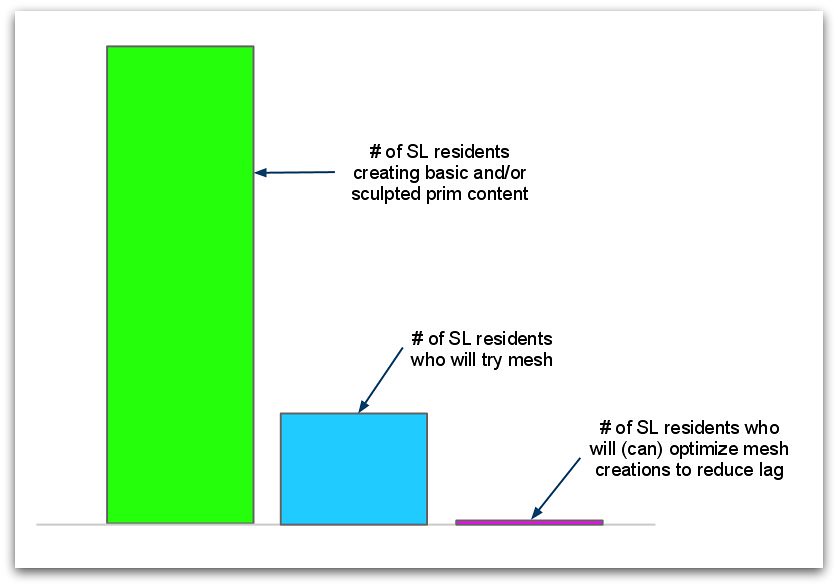
How Mesh Will Reduce Lag


Share Some Grace:

Is Citzalia a Missed Opportunity for Second Life?

cc image courtesy http://www.flickr.com/photos/locace/2664840730
When I first learned that the European Parliament was venturing into virtual worlds to help improve citizens' understanding how the EU democracy worked I was intrigued. I just assumed based on the initial reports about avatars and building reconstructions that Second Life was the platform.

What a good example of how Second Life might be used to help realize that "improve the human condition" vision. I was wrong.

Introducing Citzalia
Citzalia is democracy in action. It is a role playing game and social networking forum wrapped in a virtual 3D world that captures the essence of the European Parliament. You may even recognise parts of the building.
Citzalia is a world you inhabit and help create. Using your avatar you can walk around, interact, network, debate the issues of today, propose legislation, vote and learn about how the European Parliament works for citizens. You can be a Member of the European Parliament (MEP), a journalist, a student or any role you want to create.
Others will be able to vote on the quality of your proposals and you will be able to vote on theirs. By earning experience points you will be able move up to new expert levels in Citzalia.
Current Members of the European Parliament (MEPs) and European officials will be on hand to guide you through the procedures and provide background information.

The initial cost to develop democracy in action - €275,000 (~ $353,000) - and this is what it looks like.


As you can see, Citzalia is more Metaplace than Second Life, but even in the most primordial state, Metaplace was more visually appealing than these first images.

Citzalia is currently accepting beta users, and when completed will include a Citizens' Agora to debate EU issues, a Press Room where articles can be published to the Citzalia newspaper, a EU Lex Lab forum offering a simulation of the legislative process, a library, a Kids' Zone and an Exhibition Hall. Participants will be able to create their own offices which they can furnish and decorate with pictures, their own blog, Web cam and voice messages.

Once a participant has tabled a legislative proposal, other players will be able to vote on it. By contributing to the discussions and content, participants accumulate experience points, which appear on their profiles. EU officials hope the game will provide a platform for debate and discussion of the issues that have been, are or can be addressed by MEPs.

I think this was a missed opportunity for the EU Parliament as well as Second Life. There is already a healthy base of EU Residents in world and there isn't anything in the experience of Citzalia that could not be delivered except possibly the Kid's Zone. Well there was the Teen Grid ... 


Share Some Grace:

Monday, August 16, 2010

How to Be a Good Chicken

cc image courtesy http://www.flickr.com/photos/eyesore9/3206408088
Over the past few weeks Linden Lab CTO, er CEO, Philip Rosedale has been working to restructure the Second Life strategy, development priorities and even processes. At the town hall meeting and at SLCC, he mentioned a few times that there are about 15 Scrum teams at the Lab working on various of the "back to basics" bits as well as parts of another list.

Scrum (in this case) refers to a software development process framework that has (almost) become a regular part of modern day vernacular, but if you aren't in the industry you may have had to do a little looking around to find out what the heck Philip was talking about. There is plenty to read if you are interested, but honestly it's tough for a non-software development person to appreciate the implications of an iterative development approach over what had been the norm of laboriously slogging through a lengthy linear development process only to get to the end and realize you got it mostly wrong.

Scrum is a way to embrace inevitable ambiguity and changing requirements in a team-based framework to execute on well-defined buckets of work (backlogs) over prescribed periods of time (sprints). It's not a cure-all or a cult, it's a process framework and it can work very well to produce a minimum viable product upon which subsequent improvements can be made in a transparent and accountable way.

While the essence of Scrum is generally straightforward, in some cases (such as coordinating 15 dependent Scrum teams) it can be blindingly difficult to execute for a variety of reasons, most of which we Residents needn't concern ourselves because all we need to know how do to is this: be good chickens.

Scrum Roles and the true nature of ham and eggs - commitment

One of the most important parts of Scrum is the concept of participant roles for which there are two main divisions - pigs and chickens. This division signifies a person's involvement in the project, described in this way because at a breakfast of ham and eggs the chicken may be dedicated, but the pig is fully committed. (Get it? Okay, moving on..)

In a Scrum, pigs are the ones that commit to get the work done and while the chickens care about what gets done their contribution commitments are intellectual. In other words (and despite rumors to the contrary) Residents are the chickens, not the pigs.

This weekend Esbee Linden, Oz Linden and Q Linden gave the SLCC audience an overview of the latest viewer development called Project Snowstorm including the Scrum team roles (the pigs).
  1. Q Linden is the Scrum Master and technical lead; he keeps the Scrum team focused on the current chunks of work (sprint backlog) and removes obstacles and distractions.
  2. Oz Linden is the Open Source Lead and will help coordinate between the Linden Scrum iterations (sprints) and the open source community.
  3. The Team includes developers Merov Linden, Tofu Linden, Aimee Linden and 3 to be named contractors.
  4. And finally, Esbee Linden is the Product Owner; her role is to maintain the list of Snowstorm priorities (product backlog) and to represent the voice of the chickens to the Scrum Team.
Yes, Esbee is the chicken whisperer.

Chicken 101

During the Q&A part of the Snowstorm discussion, one question was asked no less than four (4) times in different ways by different people. Essentially, it was "How do chickens make their intellectual contributions?" Okay, no one said that. Most people (including me) asked how Stakeholders aka Residents would be included in the Scrum.

Back in the day, a succinct answer to that question would be "no chickens in the Scrum!" but to their credit (and hopefully not demise), the Snowstorm team challenged everyone to get involved, within guidelines articulated passionately by Oz Linden.

Top 10 Ways to be a Good Chicken (by Oz, extended by yours truly.)
  1. Show up. The Daily Scrum is 6:30am-7:30am PDT at Scrum Platform
  2. Propose Viewer features using the guidelines outlined here.
  3. Think ahead - strive to be proactive over reactive.
  4. Be civil and not rude.
  5. Provide productive, useful feedback. The Product Owner can help you understand what is productive.
  6. Be specific and contextual in your remarks, as opposed to generalized and broad sweeping.
  7. As a general rule, chickens are not allowed to speak or interrupt a Daily Scrum meeting  - don't take it personally and please don't talk or interrupt. 
  8. If you are given the chance to speak during a Daily Scrum, please don't waste the pigs' time.
  9. Don't expect your favorite backlog item will be added to the sprint backlog just because you show up routinely.
  10. And finally, "Regard it as just as desirable to build a chicken house as to build a cathedral.” courtesy, Frank Lloyd Wright.
.

Share Some Grace:

AvaCon and the Miracle SLCC 2010


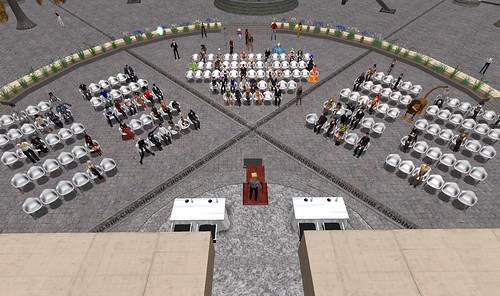
The Second Life Community Convention (SLCC) wrapped up yesterday, rounding out a weekend of keynote announcements and pronouncements by Linden Lab as well as a tightly packed schedule of Resident-led discussions and presentations. If you missed any of the SLCC presentations, many of them are archived here.

I could not resist snapping the image from ustream.tv that popped up with a recommendation to watch Chris Pirillo Live overlaid on the SLCC 10 backdrop - entirely full of win.

AvaCon FTW

Also full of win was the new organization behind SLCC, AvaCon. Who is AvaCon? From the official SLCC site:

AvaCon, Inc. is a non-profit organization dedicated to promoting the growth, enhancement, and development of the metaverse, virtual worlds, augmented reality, and 3D immersive and virtual spaces. We hold conventions and meetings to promote educational and scientific inquiry into these spaces, and to support organized fan activities, including performances, lectures, art, music, machinima, and much more. Our primary goal is to connect and support the diverse communities and practitioners involved in co-creating and using virtual worlds, and to educate the public and our constituents about the emerging ecosystem of technologies broadly known as the metaverse.

You will never make it in time, no one will come and it will suck .. go.

Previous SLCC were organized by The Future United, who abandoned the conference just this year, giving AvaCon a few scant months to organize themselves and pull off a major conference. They did so not only in the host city Boston, but also on the web and in-world.

The AvaCon team was able to attract attendees, including several key Lindens, and responded flexibly to ever changing agendas. The official site and associated social media outlets were professionally designed and maintained with clear information and attention to detail. It was just short of miraculous.

I'm sure that nothing compares to actually being at SLCC in the flesh, the AvaCon, their partners and volunteer residents made the experience more accessible virutally than it's ever been.


The event was so professionally produced, I am already looking forward to next year.

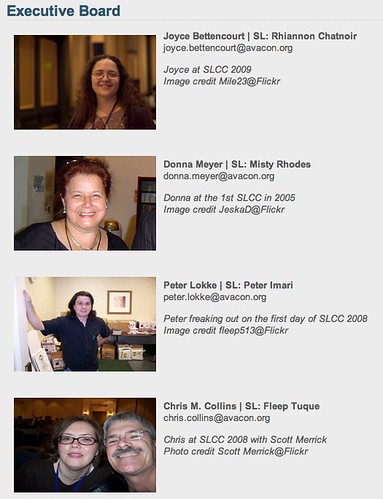
The AvaCon executive board consists of long time Second Life Residents Joyce Bettencourt (Rhiannon Chatnoir), Donna Meyer (Misty Rhodes), Peter Lokke (Peter Imari) and Chris M. Collins (Fleep Tuque). Say hello and thank you the next time you are in world.


Share Some Grace:

Sunday, August 15, 2010

BREAKING NEWS: @SecondLie Jumps the Shark

cc image courtesy http://www.flickr.com/photos/billward/3377873371

In his opening remarks at the Second Life Community Convention (SLCC), Philip Rosedale recounted the time in which speculators were convinced that Second Life had "jumped the shark". The audience chuckled, nodded and tried to recall where they were on that fateful day.

Jumping the shark is a fate known to many, Rosedale and the tribe of Residents were happy to escape.  

But not everyone is so lucky. 

In one fell swoop today, the parody twitter account known as @SecondLie moved swiftly from up and comer to the undesirable position of shark jumper thanks to John Lester, formerly known as Pathfinder Linden, who announced his love for @SecondLie as part of his awesome SLCC keynote.

Good riddance @SecondLie, and thanks for all the alpacas.

.

Share Some Grace:

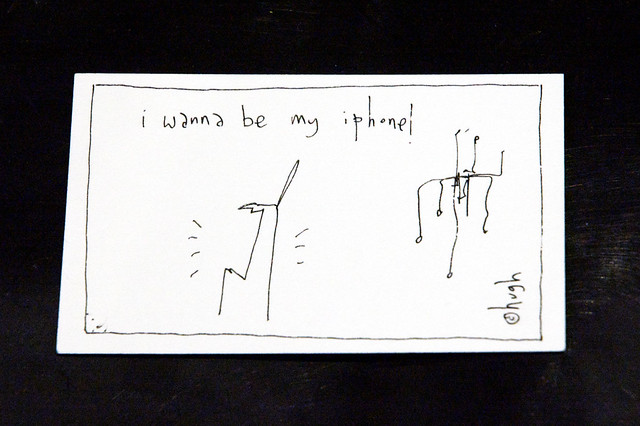
I meant fun like the iPhone

cc image courtesy http://www.flickr.com/photos/lucasartoni/3098240914
cartoon by Hugh MacLeod
Linden Lab CEO Philip Rosedale opted to miss the first two days of his family vacation to address this year's Second Life Community Convention (SLCC) after a few people speculated about why he wasn't attending in person, calling him out for "phoning it in" and speculating about the financial health of the company. Apparently it was more important to squelch those than to .. I dunno, live?

Speaking of phones, Philip opened the talk with a clarification of what the Fun part of the "Fast Easy Fun" strategic guideposts really meant.
I didn't mean fun like World of Warcraft, I meant fun like the iphone.
Philip then paused to admire his new Droid.

Acta, non verba

Another notable part of the opening was that Philip announced that the Lab will get into the process and tempo of delivering a roadmap to the community in return for a measures of success based on action rather than communication.
I hope you'll judge us by our actions as a company really, more than by the conversation that we have around this stuff. Not that conversation isn't important, because in many cases it evolves the actual features and things we do but ..
It's really more important at this point to evaluate us on our capabilities and what we actually deliver, tell you in some cases we're going to deliver and you know, measure us against that rather than measuring us on the nature of the process of communication.
It was Crap Mariner who captured the spirit of the judge us by our actions ideal after Philip's SLCC keynote - reminding us of  the motto of the Merchant Marines:

cc image courtesy http://www.flickr.com/photos/garrettc/3531552607
I have a secret list

Philip walked through two lists of things that are being worked on by the 15 scrum teams at the Lab but he also said he would blog the details of all that he covered in the keynote, so in the spirit of Acta, non verba, I'm going to wait until he does so I don't misinterpret what:  "We are going to ship mesh." really means.

If you missed the keynote, I captured the audio of the talk or you can watch Philip's keynote courtesy of Treet.tv.

.
Share Some Grace:

Thursday, August 12, 2010

Pirillo on Second Life, Take Two

http://www.flickr.com/photos/lwr/32062285
Chris Pirillo's Second Life History lesson was about to become a classic drive-by Second Life shooting incident until yesterday, when it didn't.

I'm not sure if Chris was amused, befuddled or both by the reaction from the Second Life community to his commentary that Second Life was overrun by porn and gambling addicts, but at least he didn't ignore it, sit quietly and wait for it to go away.

His comment to me was: "Not quite sure how I'm to blame for SL's / LL's ills?" I can't find any place where anyone blamed Chris for the state of Second Life but to be sure, no one was pleased with his offhanded hyperbolic commentary that was directed at people instead of the Lab or the platform.

The good news is that Chris listens and is open minded; he agreed to revisit Second Life with Oliver Szondi, using Viewer 2.1 and traversing some of the oldest places in world.

Yep, you guessed it, it was ugly.


Now, a much better first hand report from Chris.
Bottom line? I still don't get it. Yes, it's a virtual world / community where you can create your experience - but performance and usability is still ass-nasty (no way around it).
Credibility, increasing.

Yesterday, Phaylen Fairchild had a great conversation with Chris about his initial post, the community response and his most recent experience (more podcasts, please Miss Phaylen).

During the conversation Chris was still curious why there was such a virulent response to his initial post asking, "Why are people pissed at me?". But Phaylen leads him gently to the self realization:
If I focused specifically on just the amazingly horrendous performance issues, I don’t know if we’d be having the same discussion.
Precisely.

Phaylen and Chris' conversation is a must listen - it's packed with wonderfully insightful bits teased out by this end note from Phaylen:
I didn’t much expect to agree with Chris Pirillo. I thought it would be an interesting debate. Unfortunately, I couldn’t debate, because on many of his points, when speaking explicitly about his experience, I could only, sadly agree.
Many thanks go to Oliver and Phaylen who stepped up and helped move the conversation forward and to Chris for taking the time to listen and re-engage objectively. The conversation was needed and highlighted a few difficult questions:
Is there a foreseeable path to better performance and usability? After seven years, are we kidding ourselves?
And questions Charlanna Beresford recently asked - is it possible to describe the value of a virtual world to the uninitiated?  Does Second Life have a broader purpose that appeals to the masses?  Or does it simply resonate with a smaller niche of society? 
    And finally, did Linden Lab miss an opportunity to engage in an important conversation? Or, was it best that they were no where to be seen, heard, or otherwise?
    .

    Share Some Grace:

    Tuesday, August 10, 2010

    Second Life Historian Chris Pirillo Tells All

    cc image courtesy flickr.com/photos/lockergnome
    Recently Chris Pirillo "founder and maintainer of Lockergnome, a network of blogs, web forums, mailing lists and online communities" provided a much needed revisionist history lesson about "What happened to Second Life?" for his loyal community members.
    Over on Lockergnome, Guyfromdenmark wonders why Second Life never became a hit. When it was first launched, he (and all of us, really) thought that it would be a HUGE deal. It pretty much just fizzled and died, and our Denmark friend asks the community their thoughts on what happened.
    Other than the "it pretty much fizzled and died" teaser, Chris reveals the real heart of Second Life history:
    Nothing really “happened” to it other than being overrun by people addicted to porn and gambling.
    So, there you go. The world according to Lockergnome.

    A few people have asked if Chris has ever been in Second Life, and the answer is yes.

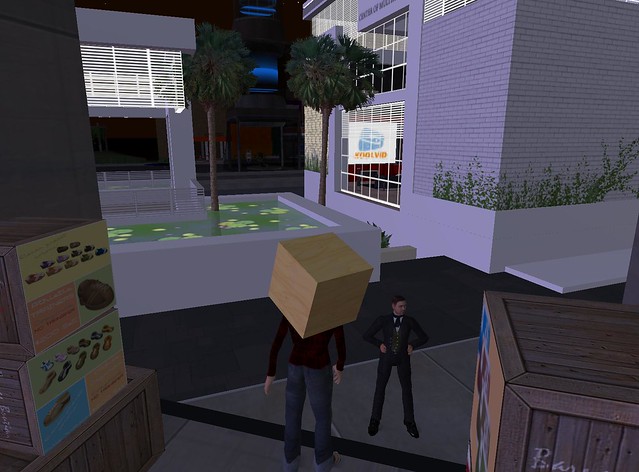
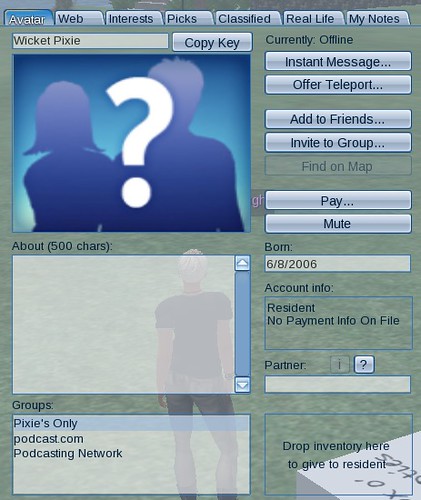
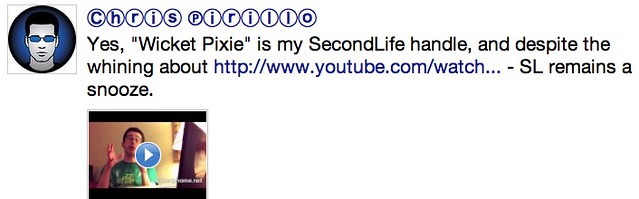
    He joined in 2006 as Wicket Pixie (also pictured above) and his assessment then "Second Life, I don't Get It" garnered a reply from Robert Scoble. Scoble offered to help Chris out saying:
    Here's a little secret Chris: Second Life IS lame. Why? Cause the people in Second Life are the ones who built it. Think about that one for a while. Maybe if it's lame you just haven't built something not lame yet.


    So there you have it.

    Second Life pretty much fizzled and died because it was lame, was overrun by people addicted to porn and gambling, and remains a snooze.


    I wonder if he still has that box on his head?

    .
    Share Some Grace:

    Sunday, August 08, 2010

    Save Our Ship? USS Second Life

    cc image courtesy flickr.com/photos/bredgur/

    Is it just me, or has a monsoon of "how to save Second Life" conversation hit our virtual world schooner?

    Life preservers are being carefully crafted - achievements! mesh! immersion! free land! social media! - and flung over the side with reckless abandon with nary a "heads up below!" warning.

    Often I am compelled to run around commenting here and there, but right now I'd rather not risk treading the dispirited waters lest I get wrinkled fingers and toes.

    Instead I'll just stand here clutching my sculpted life preserver, sipping a glass of icy mint tea, singing to myself and wondering ...

    Does Second Life need to be saved? Saved from what exactly? 

    Extinction, you say? Surely you mean "extinction" like the triceratops or the brontosaurus.. right

    http://xkcd.com/636/


    Have we become so disillusioned with that which originally captured our imaginations and hearts?

    Share Some Grace:

    Friday, August 06, 2010

    The Calculus of Mesh in Second Life


    I've been wandering aimlessly in the fields of off-grid Second Life conversations over the last two days and found myself nearly strangled by the overgrowth of outrage regarding a Linden Lab employee action  - specifically the release of independent contractor Qarl Linden.

    The story played out publicly on Qarl's personal blog and then subsequently around, and around, and around our virtual campfires with various WTF-esque outcries, protests of burning sculpted prims (Qarl helped bring sculpted prims to the grid), a petition to rehire Qarl, and one lingering but repetitive question "But what about mesh?!?" (Qarl was working on mesh). Make no mistake, Qarl was loved and admired.

    Putting aside legalities and technicalities of employee actions, and choosing to ignore the intriguing cultural undertones of protests and petitions, what's left to discuss are questions about strategic direction and tactics. Such is the question: What about mesh?

    But don't we already know the answer to that question? I think we do.

    The answers are in the back of the Book of Rosedale

    That is, unless you missed the lengthy and comprehensive talk Philip delivered to the Second Life Residents on July 30th. This was the talk where he laid out precisely how and what the Lab was going to do in terms of getting back to basics by focusing on universal and core user experiences - those things like lag and crashing and the overall experience that are true for everyone regardless of who they are or how they "use" Second Life.

    That means you also missed how everything the Lab does will be focused on maximizing the success of the meta-economy by optimizing the way people "find, try, buy and use or experience" the content such as 1) fixing search in a way that is balanced for content creators, merchants and consumers while maximizing the economy, 2) making the process/action of getting to content and using it trivial and 3) shifting the way new users enter the world so that entry points, or links, go directly to content, people or events without going through the current user registration, welcome and training areas.

    That's a lot to miss. Fortunately, you can still watch or listen to the entire talk.

    No really, go listen to Philip lay out The Plan to increase the overall success of the world builders by driving toward the concept of the "biggest economy", optimizing the overall user experience and adopting a fundamental mechanism to evaluate new capabilities (like mesh) through the lens, or filter, of that success. Or, in his words:
    So that's the plan, on everything whether it be the economy, getting back to basics and/or winning back the technology lead. What we are doing now is we're applying it across the board as a filter on everything that we're doing. 
    We are asking the question "Does this fit with this plan? Does its priority bubble up to enough points in this plan where we should be working on it now and not later?
    So we are applying this to everything we're doing.
    I think everything here means that the Linden team will re-evaluate all new features and extensions - promised, anticipated or otherwise - including everything from Second Life Enterprise (highlighted as an example) to mesh.

    No seriously, what about mesh?

    So maybe the subtlety of the new Linden economic decision model hasn't resolved itself so clearly.  That's okay, Philip answered the question about mesh directly during his talk.
    We're very excited about the potential impact of mesh as on the economy, on quality of the user experience on the sort of general things that people want to do inside virtual worlds We're very excited about it. 
    Applying the filter of what we're thinking about right now? We're being careful to make sure that there's a way to implement mesh so that it has a huge impact, but that the impact on rez time and frame rate is either neutral or positive. 
    And so there's a bunch of calculus that we're doing, some of it in concert with the beta users of this capability, to make that we're not going to increase lag or slow down the experience. But that is where we are on mesh.
    Based on this statement and the enormity of the economic, user experience and back to basics backlog the Lab is already facing, I'd conclude that the calculus of mesh says that over a short term, the changes required to integrate mesh rapidly approach zero. Where, when and even if, the curve shifts to positive is a matter for the market to determine.

    But then again, both my calculus and economics classes usually collided with the best surf times.

    (And Qarl, best wishes rendering your next adventure. Hopefully we will see you again.)
    Share Some Grace:

    Apture