Showing posts with label social networking. Show all posts

Wednesday, May 26, 2010

Second Life Retention Recipe: Chat More


Chun-Yuen Teng and Lada A. Adamic from the School of Information at the University of Michigan have just published some interesting research on user retention in the virtual world Second Life ®.

The researchers observed that a high percentage (95.4%) of users who had made some financial investment in SL were likely to remain.  From there, they set out to determine which factors were the best predictors of retention. The findings are quite interesting and I'll summarize, but please read the detailed report for the analysis.

Linden Lab provided the research team a dataset on user activity including snapshots of the social network, group affiliations, as well as summary interaction data such as first and most recent login, user-to-user transactions and pairwise chat frequencies. The researchers focused on the slice of data spanning May-June 2009 and evaluated four different facets of the user experience: usage (time spent), networking (number of contacts, groups and social cohesion), interactions (frequency and regularity), and financial transactions (selling and buying).

1) On Usage
The total length of time spent in SL was not a significant predictor, however the intensity (total time spent in world) was a strong predictor.

2) On Networking
While all parameters of networking (# friends, # active friends, % active friends, clustering, # groups, group overlaps) were highly correlated with retention, the number of raw contacts and groups, were key to identifying which users stay. The diversity of those contacts was a positive predictor but not a strong correlation.

3) On Interactions
For this I will quote directly from the report:
We observe that almost all chat parameters are more predictive that the static network measures above.  Furthermore, one need not resort to complex metrics because the best predictions are also the simplest, e.g. the number of chat partners (not necessarily friends), or the number of days on which the user chatted.
In other words, talking with people matters.

4) On Financial Transactions
Here, the researchers looked at data on purchases, sales, and transfer of goods as well as proximity within the social graph.  The results indicated that while economic activity was correlated with retention, it was less so than chat.  Spending money was more highly correlated than making money.  Having a high proportion of free transactions was highly predictive. Profits did not improve the predictions of whether a user would stay.  The amount of money paid to Linden Lab versus other users was only weakly predictive.


Share Some Grace:

Friday, May 09, 2008

Upholding Social Norms

Recently, I've been observing what I consider to be an erosion of social norms within the growing resident population within the virtual world of Second Life (SL). I think to some extent, this was to be expected simply due to the explosive growth but I do think there is something a little more "meta" going on and I wanted to share a few observations. Before I go much further, I should say that the following represents my personal world view and is not intended to extrapolate to the general populous. It may simply speak volumes about the Second Life residents I encounter, and have little to do with the average population but at the least, it may provide food for thought and discussion in a larger context.

When Grace entered Second Life in Feb. 2006 the feel of the community was akin to Mayberry, USA. By that I mean, the population was less than 150,000 and residents were generally neighborly, helpful and glad to see you. I was fortunate enough to stumble into the tranquil community of Mill Pond as a home base but I spent most of my time traversing the grid, trying to get my head around the world as it were. Nearly every day of my first few months in world I heard "Welcome to Second Life" as I met new people and visited new places. There were leagues of well organized groups and individuals whose focus was to help acclimate new comers, from NCI to the Shelter and educational groups that taught basic skills. Inherent in these exchanges, beyond just building skills, were simple reinforcements of social norms and acceptable behaviors. It wasn't overt, it was kind and gentle and in the spirit of keeping the world of Second Life a place of community and collaboration.

Beyond the new resident centers, object lessons in de facto social norms were consistently reinforced by my fellow residents. This included simple things such as: greet and welcome people, be kind to newbies, excuse yourself when you left a group conversation, etc. It also included more subtle practices, such as waiting until you've established a bit of a relationship before you offered friendship - at that time calling cards were helpful without the implied social contract of a friendship. This was reinforced somewhat by the feature set because then your friends could not only see if you were online, they could also map you by default. This single point, beyond common courtesy, was a good deterrent to quick friends.

I realize I sound like some old geezer sipping a glass of sweet tea and reminiscing about "the good old days", but really I do have a point beyond simple nostalgia.

Reflecting upon my early Second Life social experiences and those today I see dramatic changes, especially related to social privacy. For example, part of the subtle but consistent reinforcement from the early community was that the separation between one's Second Life (SL) and real life (RL) was assumed, and the merger of those two was the decision of each individual to be exposed, discussed, etc. at their discretion and without prompting and if shared, certainly held in the utmost of confidence. I am not talking about the philosophical arguments related to immersion versus augmentation here, I am referring to simple courtesy and what was then a seemingly set of shared values and social contract terms that embraced the construct and consequences of what it meant to have social privacy.

Social privacy wasn't cast as "hiding behind your avatar" nor were the Second Life Terms of Service waved about by town criers, it was woven into the culture of the early era community and it was reinforced accordingly. Sharing someone's real life information and private chat logs with a third party was not only frowned upon, there was almost a scarlet, maybe crimson, letter cast upon those residents that were careless in that regard. Social privacy was considered paramount, and unfortunately I see that particular aspect of the Second Life culture eroding every day without obvious consequence.

In the material world there are forces that shape our social behavior such as fear of legal and social consequences and attendant regulation, which are largely choreographed by immediate and appropriate feedback. Often in the real world the law often becomes the lowest common denominator to constraint and social decorum.

However without feedback methods, those same consequences in online communities including Second Life are often missing, especially with a Laissiez-faire approach to oversight even in light of the Big Six. The "law" here in Second Life boils down to the Terms of Service, which clearly most people don't read or are otherwise immune simply due to the lack of obvious consequence. Without the means of consequence we know humans will push until there is some edge, and we are left with an eroding and destructive community.

Real world law is not the answer. Real world law doesn't solve destructive social behavior in communities and just to be clear, anonymity is not the problem. The arguments about identity verification and trust, while tuned to the real world, are inherently flawed in a space where new ways of thinking availed because of anonymity and the constraints it imposes. Additionally, no legal system is going to dirty itself by trying to moderate "Don't be a dick".

So what is the answer, or maybe what are the questions?

Are there different moral codes and norms that we are willing to adopt in online spaces to accommodate this new medium? If so, does self-moderation work in large and diverse social spaces to reinforce social norms? For example, are *you* willing to ...
  • gently remind that new friend that just said something like "obtw ABC XYZ is rly a dude irl" that sharing or even discussing another person's real life is not acceptable?
  • delete the notecard someone just dropped on you that contains a private conversation and kindly remind them not to do it again?
  • even if you think you've "fallen in love" with another resident upon first sight, are you willing to give that resident the social privacy they rightly deserve?
  • speak up in a public forum when a resident is being mistreated?
  • defend a fellow resident's right to anonymity?
  • remind the resident that disrupts an event with repeated transmissions of advertisements, sounds or even chat spam, that they might find a better outlet?
  • write a blog post reinforcing your view of social norms?


Well, are you?

Share Some Grace:

Friday, January 04, 2008

The 25 Group Symptom in Second Life

I have been struggling with my first of 2008 posts as it was in theory going to be the predictable predictions post, but I really hate prediction posts and frankly another issue has been weighing more heavily on my mind - the "25 Groups" limitation.

The "25 Groups" problem has been swirling about the grid for many months, and most recently gained more press appeal once it was adopted by vocal bloggers (1) (2) (3) in an attempt to get people to vote on the JIRA entry. I agree wholeheartedly with Ordinal Malaprop's perspectives on this matter and *if* I could log in to Jira right now, I'd quote from some of the dialog there.

I did raise a vote on Jira MISC-208 rather than abstain with the sole intent of raising awareness about how horribly broken Second Life Product Management has become as evidenced so clearly by this single case study, even before it has fully unfolded. I'll get right to my punch line, so we don't miss it:

The group limitation is a symptom, not the cause.
Simply raising the group limit, even without bounds, will NOT solve the problem(s) and may create more trouble.

Starting with group-owned land and diverging from there, Second Life Residents have found creative ways to use groups to overcome what are otherwise shortfalls or failings in the product. Many group features such as basic instant messaging are unreliable, so why then would the populous request more of a bad thing?

The real problem is that this is a symptom of much larger issues, and the rush to determine a quick fix or even the multitude of workarounds can lead to yet even larger problems. What is required in this case, and many others is some serious root cause and usage analysis that any Product Manager would have likely already done. In fact, I mentioned it before, but I will say it again more firmly:

It's far past time for serious Second Life
PRODUCT MANAGEMENT


Second Life Product Management is a mess, and this particular feature request "More than 25 groups!" has demonstrated many failings of the current system and attendant process that I won't rant forever on all of them, but here are my two main peeves.

1) JIRA does not replace Product Management
Jira was developed and is used quite successfully as a bug and issue tracking tool and it is not the problem. Putting Jira usability and due process issues aside, the first sign of the problem is that Jira is being used as a catch all repository for everything to bugs, requirements, priorities, assignments, and feature requests. I dare say if you had the intestinal fortitude, you might even find a marriage proposal swirling amongst the chaff. Even worse, the implication that the number of votes something gets determines it's priority is deplorable.

Product Management requires forward thinking and proactive planning based on two things: the product road map informed by a healthy business plan and the data about the operations current deployment. Data can include include anecdotal reports, but it should be balanced with meaningful and verifiable sources of information. I have yet to see a meaningful product road map from Linden; perhaps it's held close to the vest for business reasons, but the closest we've come to insight are blog mentions about things such as Expressive Puppeteering - remember that highly publicized feature?

2) Discussions of solutions to symptoms are dangerous!
Making a simple statement such as "increase the number of groups" is much like walking into your doctor and demanding an increased dosage of pain killers; in the end the results might be strikingly similar. Likewise, alternative solutions to resolve the symptom are often useless and at worst more harmful. Consider the cases: Patient: "I need more pain killers because it hurts when I raise my arm". Doctor: "Stop raising your arm.", or perhaps Patient:"I need more pain killers because it hurts when I raise my arm.", Doctor: "Let's just cut off that arm."

Finally, random discussion about why something cannot be changed technically are valid to and for a particular audience, but lend little to the overall analysis and subsequent collective understanding of an issue. The most important effect of this particular symptom should be to raise awareness about the multitude of issues surrounding what is ultimately the most fundamentally broken element of the Second Life product - sociability and networking.

To actually resolve the 25 group symptom and uncover many others, Linden Lab should take a comprehensive look at the spectrum of how groups are used within Second Life (versus "as designed" use cases) as well as the attendant pain points such as the routine of even simple predictive messaging failures. Let's face it, messaging is hardly a difficult technology to master but on how many occasions have your attempts to message even a moderately sized group failed? Being able to actually contact people in a reliable manner is sort of key to a socially based virtual world, and any product manager might be losing sleep about it.


Share Some Grace:

Tuesday, October 30, 2007

Defining Virtual Worlds, a Redux

The "harness a virtual world definition for the mainstream" meme has been revived, so I thought I'd dust off my April post and breath some new life into it and into the conversation.

Much of the recent discussion revolves around defining "social" virtual worlds and building a list of those that met a certain criteria. I'm not a list maker. I try to use lists for grocery shopping, but once I get to the market that list may be outdated or usurped by evolving conditions, which is why I prefer that more time be spent on a definition or context.

But before we get too far off in the Webster weeds, I personally think it's important to know why it's important to define something. Definition is important in a context toward understanding, and the context in which I've chosen is to understand or draw some insights is: What makes these largely ill-defined social spaces successful? You may not agree with that context, in which case you may want to stop reading here, but my intent is certainly not to build a list but rather learn something in the process of the definition exercise.

I found Onder's post on this topic particularly compelling in which his definition was within a context of comparing Second Life to alternatives. I was somewhat surprised that he did not throw in on the Metaversed post about the topic, but perhaps we share the same disdain for lists. Nonetheless, I want to highlight a superset definition which I've pulled from Raph's post:
A Social Virtual World has game-like immersion and social media functionality without narrative driven goals. At its core is a sense of presence with others at the same time and place.
[UPDATE: One correction/clarification to be made here. This was not Raph's definition, rather one which he pulled from the referenced Metaversed.com post. Thanks Raph]

This is lacking a key element from my perspective. It may be in hope to be a succinct as possible, but to me there are at least three critically important elements to a virtual world.
1) Socialization - There are adequate means by which people socialize, form and maintain affinity groups, communities and even whole new societies. Socialization is overwhelmingly the reason people are online and the enablement of such cannot be over-emphasized, over-supported or over-maintained.
SIDEBAR: I'll take out a brief moment and smack LL over the head with their product management road map. This is where all things start and end, and if you cannot get socialization right, you have failed. If group communications do not work efficiently, you've failed. If profiles fail to load, guess what? If my friends don't show on line and I can't teleport someone I just met ... do not collect $200, go directly to jail.
2) Immersive and Participatory Media - There is underlying dialogue and interaction with assets - whatever that may be - ranging from full scale user creations to game play and event to simple utterances of the Twitterdom type. Users must be able to create, but there is equal part to play in consumption and evolution of someone else's creation so that in the end, there is something to do.
Mediated or otherwise, creation and consumption is not one-way, but rather it depends upon both the immersiveness and synchronicity of the platform. I think these two are covered by Raph's definition but there is at least one critical element missing.
3) Marketplace - There is a marketplace that provides the ability for people to a) define value and b) transact on items of value in the world on many levels up to and including RMT. Currency can be defined and influenced by the world's culture and subcultures. In virtual worlds, there are two forms of currency - one that is only usable in world, and the other that can be traded outside of the world .
One non-trivial form of social virtual world currency is social currency. Social currency is earned according to the cultural rules defined by #1 Socialization; it is often of higher value inside the world in which it was earned and it is the fabric that ties points #1-3 together. It can inflate or recess, depending on cultural factors and it's value it entirely subjective, the market can shift and your ability to "cash out" is entirely dependent upon your ability to socialize, your participation and a market against which to trade.

Marketplace is a lynch pin of social virtual worlds - it is not only critical to the definition - it is largely the element of success or failure. Without some form of marketplace, a social virtual world will fade into oblivion for there must be some economy supporting the weight of those that choose the equivalent of "welfare", and it provides a foundation for those that are goal-oriented and motivated by whatever currency is defined, be it real money, celebrity, stars, trinkets, or spotted puppy dog tails.
Share Some Grace:

Wednesday, October 10, 2007

Virtual Worlds Conference and Expo 2007


I'm at the Virtual Worlds Conference this week and I'll be focusing my attention in two primary areas: the use of virtual worlds as a transmedia platform and new business models afforded by the attendant emerging markets and technologies.

If you have a question or want me to try to track down some information, drop me a comment.

Selected Updates
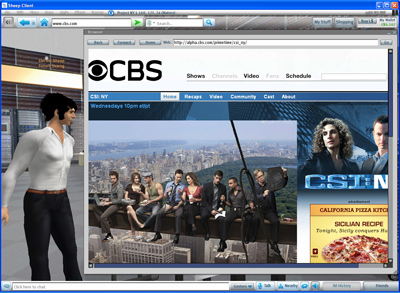
I usually skip keynotes unless I know the speaker and they often feel like eating dry toast, but I am really glad I did not miss Anthony Zuiker. In addition to being the perfect personification of "tram tour guide makes it good", Anthony is the consummate showman. None of this distracted from his unveiling of the upcoming CSI episode on October 24th as a significant step toward transmedia story telling in conjunction with The Electric Sheep Company.

Unlike the Law and Order debacle, Anthony is using Second Life to extend the story and the viewer's experience not just that night, but in an on going unfolding arc that will wrap on February 6th. I had the chance to talk to Anthony last night at an after-party, and he really does get it. I encouraged him to talk to Henry Jenkins which I hope he does, he has the energy and resources to take this concept far beyond Henry's musings.

The Electric Sheep have been busy bees, in conjunction with the CSI release, they unveiled their new Second Life viewer, touted as the first commercially licensed viewer since the client was open sourced by Linden Lab. I think this deserves it's own post which I'll write later.


In an interesting partnership, IBM and Linden Lab are teaming up to create a new set of standards to increase interoperability between worlds. From the IBM press release:
IBM and Linden Labs today announced they will work with a broad community of partners to drive open standards and interoperability to enable avatars -- the online persona of visitors to these online worlds -- to move from one virtual world to another with ease, much like you can move from one website to another on the Internet today. The companies see many applications of virtual world technology for business and society in commerce, collaboration, education, training and more.
This is definitely something I will blog more about later.

More Updates:
Thursday was mostly a meet and greet day for me. As for the Day-2 keynote, Christian Renaud is a finely tuned speaker, but his powers of ten introduction and a near-forensic analysis of how we get to the future via standards, committees, and councils (oh my) left me a bit cold. I'm not arguing for rah-rah and pom-poms, just a bit more insight into what's actually working in virtual worlds before we dive head first into a morass of standards.

Suffice it to say that "interoperability" was the buzz word of day 2, and I was surprised not to hear more buzz about the InDuality multi-platform viewer developed by Clive Jackson, CEO and Founder of Pelican Crossing. You may recall, Clive helped me escape the prison of defining "virtual world" with a great paper entitled The Metaverse 2.0 in this previous post. I completely missed meeting Clive and the InDuality demo so if anyone was lucky enough to see it, drop in a comment with your impressions.

I was lucky enough to spend some quality time with Raph Koster and Jason Hable from Areae to get an under the hood tour of Metaplace. On a side note, if you've not had a chance to hear Raph speak, you want to put that on your life list and in the mean time, you can find a lot of what he thinks out loud on his blog. Metaplace is still in a closed alpha, but by the grace of the virtual goddesses, I will get a chance to kick the tires before year end and the only thing I will tell you is you might want to tune up your Lua skillz. (No, I don't know where the auto references came from; perhaps I'm traveling too much).
Share Some Grace:

Tuesday, August 07, 2007

Dunbar's Number - Groups in Second Life

You've probably heard "Dunbar's number" tossed about recently with respect to social networks. I would venture that before social networks became the hot topic, Dunbar's number was referenced fewer than 150 times in any year since British anthropologist Robin I.M. Dunbar journaled it in 1992 (yes, his middle initials really are "I.M"). Today, there is probably at least one Dunbar meme running around - something like "What are 5 social networks in which you have more than 150 "friends"? (If someone knows of one, please drop a comment and share.)

Thanks to the evolution of snack sized media and information, the collective understanding of the Dunbar number is fueled by Gladwell, Watts, or Buchanan quotes, or even a Wikipedia snippet such as: "150 is the maximum number of people that can belong to group to maintain social relationships". These bits boil it down to a number and while technically correct, the implications of Dunbar's number are far more important that the absolute value and it is these that help us understand how we can improve social networking feature such as groups within Second Life.

Read Dunbar's famous paper "Co-Evolution of Neocortex Size, Group Size and Language In Humans", here. In case you don't, there are a few critical points (hint: these are crude notes, you really should read the paper):

  • The derivation of the "Dunbar number" is based field studies on primate group behavior and Dunbar's hypothesis that there is a correlation between relative neocortex size and group size.
  • Dunbar extrapolates from the measured primate data and the comparative size of the human cortex to reach a number of 147.8.
  • Dunbar extends his analysis to cultural and historical data that reinforces the "average" number of 150 for group size to include armies, nomadic tribes, terrorists, etc.
  • The number applies to groups with strong incentives to stay closely connected such as survival.
  • In order to maintain group cohesion, 42% of a person's time must be spent performing "social grooming", else the tenants of unstructured trust will not hold and the group will lose cohesion and group "rules" will not be followed, etc. And a hint from Dunbar as to how to address that dilemma: " My suggestion, then, is that language evolved as a "cheap" form of social grooming, so enabling the ancestral humans to maintain the cohesion of the unusually large groups demanded by the particular conditions they faced at the time."

Christopher Allen has extended Dunbar's paper in a 2004 blog post describing why he thought there was a misunderstanding of Dunbar's ideas based on a preoccupation with the absolute. It's a worthwhile read, as is the rest of his Life With Alacrity blog. He delivered a more concise presentation of his argument at IT Conversations in 2006 called The Dunbar Number, and I encourage you to download the briefing and listen to the recording as I will reference here to give some background.

From a modern world perspective and using social network analysis, Chris Allen hypothesizes that that different group sizes impact a group's behavior and their choice of processes and tools. Based on empirical data from MMOG and online communities, he suggests that for non-survival groups, the equivalent Dunbar number falls somewhere between 60-90.

Allen argues that group dynamics have more than just the Dunbar number as a break point; three group size nodes emerge and Allen provides some insight into the group construct as it relates to size. Groups with too few people suffer from insufficient critical mass, experience group think, are unable to sustain conversation and the infamous "Echo Chamber" effect is evident. Read some of Eric Rice's "Echo Chamber" analysis regarding the failings of artificially small groups, aka elites. Overly large groups have far much too noise and cannot sustain an equal and unstructured trust. Cliques and inappropriate politics emerge and social contracts start to break down. From a Second Life perspective, an example of this might be the recent Second Citizen forum meltdown. Note that it's the group size that creates the breakdown of the cohesive bonds, not the "newbs". When group sizes grow beyond these normalized sizes, even the most senior members of the group can suffer the ill effects.

Allen also hypothesizes that there is a correlation between group size and the level of group satisfaction in an interesting double humped graph where satisfaction peaks at levels of 5-8 and 50-70, with a devastating chasm in the middle between 9-25 people.

So what does this all have to do with Second Life groups? You mean it's not obvious?
One might assume that groups in Second Life should be the mechanism to allow people to communicate "easily" across virtual geography, to Dunbar's point about language (conversation) being a cheap way to meet the required 42% dosage of social grooming, they should be a relevant means by which the group can maintain cohesion. They might represent centers of affinity, and sub-cultures.

However, groups in Second Life aren't about group cohesion or social grooming, they are largely about announcements, group land, business updates and product releases - in other words, they are one-way push based communication channels. This is a critical need, but does not serve to build cohesion within the community. How many times have you seen someone chastised for chatting in a group IM? How often are the words "this is not the place for that discussion" or "this group is for announcements only - not chat", or my recent favorite, "no ones cares what you think"? This adopted use of the group function indicates that there are basic communication mechanisms missing with the Second Life platform that are necessary for cheap communication.

Groups in Second Life are often plagued with the "size matters" syndrome. How often have you heard an exuberant "my group passed 500 members"? The value of a 500 person group in Second Life is rarely more than an ego boost for the founding member, combined with some artificial strength in numbers false front. Groups of this size are effective in cases where there is a specific, goal oriented and tangible objective such as the Relay For Life, or to generate some short term flash mob behavior. And to Allen's point, groups of these size are destined to suffer from group dissatisfaction and disintegration. An example is the Live Music Enthusiasts group, aka LME. To a musician, LME offers the largest number of individuals to which to send notices for live performances, however this size is a bonus and a hindrance as it lacks moderation, the channel is far too noisy, and there is a general break down of the "social contract" - i.e. the group charter. As a result, small factions break off and form smaller groups.


This leads to the most debilitating group dysfunction, which is the limit of 25 groups. If you spend any amount if time in world, own group land, and/or have the audacity to have more than one interest, you spend your time juggling your group memberships, adding and leaving on a regular basis. This is not just frustrating, but does highlight a significant flaw in the platform services. The strength of community is the ability to support large numbers of subcultures and affinity groups, while still maintaining an overarching sense of the whole. This requires a set of tools that are accessible and useful for the uber-group interaction.

The most effective tools for large or uber-group interaction are discussion lists that are reputation-filtered, wikis or multi-author workspaces, public blogs and social networks. None of these work within the current world, but are necessary complements to maintain community cohesion. Linden failed to recognize this, even after the rash of complaints when many of the "official" Linden forum segments closed. The other forums that have gained audience are focused on maintaining their community, which tangentially relates to Second Life but does not serve to build community cohesion. The failings of
Second Life groups is largely why I spend time on Twitter catching up within my selected group of Second Lifers.

I tried to do some analysis of the bugs associated with groups in Second Life via Jira, which is why this post sat gathering dust for a week. I've given up, but I'd love to hear your perspective on groups and what changes could/should be made to Second Life to improve or establish some basic group functions.

Update#1: I could not make this up. Just hours after I finished this post, I got a group notice that said the following:
Please do not use group chat for communication.
Update #2: Hikkup was so successful in the last post, let's use it again. Click the link and sound off, or better yet - follow the lead and use the comments. What changes could/should be made to Second Life to improve or establish group cohesion?


Share Some Grace: