Showing posts with label technology. Show all posts

Wednesday, October 10, 2007

Virtual Worlds Conference and Expo 2007


I'm at the Virtual Worlds Conference this week and I'll be focusing my attention in two primary areas: the use of virtual worlds as a transmedia platform and new business models afforded by the attendant emerging markets and technologies.

If you have a question or want me to try to track down some information, drop me a comment.

Selected Updates
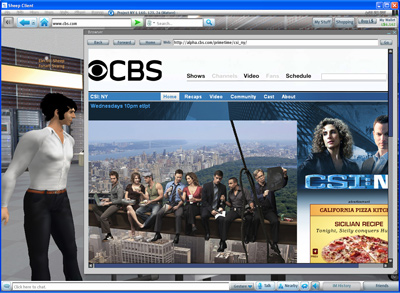
I usually skip keynotes unless I know the speaker and they often feel like eating dry toast, but I am really glad I did not miss Anthony Zuiker. In addition to being the perfect personification of "tram tour guide makes it good", Anthony is the consummate showman. None of this distracted from his unveiling of the upcoming CSI episode on October 24th as a significant step toward transmedia story telling in conjunction with The Electric Sheep Company.

Unlike the Law and Order debacle, Anthony is using Second Life to extend the story and the viewer's experience not just that night, but in an on going unfolding arc that will wrap on February 6th. I had the chance to talk to Anthony last night at an after-party, and he really does get it. I encouraged him to talk to Henry Jenkins which I hope he does, he has the energy and resources to take this concept far beyond Henry's musings.

The Electric Sheep have been busy bees, in conjunction with the CSI release, they unveiled their new Second Life viewer, touted as the first commercially licensed viewer since the client was open sourced by Linden Lab. I think this deserves it's own post which I'll write later.

In an interesting partnership, IBM and Linden Lab are teaming up to create a new set of standards to increase interoperability between worlds. From the IBM press release:
IBM and Linden Labs today announced they will work with a broad community of partners to drive open standards and interoperability to enable avatars -- the online persona of visitors to these online worlds -- to move from one virtual world to another with ease, much like you can move from one website to another on the Internet today. The companies see many applications of virtual world technology for business and society in commerce, collaboration, education, training and more.
This is definitely something I will blog more about later.

More Updates:
Thursday was mostly a meet and greet day for me. As for the Day-2 keynote, Christian Renaud is a finely tuned speaker, but his powers of ten introduction and a near-forensic analysis of how we get to the future via standards, committees, and councils (oh my) left me a bit cold. I'm not arguing for rah-rah and pom-poms, just a bit more insight into what's actually working in virtual worlds before we dive head first into a morass of standards.

Suffice it to say that "interoperability" was the buzz word of day 2, and I was surprised not to hear more buzz about the InDuality multi-platform viewer developed by Clive Jackson, CEO and Founder of Pelican Crossing. You may recall, Clive helped me escape the prison of defining "virtual world" with a great paper entitled The Metaverse 2.0 in this previous post. I completely missed meeting Clive and the InDuality demo so if anyone was lucky enough to see it, drop in a comment with your impressions.

I was lucky enough to spend some quality time with Raph Koster and Jason Hable from Areae to get an under the hood tour of Metaplace. On a side note, if you've not had a chance to hear Raph speak, you want to put that on your life list and in the mean time, you can find a lot of what he thinks out loud on his blog. Metaplace is still in a closed alpha, but by the grace of the virtual goddesses, I will get a chance to kick the tires before year end and the only thing I will tell you is you might want to tune up your Lua skillz. (No, I don't know where the auto references came from; perhaps I'm traveling too much).
Share Some Grace:

Tuesday, July 10, 2007

Virtual Trust in Your Second Life

In my early discussions about the power of the Second Life platform, I discussed what I called "unmediated conversation". Unmediated, in this case, by the real life factors that influence our face to face human interactions. I argued that in a medium where you could be anything, the infamous three second "first impression" rule had to be violated in some way, allowing for a richer, more meaningful initial engagement that transcended appearance and therefore led to deeper relationships.

After all, in a place where one could be any shape, thing, sex, species, etc. why would we allow ourselves to draw conclusions about the person behind the pixels in a mere three seconds simply based on their virtual manifestation? Did I mention that I *assumed* all of this?

This week my good friend DrFran Babcock started to dispel some of the myths I'd formed in my own mind in her Mental Health Missives podcast. DrFran highlights a study by Kristine L. Nowak and Christian Rauh published in the Journal of Computer-Mediated Communication entitled "Choose your ‘buddy icon’ carefully: The influence of avatar androgyny, anthropomorphism and credibility in online interactions". The study hypothesis calls my "unmediated conversation" assertion to task:
The fact that we can separate the avatar from the behavior allows an exploration of the extent to which this reliance on visible information in the perception process is due to the lack of conscious control and the relative stability of the body. Perceivers know that the avatar is consciously chosen, easy to change, and not stable. Therefore, if people rely more on a person’s behavior than on the visual information (avatar) when online, it is likely that people rely on characteristics of the offline body due to its stability and the fact that it is beyond conscious control. However, if the characteristics of the avatar have a stronger effect on the online person perception process than behavior, this implies that people rely on visual characteristics for some other reason.
I know, read it again .. it will make sense. Where do academics learn to write? We digress.

The researchers conducted a survey and an experiment. The survey was used to determine how people perceive a group of 30 avatars in static context created from 3D models using Poser 5 for human and 3D Studio Max for the non-human avatars; those results were used to base the selection of a stimulus for the experiment. The participants evaluated the avatars in terms of their androgyny, anthropomorphism, credibility, homophily, attraction, and the likelihood they would choose them during an interaction. Here are the avatar mug shots.


Figure 1. Avatar images


As you can see there is a variety of human male and female as well as non-human avatars. It's not quite as diverse as that which we encounter in Second Life, but it representative set.

The results from the report Conclusion:
Avatars that were more anthropomorphic were perceived to be more attractive and credible, and people were more likely to choose to be represented by them. The strongest predictor of these variables, however, was the degree of masculinity or femininity (lack of androgyny) of an avatar. Further, those images with strong gender indications (either more masculine or more feminine) were perceived as more anthropomorphic than images (whether human or not) without strong indications of gender. These results also support the claim that people anthropomorphize anything they encounter (Reeves & Nass, 1996), even bottles and hammers, to some degree.

Further, while all images have some level of anthropomorphism, not all images are either feminine or masculine. Some images are both masculine and feminine and others are neither. All things being equal, more anthropomorphic or less androgynous avatars are more attractive, credible, and homophilous, perhaps because androgyny and low anthropomorphism increase uncertainty. These results are consistent with the suggestion that people have higher expectations of anthropomorphic avatars and that there will be consequences for violating these expectations (Garau et al., 2003; Slater & Steed, 2002). The results suggest that less androgynous (more masculine or feminine) avatars may also carry higher expectations.

Finally, it seems that the characteristics of an avatar may at times provide useful, and relatively accurate, information about the person it represents. Although a small percentage of subjects reported a preference for androgynous avatars, a majority reported a preference for avatars that were 'like' them, at least in terms of gender. This suggests that users may also want to match other characteristics such as hair color and race, perhaps sexual orientation, or even hobbies. This means that designers should continue to provide a wide variety of choices. This would not only increase user satisfaction, but could also provide useful information about people in online interactions. Finally, providing minorities, such as Hispanic and African Americans, choices of avatars that match their ethnicity or race may make them feel more comfortable and may also help to prevent marginalizing minorities and other traditionally disenfranchized groups in online environments by making them obvious, visible participants.
I know what you are thinking "So much for your unmediated conversation, Grace." Not so fast, notice that this study was conducted statically. In other words, there was little context nor was there interaction.

I strongly maintain that the three second first impression is largely influenced by the context of the interaction. For example, suppose you are wandering around Second Life and out of the blue you get an instant message from someone you don't know. "Hi Grace". (Yes, I know you aren't Grace, please play along.) What do you do? Do you respond quickly and openly? Do you check the avatar's profile, quickly scanning for hints? Do you just ignore it?

Now consider the next scenario. You teleport into a crowded live music venue where you know no one. Out of the morass, someone says "Hi Grace". Now what do you do? Do you react differently?

Finally, consider the following; you are wandering through the SL Botanical Gardens and you stumble upon an infinitely peaceful setting that is empty, minus a brightly colored dwarf dangling his feet in the water and whispering to the fish. He looks up and says "Hi Grace". Well?

This goes to the argument of whether virtual worlds have to be 3D. The answer is of course no, unless you want to capitalize on the immersive and contextual experience.

What do you think?
Share Some Grace:

Saturday, June 23, 2007

Mr. Paffendorf Says Hello to the Future

Jerry Paffendorf (aka SNOOPYbrown Zamboni) announced his departure as The Electric Sheep Company's "Futurist in Residence" yesterday. I heard it first on Twitter, which is becoming a tool on which I increasingly rely in a tumultuous love - hate relationship.

Many times I heard people say that Jerry had "the.best.job.ever.", but being a "Futurist" can be hard work. The world we live in today is changing more quickly than I think many of us truly understand, or stop to think about other than to randomly (and annoyingly) quote Moore's Law.

No Futurist can spend much time running about talking about what we already know and are adopting, rather they have the tough job of opening our minds to yet to fore adopted ideas and trends, and try to help shape thinking likewise. For a Futurist, it can get lonely out there, where there is no one to hear you fall.

Futurists sometimes have the unenviable job of pointing out the obvious, or assembling facts in creative ways that once revealed, make you think "oh, $#%*". Perhaps this compelling video will show you what I mean.


Shift Happens - Watch more free videos

Jerry is off to pursue his passions and a new business venture for a service that combines passive gaming, lifestreaming, and collaborative web browsing with virtual world elements. Best of luck to Jerry, Entrepreneur.
Share Some Grace:

Saturday, June 16, 2007

Etch This

DISCLAIMER: This has nothing to do with Second Life or Virtual Worlds, but as an etch-a-sketch junkie, I felt it was my obligation to share. More *real* blogging on the virtual space next week. I am not to be held accountable for your soon to be new addiction.
Etch away...


Share Some Grace:

Tuesday, May 29, 2007

Intel Launches New Second Life Initiative


The Intel sim is packing nicely with over 50 avis anxious to hear about Intel's new initiative. Updates coming once we get underway.

There are no updates as I crashed like a runaway train and subsequently was not motivated to relog and try again. I'm sure 57 Miles will have the complete scoop - assuming he didn't take a nose dive as well.

posted by Grace McDunnough on Intel Software Network using a blogHUD : [permalink]

Share Some Grace:

Monday, April 16, 2007

Second Life Indagatrix: Geek Squad Island


I saw the announcements earlier this month, but just recently found my way to Geek Squad Island. The build promotes the Geek Squad services, and has office hours from 6 p.m. to 3 a.m. EDT, seven days a week which may come in very handy after Wednesday's update. According to the Geek Squad site,
Geek Squad Island will act as the virtual home for Geek Squad, a place where customers and Agents can interact in digital space. Housed atop a pair of volcanoes connected by a steel-and-glass transit system, the island is an immersive environment in which residents can explore the Geek Squad mythos, interact one-on-one with real life Geek Squad Agents in avatar form and test out a virtual representation of real world support services.
There is an underground amphitheater and transit system from which you can take a transit tube ride to either the House of the Future or The Volcano and History Museum. If you are sensitive to motion, I would recommend that you just fly. The transit tubes are interesting, but a blur of grey and orange was not my personal favorite although I did get this great inside shot.


The House of the Future has a tour HUD; don't miss it like I did on the first visit. It provides you with a description of the elements that a well-equipped futuristic house might have such as a Murphy bed. Yes, I said Murphy bed. Who needs a Geek Squad when you have a Murphy bed?


The Volcano area has a spinning disc platform over the volcano on which to entertain yourself with bumper cars. If you've come alone you may get bored quickly since there aren't any NPC around to abuse or bump. And a note to the ladies or gents wearing kilts, you have to wear a bumper car attachment that will attach where your skirt *was* so be forewarned.
Share Some Grace:

Tuesday, April 10, 2007

Second Life Search

If you read CNET's article in February or if you've spent any time in world trying to actually, you know *find* something in the vastness of Second Life, you know that search is, well .. "She's dead, Jim".

Cracking the search code is a critical component within the virtual world arena and the challenge within Second Life is fraught with the usual issues about privacy, ownership, etc. A few early entrants including Second 411 have struggled to develop a significant user base in part because, well no one can find them either, and quite possibly because they chose the opt-in path which requires action on the part of the searchee. An opt-in service is difficult to get going, but it is commonly considered more community friendly than something like the real world Do Not Call Registry, but now there's a new spider in town.

On April 7th, a new avatar was brought forth into the grid, and they called it's name Grid Shepherd. Grid is a automated scan bot or spider, developed by the Electric Sheep Company (ESC) as lauded by 3pointD.com, was unleashed on Monday to scour the Second Life grid once every 24 hours, gathering publicly accessible data on items that were marked for sale.

There is the predictable community rebuff, with some angst around performance, a generally community unfriendly deployment, privacy and the requirement to opt out rather than opt in. As is often the case, some of the more intriguing arguments (i.e. there is something to be learned here) are about *how* the bot was deployed, and not *that* the bot was out and about. In general, bots are a touchy subject in Second Life, if you aren't aware, catch up on the Copy Bot and the Land Scanners.

Opt Out for You, Opt In for Me?
The ESC service is an opt-out service and to do so, you need to get up and visit Sheep headquarters, find search.sheeps.com sign and change your privacy settings. I hope it works better that the Do Not Call Registry.

Ironically, the ESC Labs Terms Of Service require that automated querying of Grid's output is not allowed without expressed permission or an "opt in" by ESC.


For a first start, I'd say this was a fine effort technically although a bit of a blundered deployment. Too often, we technologists adopt the "shoot, shoot, look" rules of engagement and in the new renaissance, we really must consider many more perspectives about not only what we do, but how we do it.

Now I am off to modify the metadata of my for sale items to optimize those blasted bot results.
Share Some Grace:

Thursday, April 05, 2007

Virtual Worlds 2007 Observations

Last week, the "first" Virtual Worlds conference subtitled "The Future of Marketing and Media" was held in New York. I've been sitting on this post for a week and after much deliberation, I've decided to unleash it in a form that is nothing more than my observations and commentary.

You can find plenty of posts about the "news" of the conference and you can watch a few celebrity interviews, so I won't bore you with additional minutia about suits, overbooking, under planning and poor execution. Those elements are the subject of most of my scribbled conference note expletives, but there are others so let's get going.


I've been working in this space for about a year now and aside from technology, my primary motivation for attending the conference was two-fold:
1) find out what strategies are being employed in this space, and 2) get some *data* regarding results of the much publicised endeavors. The conference was run more like a fire side chat, so I got very little of either despite agenda headliners such as: "Defining you Strategy, What does ROI mean to you?"

Matt Bostwick , Jeffrey Yapp and Steve Youngwood of Viacom's MTV Networks and Nickelodeon provided the most comprehensive information with their aggressive virtual world progenies
Virtual Laguna Beach (VLB) and NICKtropolis in tow. Viacom announced new "niche" worlds in development including Pimp My Ride, LOGOWorld and a nightclub/music project based on Doppleganger's music lounge where the intent is the further blur the lines between TV, the web and a 3D world. They have branded their strategy "4D TV" which in mathematical terms is 4D TV = TV + 3D, a true representation of the blurring lines between pure linear TV and on-line engagement models. To quote Bostwick from CNET's article:
"Our goal is to let them create their own story lines and content. We think this will come full circle when the content flows from inside our worlds onto the screen."
Have I heard that somewhere before?

I found a few tidbits of the Viacom self-reported data below intriguing and if we knew how much they have invested in these properties, we'd have some insight into the 4D equation.
  • For VLB in-game advertising, 99% of the resident population were exposed to ads, and 85% of those chose to interact with the brand element within 2 weeks of deployment
  • Last month, over 92,000 people clicked on "Add a buddy" from virtual MTV
  • NICKtropolis launched in January and has over 2.4 million registered users, of which 1.3 million users have created rooms
  • The Neopets site gets 11 million uniques a month and the "average" person spends 3 hours a week on Neopets
So that was a big media company perspective, but if you want data you look to IBM, right? After all, IBM announced that they are investing $10M over the next year in virtual worlds including an expanded presence in Second Life and their own 3D intranet.
“Every time we've moved ahead in IBM, it was because someone was willing to take a chance, put his head on the block, and try something new.” - Thomas J. Watson
It didn't take *that* long for some IBM suits to put their head on the block for virtual worlds. But most people don't know that the IBM onslaught into Second Life was actually led by individuals with a passion and some forward thinking, not a top-down strategy, and that may be the best strategy lesson that was not told. If some of these IBMers, rather than Collin Parris, had addressed the conference I expect the discussion would have been more lively, engaging and not laden with big blue speak, jargon and a lesson on value chains which sounds vaguely like the old IBM strategy, with just a new "D"imension.

IBM had a chance to impress the attendees with their VW expertise when a question was raised as to whether there was anything that small businesses could learn from what the large businesses are doing in virtual worlds but the answer was "No, it's too early to tell". No?!? If you asked that question -- call, Skype, email, Linked In, Twitter or smoke signal me and let's talk. There are plenty of lessons learned to date, even in these primordial times.
"What is reality anyway! It's nothing but a collective hunch." - Jane Wagner, The Search for Signs of Intelligent Life in the Universe
My largest and possibly most depressing discovery from this Virtual Worlds conference, is that collectively we have no definition for the entity we call "virtual worlds". More than once MySpace was touted as "the largest virtual world" which to me is a resounding call for at least a collective consciousness instead of the collective hunches about this emerging platform. I've been working on my own definition which will be the subject of a future post once I've drawn the pretty graphics.


Share Some Grace:

Wednesday, November 08, 2006

Virtual Worlds, Mixed Reality Make HOTLIST

The folks over at Innovation Lab have published their HOTLIST 2006 which "comprises the prevailing tendencies permeating research, product development and service design within the field of information technology."

You can find the hotlist detailed posting here, but I spent some time thinking about how many of these are, can and will be applied within Second Life.

1. Customermade

When customers and users "infiltrate" the product-development work of companies or organisations and begin to design and create their own products and services.

This could be a hot topic for debate within Second Life, but on the surface, I'd say that the underlying premise of Second Life defines Customermade. I am sure some would argue to the contrary. What do you think?

2. Geo-Awareness
The filling station knows you're on your way, and – via the navigating system in your car or your mobile – it will send you an offer on the petrol, and at the same time it will advertise the dish of the day in the station's cafeteria.
This is a tough one, arguably depending upon some real life location based needs. Although, one could easily conceive of a SLURL based integration for a services model, something like a AAA for Second Life.

3. Thing Connection
Thing Connection is the keystone of the 4A concept – Anytime connection, Anywhere connection, Anything connection – by Anyone. Otherwise known as ”An internet of things” – in other words: when things communicate with each other.
Largely missing from Second Life is easy and transparent communication vehicle through the virtual membrane. Some attempts are underway, but this is still largely uptapped.

4. Virtual Worlds - I think we can skip this one.

5. Web Applications The Next Generation
The Web, and not the PC, constitutes the new centre of the universe. This entails a shift from software to web-based applications where the overt and the social will come to play an increasingly substantial part.
Depending on how well Linden labs does with Customerade, largely untapped capabilities for the platform may be uncovered. Notice that NING (referenced in the detailed post) is a service I use here on this blog - it is powering the Second Life photos block in the sidebar.

6. Digitial Product Placement
Digital and virtual advertisement pillars. The digital billboard of the future will be blank space – to be filled in with messages directed at specific target groups. Thus, a major sports event attracting different viewer groups will, simultaneously, be showing ads for the local bakers as well as for an international online bank – and on two different TV stations.
Let them eat soup from the green screen. Can this be the root of the immersionist versus augmentationist debate? Perhaps not, but centainly a central theme in the burgeoning Second Life space.

7. Web Video - YouTube? I'm bored with this one, let's move on.

8. Mixed Reality
The fusion of digital, virtual and physical products is near. The remote control of tomorrow will juggle the programmes; and, at the smallest flick of your wrist, your new telephone will scroll through the menu – and then it can also be used in a virtual game of table tennis .
Some say that active SL Residents have moved too far out of the real world and into Second Life, what if you moved more of Second Life *into* the real world? Ingenious second lifers have already started to investigate haptics technology to extend your Second Life experience. What if you could interact with the world of Second Life in an entirely new way?

9. Expanded Search
Search engines are becoming more than just a match of words and numbers in a colossal database. More "intelligent", meaningful and automatic searches are starting to gain foothold.
For me, this is the largest black hole in the Second Life galaxy. I really like the second411 HUD, but a robust and innovative search model (note, not just engine) will be absolutely required if the world continues to grow.

10. Humanitarian Technology
Profit-generating technologies and humanitarian aid in one! Too good to be true? Probably - but it's nevertheless reality. A perspicacious neo-philanthropy is immanent.
Once you catch your breath, consider the *good* that is being accomplished within Second Life - Dreams Shockproof, Brigadoon, and Support for Healing, to name a few. But clearly, this are mssing the *profit* part of the equation. If you have a good example of profit, philantropy, and Second Life in the same sentence, let me know. While not as much of a black hole as Search, this is still a fertile field.
Share Some Grace: