Showing posts with label future. Show all posts

Monday, January 28, 2008

Second Life ... Rights

Reader warning: this blog post is more a stream of conscience post that I would prefer. Proceed with caution.

I've had blog-block for the better part of three months now. I managed to squeak out a post or two, but there's been something eating away in the back of my mind that I was unable to articulate. Each time I sat down to post, that thought was lingering, half spoken, half digested, half seen, but never fully mature. It's still not fully matured, but at least it's here now. It's about the design of Second Life, or rather the lack of design and what it means for avatar "rights".

What struck me today as I was listening to Robin Linden speak at the MacArthur Series on Philanthropy and Virtual Worlds: Considering Civil Liberties was this: that which we know collectively as "Second Life" was not designed from a master plan, but evolved from a set of seedling technology and social hypotheses that have subsequently matured like kudzu and are strangling all of the simple minded summaries such as "Second Life is a 3D game" and raising larger issues about behavior, and therefore rights.

Despite what Ginsu Yoon espouses, Second Life is neither a game nor a product in the typical shrink wrap sense, and it has far and away exceeded a "software as a service" offering. It is a system of systems that includes hardware, software, financial, social and political systems and most of all, people. Where you have people you have to determine whether you impose a social contract and define rights, or you can you decide not to decide - as in the case of Second Life.

Ever the social optimist, Philip Rosedale in 2004 interview with the Second Life Herald explains this philosophy:
So SL poses a new question... what if the online environment offered you MORE freedoms than the real world, in just about every way. I assert, by comparison to these historical cases, that we might therefore actually behave better in such a place. We might learn faster, interact more deeply, and therefore become better people, at least on some levels.

Of course we think they (property rights) are fundamental rights. We think of SL as like a developing nation, and it has been shown repeatedly in history that the nations which give strong land and IP rights to their citizens grow fastest and are most competitive. BTW, there is a book called 'The Mystery of Capital' that really hammers this point home. Other folks haven't done this for two reasons... One is that they don't have the deeper mission that we do... to create a new and better world. And the second is that they fear (as large companies) the legal risk that comes with the position. They don't want to deal with all the challenges. I think the first point is fundamental though... they are simply building entertainment products... and from a simple perspective entertainment is easier to do with lots of control. We are just looking at things from a much larger scale.
Arguably the most interesting thing about Second Life is the combination of creative freedom and people, some with strongly held convictions that residents have rights akin to those in the U.S. Constitution. The challenge is, however, that property rights and IP ownership mean consequently that governance is neither centralized within Linden Lab, nor can it be held by any other single entity. Linden Lab cannot assume the "god" role of typical MMOG designers simply because far too many things are outside their control and as such, logically they will react as required to avoid any legal liability but will otherwise not impose. This has been demonstrated in the rulings regarding age play, gambling and of late, banking institutions. Of course these restrictions make Philip sad; they violate the very core of his beliefs about societal evolution.

In today's MacArthur discussion, the First Amendment was cited in context of actions that take place in world and on Linden Lab managed forums, which are essentially private property. Didn't the Supreme Court rule that the U.S. Constitution does not give individuals the right to enter and remain on private property to exercise their right to free speech except in the case of public spaces such as shopping malls? Unless Second Life is considered a shopping center (arguably a stretch) it's private property, and the "free speech" argument holds no water especially in the case where banning or otherwise excluding individual rights is essential to maintaining Second Life as a business.

So this is the root of my blog-block:

What is Second Life?
Is it Philip Rosedale's world changer, or simply a business?
Can it be both?

People often ask me "Who will build the "Second Life" killer application?" The answer is there will be no single Second Life killer. Second Life may ultimately die under the weight of its own expanse and our inability to successfully address the multitude of social and legal issues it has raised. In return we will have highly structured, tightly controlled Stepford virtual worlds, all lined up in pink chiffon and serving cupcakes.

The vision of Second Life as world changer requires we start seriously addressing the social, political and cultural issues in something more than one hour fireside chats with hand picked celebrities in well-controlled settings. We need serious and actionable discussion and people who aren't afraid to get their hands dirty and their knees skinned. It's going to be a long haul.
Share Some Grace:

Wednesday, October 10, 2007

Virtual Worlds Conference and Expo 2007


I'm at the Virtual Worlds Conference this week and I'll be focusing my attention in two primary areas: the use of virtual worlds as a transmedia platform and new business models afforded by the attendant emerging markets and technologies.

If you have a question or want me to try to track down some information, drop me a comment.

Selected Updates
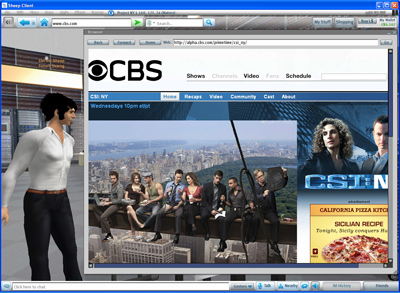
I usually skip keynotes unless I know the speaker and they often feel like eating dry toast, but I am really glad I did not miss Anthony Zuiker. In addition to being the perfect personification of "tram tour guide makes it good", Anthony is the consummate showman. None of this distracted from his unveiling of the upcoming CSI episode on October 24th as a significant step toward transmedia story telling in conjunction with The Electric Sheep Company.

Unlike the Law and Order debacle, Anthony is using Second Life to extend the story and the viewer's experience not just that night, but in an on going unfolding arc that will wrap on February 6th. I had the chance to talk to Anthony last night at an after-party, and he really does get it. I encouraged him to talk to Henry Jenkins which I hope he does, he has the energy and resources to take this concept far beyond Henry's musings.

The Electric Sheep have been busy bees, in conjunction with the CSI release, they unveiled their new Second Life viewer, touted as the first commercially licensed viewer since the client was open sourced by Linden Lab. I think this deserves it's own post which I'll write later.


In an interesting partnership, IBM and Linden Lab are teaming up to create a new set of standards to increase interoperability between worlds. From the IBM press release:
IBM and Linden Labs today announced they will work with a broad community of partners to drive open standards and interoperability to enable avatars -- the online persona of visitors to these online worlds -- to move from one virtual world to another with ease, much like you can move from one website to another on the Internet today. The companies see many applications of virtual world technology for business and society in commerce, collaboration, education, training and more.
This is definitely something I will blog more about later.

More Updates:
Thursday was mostly a meet and greet day for me. As for the Day-2 keynote, Christian Renaud is a finely tuned speaker, but his powers of ten introduction and a near-forensic analysis of how we get to the future via standards, committees, and councils (oh my) left me a bit cold. I'm not arguing for rah-rah and pom-poms, just a bit more insight into what's actually working in virtual worlds before we dive head first into a morass of standards.

Suffice it to say that "interoperability" was the buzz word of day 2, and I was surprised not to hear more buzz about the InDuality multi-platform viewer developed by Clive Jackson, CEO and Founder of Pelican Crossing. You may recall, Clive helped me escape the prison of defining "virtual world" with a great paper entitled The Metaverse 2.0 in this previous post. I completely missed meeting Clive and the InDuality demo so if anyone was lucky enough to see it, drop in a comment with your impressions.

I was lucky enough to spend some quality time with Raph Koster and Jason Hable from Areae to get an under the hood tour of Metaplace. On a side note, if you've not had a chance to hear Raph speak, you want to put that on your life list and in the mean time, you can find a lot of what he thinks out loud on his blog. Metaplace is still in a closed alpha, but by the grace of the virtual goddesses, I will get a chance to kick the tires before year end and the only thing I will tell you is you might want to tune up your Lua skillz. (No, I don't know where the auto references came from; perhaps I'm traveling too much).
Share Some Grace:

Saturday, June 23, 2007

Mr. Paffendorf Says Hello to the Future

Jerry Paffendorf (aka SNOOPYbrown Zamboni) announced his departure as The Electric Sheep Company's "Futurist in Residence" yesterday. I heard it first on Twitter, which is becoming a tool on which I increasingly rely in a tumultuous love - hate relationship.

Many times I heard people say that Jerry had "the.best.job.ever.", but being a "Futurist" can be hard work. The world we live in today is changing more quickly than I think many of us truly understand, or stop to think about other than to randomly (and annoyingly) quote Moore's Law.

No Futurist can spend much time running about talking about what we already know and are adopting, rather they have the tough job of opening our minds to yet to fore adopted ideas and trends, and try to help shape thinking likewise. For a Futurist, it can get lonely out there, where there is no one to hear you fall.

Futurists sometimes have the unenviable job of pointing out the obvious, or assembling facts in creative ways that once revealed, make you think "oh, $#%*". Perhaps this compelling video will show you what I mean.


Shift Happens - Watch more free videos

Jerry is off to pursue his passions and a new business venture for a service that combines passive gaming, lifestreaming, and collaborative web browsing with virtual world elements. Best of luck to Jerry, Entrepreneur.
Share Some Grace: