Showing posts with label innovation. Show all posts

Monday, May 31, 2010

The Second Life Why Stories


This long weekend could not have been more timely.  I needed a refresh and while Saturday was framed by 6am and 6pm Grace O'clocks, I've had the luxury of time to explore artists markets, movies, research papers and books. Now it's Monday and I need to turn my attention to Three Thanks - right after I get this post out of my head.

One book I finished was Simon Sinek's "Start With Why". I ran across Simon's TED Talk "How Great Leaders Inspire Action" (also the subtitle to his book) and was left wanting more, so I grabbed a copy of his book. 

Unless you are seriously into marketing texts, I think Simon's TED talk is just enough to get the main point across which is an elegant idea that Simon calls his "discovery".  Simon embodies his discovery in what he calls the The Golden Circle. It's a simple concentric circle model with WHY at the center, surrounded by HOW and WHAT.

He describes the implications as this:
Every single person, every single organization on the planet knows WHAT they do, 100 percent. Some know HOW they do it, whether you call it your differentiated value proposition or your proprietary process or your USP. But very, very few people or organizations know WHY they do what they do. And by "WHY" I don't mean "to make a profit." That's a result. It's always a result. By "WHY" I mean: what's your purpose? What's your cause? What's your belief? Why does your organization exist? Why do you get out of bed in the morning? And why should anyone care? 
Simon predominantly uses three case studies to demonstrate how the idea of WHY is a differentiator for success: 1) why Apple has become a predominant technology company, 2) why the Wright brothers succeeded despite lack of funds, and 3) why Martin Luther King inspired the nation not with what should be done, but with the why of his beliefs.

He argues that organizations that begin with a strong sense of WHY and keep themselves centered there are far more effective that those that focus on WHAT they do or HOW they do it.


Share Some Grace:

Wednesday, February 06, 2008

Second Life Copyright Conundrum

The internet is a copy machine. At its most foundational level, it copies every action, every character, every thought we make while we ride upon it.
- Kevin Kelly
If you read just one blog post today, skip this one and go read Kevin Kelly's pseudo blog post at The Technium entitled "Better Than Free"; then please come back for some context. [Kudos and hat tip to Malburns for the link]

A friend recently sent me a tweet inquiring as to my opinion about this post by Tateru Nino regarding the on-going allegations, outrage and uproar about content "theft" in Second Life. I was loathe to get into the debate, but was subsequently motivated by Ziggy Quirk who makes a lengthy YouTube plea:
"Why would anyone walk into a store and spend 400 or 500 Linden on a dress, if they can get a dress of similar quality for free or very cheap from a reseller?"
According to the laws of the United States under title 17, of the U.S. Code, copyright affords the creator protection from gainful reproduction of their creations. Apparently there are creators in Second Life that believe Linden Lab is responsible for enforcing that protection whether it be through technical Digital Rights Management (DRM) solutions, or through intervention and police action. I find this ironic and humorous but regardless of my personal opinion, there are larger issues at hand in this world of digital emergence where every 1 and 0 can be, and is copied.

Today's bits have no inherent value. Like the pennies you leave at the cafe, they take up space and are not worth the price of transport. Yes, I mean Ziggy Quirk's teddy bear is intrinsically worth nothing and it does not matter how many hours she spent crafting it, in the space of time approaching zero, it can and will be copied. Copyright does not protect you from copying. The second half of the copyright is the gainful part; technically you are protected from gainful reproduction but that protection occurs if *you* decide to take action to uphold your own rights. This is where the mysteries of the DMCA and attendant legal proceedings get murky, and generate urban myth. You must file a DCMA infringement notice to the letter of the law. Note in the Linden Lab policy it states very clearly:
When a valid DMCA notification is received, the service provider responds under this process by taking down the offending content.
See the word "valid"? This is the first gate, invalid requests do not even require a response. If you file an invalid DCMA notice, you aren't going to get a red-lined copy back like you did in the 3rd grade. I am sure there must be some poor schmuck with the job title "DCMA Infringement Allegation Validator", sitting in a dimly lit room next to a gigantic shredder with In-A-Gadda-Da-Vita playing softly in the background. If you want to shine a little light in his day, go get a template to follow and follow the technicalities precisely but modify it to your specification situation; this is no time to be careless.

From the Linden Lab policy, the notification must:
  1. Identify in sufficient detail the copyrighted work that you believe has been infringed upon (i.e., describe the work that you own).
  2. Identify the in-world item that you claim is infringing on your copyright, and provide information reasonably sufficient to locate the item in-world. For example "The allegedly infringing work I am referring to is located on the map area labeled 'Freelon, 104,30,56'."
  3. Provide a reasonably sufficient method of contacting you; phone number and email address would be preferred.
  4. (Optional) Provide information, if possible, sufficient to permit us to notify the user(s) who posted the content that allegedly contains infringing material. You may also provide screenshots or other materials that are helpful to identify the works in question. (This is for identification only, not to "prove" substantive claims.)
  5. Include the following statement: "I have good faith belief that the use of the copyrighted materials described above and contained on the service is not authorized by the copyright owner, its agent, or by protection of law."
  6. Include the following statement: "I swear, under penalty of perjury, that the information in the notification is accurate and that I am the copyright owner or am authorized to act on behalf of the owner of an exclusive right that is allegedly infringed."
  7. Sign the paper (sic) [You have to include a real or digital signature.]

If your notice has all of those elements, then it should be valid. If it misses any of those elements, it will very likely be rejected, forcing you to refile your notice and causing a delay in getting resolution. A good overview of how to write an effective DMCA notice is here. Note that it costs nothing to file a DMCA. However, you are liable for damages for false claims, so be careful if you try to allege an infringement unless you are certain. There are plenty of resources available to individuals that have the wherewithal to pursue them. If you want to walk through specific details and examples, head over to Chilling Effects; it is primarily focused on web sites, but it has very helpful information.

IMPORTANT NOTE: I am not a lawyer and nothing in this post is to be taken as legal advice, counsel or otherwise . This it is based upon my personal research into copyright law and the DMCA, it is not to be taken as legal truth. If you have a question about these issues, please consult an attorney.

So filing a DMCA notification just the first step, it's easy to stumble and therefore equally easy to understand why there are so many claims from the Second Life community that "I filed a DMCA notice and Linden Lab never responded!". There is no requirement to respond to an invalid allegation, and it is not in the interest of Linden Lab or the community for valid notifications to be ignored.

That is the DMCA story, which doesn't really address Ziggy's question about copyright infringement. But realistically, her question isn't *about* copyright, it's about the dynamics of an emerging marketplace. I would argue that even if if all copyright violators were stopped (a certain impossibility) that her question would still exist because 1s and 0s have no value outside the context of the experience. The fact that anyone pays anything for virtual goods is not about tangible value, it's about the intangible human elements that we so often forget, or have failed to truly recognize.

Ziggy's bear is worthless, however, bear experience and culture has value, real value that can be translated to the marketplace so that people will actually pay potentially more and more often for her bear than for a copy. There are many other components that make up a valuable offering that can and will thrive in a virtual marketplace, and Kevin Kelly lays out a few in his article that resonate well within the Second Life culture. I'm assuming you followed the directions and have read Kevin's post, so I'm going to just dash in starting from "What is it that can't be copied?" Perhaps the most convincing example, trust.
There are a number of qualities that can't be copied. Consider "trust." Trust cannot be copied. You can't purchase it. Trust must be earned, over time. It cannot be downloaded. Or faked. Or counterfeited (at least for long). If everything else is equal, you'll always prefer to deal with someone you can trust. So trust is an intangible that has increasing value in a copy saturated world.
I've blogged before about trust in the context of Identity Verification, but in this case trust means the very essence that powers an on line interaction. I would argue that trust is the very thing that drives every social network and certainly every successful transaction. In Second Life, we have very few externally visible trust indicators such as e-Bay rankings, so we ultimately rely on word of mouth, recommendations by friends and previous encounters. The problem with trust is that it's so .. esoteric. It requires a significant up front investment which is why many of the brick and mortar companies fail in Second Life, but trust alone will not answer Ziggy's question.

There is an air of "do it or else" about Ziggy's plea. Do something, Linden Lab, or else Second Life will become a deserted digital content wasteland. There are accounts of individuals leaving the Second Life platform "because" of this situation, and in the short term there may be some disruptions to the economy but I don't believe that any sort of short term fix will actually stabilize the situation. If these virtual economies are to remain vibrant, then the forces that make the human transactions so compelling must take more of a center stage. To answer the questions, one must tap into the essence of human to human exchange which requires some new thinking about "sales".

The answer to Ziggy's question is a conundrum, and a powerful one at that.
People will buy from true content creators that create experiences and give away single elements of their creations ..for free.
I am not suggesting creators "give away the store", but rather rethink what constitutes their creation beyond a logically linked set of bits. We are in an experience economy, whereby people will expect products to extend beyond the shrink wrap and encompass a multi-dimensional existence - striking emotion, connection, meaning - and thereby attendant loyalty. I am not talking mere brand loyalty, but loyalty to the ideal, the atmosphere, the energy that surrounds the mere bits. To build this type of offering, creators must build on the intangibles, earn trust, build community, raise the bar and stretch the canvas in new ways.

Fortunately Kevin lays out "eight generatives, better than free".
  1. Immediacy
  2. Personalization
  3. Interpretation
  4. Authenticity
  5. Accessibility
  6. Embodiment
  7. Patronage
  8. Findability
Take a look at each in the context of Second Life's marketplace, and you will find some creators that are already embracing this framework, and doing so very well. A personal favorite is Kriss Lehmann and his Straylight Botanical Gardens. Let's look at what Kriss does within Kevin's framework; I think he hits on at least six, and probably seven of the eight points.

Kriss ...
  • uses subscribe-o-matic instead of a group for updates, which provides a sense of immediacy on new product offerings. [Side note - subscribe-o-matic is an extraordinary product, if you are a business owner I urge you to check it out. This is not a paid advertisement, just good advice]
  • offers products with permissions that allow people to modify (personalize) his content within suitable constraints. He fairly sets a price differentiation fo this allowance.
  • offers products are uniquely authentic and innovative within a market (landscape and plants) that was largely dominated by a couple of big players, most notably the Heart Garden Centre . You might find sculpties running rampant around the grid, but you can differentiate a Straylight product without much difficulty.
  • creates an experience and rich atmosphere at Straylight that emphasizes his products in context, rather than just a storefront. People go to Straylight, just for a walk and may ultimately stumble upon a "must have" resulting from the experience.
  • leverages the enormous Second Life flickr community to make his products not only findable, but desireable and an important element to a community of photographers hungry for rich, colorful open spaces and seductive nooks. How many flickr images do you see of fairies lounging around the Heart Garden Centre?
I don't think Kriss offers any "tangible" product for free (yet). If he does, please let me know. But what he does offer is a rich product offering, the experience is free, the community is free the access to relevant information on product releases, all free. There is no doubt that Kriss' landscaping products are powerfully creative, but put them side by side the fantasy plants at Heart Centre instead of in Straylight, and I'm not sure the product differentiation would be that great. It's the entire package that makes Straylight Botanical more compelling.

So my answer to Ziggy, is ..

Without intangibles, there is no reason someone would spend more money to buy a original over a reproduction. The intangibles are not out of reach, but may require that content creators reach beyond their individual craft, collaborate and develop community. And, if all the current content creators leave Second Life, there will be another wave standing by to take their place. The motivations for content creation are as diverse as the opportunity to fundamentally change the ways we asses value in the digital landscape .. it's an interesting time indeed but we are no where near the wasteland.
Share Some Grace:
Wednesday, October 10, 2007

Virtual Worlds Conference and Expo 2007


I'm at the Virtual Worlds Conference this week and I'll be focusing my attention in two primary areas: the use of virtual worlds as a transmedia platform and new business models afforded by the attendant emerging markets and technologies.

If you have a question or want me to try to track down some information, drop me a comment.

Selected Updates
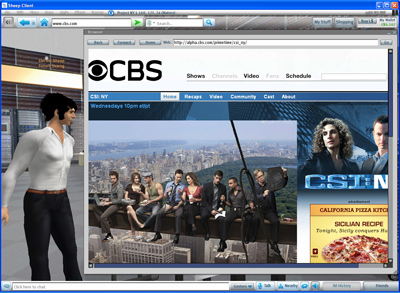
I usually skip keynotes unless I know the speaker and they often feel like eating dry toast, but I am really glad I did not miss Anthony Zuiker. In addition to being the perfect personification of "tram tour guide makes it good", Anthony is the consummate showman. None of this distracted from his unveiling of the upcoming CSI episode on October 24th as a significant step toward transmedia story telling in conjunction with The Electric Sheep Company.

Unlike the Law and Order debacle, Anthony is using Second Life to extend the story and the viewer's experience not just that night, but in an on going unfolding arc that will wrap on February 6th. I had the chance to talk to Anthony last night at an after-party, and he really does get it. I encouraged him to talk to Henry Jenkins which I hope he does, he has the energy and resources to take this concept far beyond Henry's musings.

The Electric Sheep have been busy bees, in conjunction with the CSI release, they unveiled their new Second Life viewer, touted as the first commercially licensed viewer since the client was open sourced by Linden Lab. I think this deserves it's own post which I'll write later.


In an interesting partnership, IBM and Linden Lab are teaming up to create a new set of standards to increase interoperability between worlds. From the IBM press release:
IBM and Linden Labs today announced they will work with a broad community of partners to drive open standards and interoperability to enable avatars -- the online persona of visitors to these online worlds -- to move from one virtual world to another with ease, much like you can move from one website to another on the Internet today. The companies see many applications of virtual world technology for business and society in commerce, collaboration, education, training and more.
This is definitely something I will blog more about later.

More Updates:
Thursday was mostly a meet and greet day for me. As for the Day-2 keynote, Christian Renaud is a finely tuned speaker, but his powers of ten introduction and a near-forensic analysis of how we get to the future via standards, committees, and councils (oh my) left me a bit cold. I'm not arguing for rah-rah and pom-poms, just a bit more insight into what's actually working in virtual worlds before we dive head first into a morass of standards.

Suffice it to say that "interoperability" was the buzz word of day 2, and I was surprised not to hear more buzz about the InDuality multi-platform viewer developed by Clive Jackson, CEO and Founder of Pelican Crossing. You may recall, Clive helped me escape the prison of defining "virtual world" with a great paper entitled The Metaverse 2.0 in this previous post. I completely missed meeting Clive and the InDuality demo so if anyone was lucky enough to see it, drop in a comment with your impressions.

I was lucky enough to spend some quality time with Raph Koster and Jason Hable from Areae to get an under the hood tour of Metaplace. On a side note, if you've not had a chance to hear Raph speak, you want to put that on your life list and in the mean time, you can find a lot of what he thinks out loud on his blog. Metaplace is still in a closed alpha, but by the grace of the virtual goddesses, I will get a chance to kick the tires before year end and the only thing I will tell you is you might want to tune up your Lua skillz. (No, I don't know where the auto references came from; perhaps I'm traveling too much).
Share Some Grace:

Saturday, June 23, 2007

Mr. Paffendorf Says Hello to the Future

Jerry Paffendorf (aka SNOOPYbrown Zamboni) announced his departure as The Electric Sheep Company's "Futurist in Residence" yesterday. I heard it first on Twitter, which is becoming a tool on which I increasingly rely in a tumultuous love - hate relationship.

Many times I heard people say that Jerry had "the.best.job.ever.", but being a "Futurist" can be hard work. The world we live in today is changing more quickly than I think many of us truly understand, or stop to think about other than to randomly (and annoyingly) quote Moore's Law.

No Futurist can spend much time running about talking about what we already know and are adopting, rather they have the tough job of opening our minds to yet to fore adopted ideas and trends, and try to help shape thinking likewise. For a Futurist, it can get lonely out there, where there is no one to hear you fall.

Futurists sometimes have the unenviable job of pointing out the obvious, or assembling facts in creative ways that once revealed, make you think "oh, $#%*". Perhaps this compelling video will show you what I mean.


Shift Happens - Watch more free videos

Jerry is off to pursue his passions and a new business venture for a service that combines passive gaming, lifestreaming, and collaborative web browsing with virtual world elements. Best of luck to Jerry, Entrepreneur.
Share Some Grace:

Tuesday, May 29, 2007

Intel Launches New Second Life Initiative


The Intel sim is packing nicely with over 50 avis anxious to hear about Intel's new initiative. Updates coming once we get underway.

There are no updates as I crashed like a runaway train and subsequently was not motivated to relog and try again. I'm sure 57 Miles will have the complete scoop - assuming he didn't take a nose dive as well.

posted by Grace McDunnough on Intel Software Network using a blogHUD : [permalink]

Share Some Grace:

Friday, November 24, 2006

A Room of One's Own

I work in new product development, and the first question we ask ourselves when evaluating a new product or service concept is: "What is the consumer job to be done?" or put differently, "What unfulfilled needs does this product meet?". The answers help shape the product concept and focus and naturally, when this question was posed to me about the Second Life platform, it peaked my interest. As part of the Kuurian Expedition, I led a round table discussion with Gwyneth Llewlyn on November 20th to seek out answers to this question directly from Second Life residents.

The round table was an interesting Second Life experience for me on a number of levels - not the least of which was trying to facilitate an open discussion with 15 participants without the luxury of using body language and basic human interaction cues. All in all I found it mentally exhausting and sometimes frustrating, but a good dialogue nonetheless.

I'd like to say we covered all the bases, but keeping 15 avatars on topic is challenging even under the best of circumstances. The detailed transcripts have been posted by SignPost Marvin on his site, so I am not going to do that here, but wanted to highlight just a few of the discussion points I found interesting.

A Room of One's Own
The title of this post was inspired by a comment made by my friend DrFran Babcock - an allusion to Virginia Woolf's essay entitled A Room of One's Own. The context of use was a *home* as an expressed need. In DrFran's words:
Yes, I have a sense of home here. There is a space to which I retreat when I need to. It's not a space so much as a space to be on my own and create... Like Virginia Woolf's A room of one's own.
DrFran's point of view resonated with me. I found that after a few weeks in Second Life, I was feeling a bit lost without a home. At that time, I met my now dear friend Micala Lumiere, who not only offered me a place to live on Mill Pond, but even more important, a community of which to be a part. Mill Pond is just one of many places that offer residents a chance to be part of a community, rather than be stuck randomly somewhere on the mainland. Micala has even provided people a haven in the Shakespeare and Company bookshop, adopting the "tumbleweed hotel" model made famous by George Whitman.

There are a few people such as Anshe Chung who have wagered that having a physical home in Second Life is an overwhelming need - the booming virtual real state business seems to indicate that is the case. On the other hand, the non-physical home seems to be what is most appealing to people.

SIDE NOTE: I've tried several ways to count the number of groups within Second Life, but the search result sets are constrained to 100 - if anyone has this number I'd really be interested. Nonetheless, it seems that shortly after their rezz day, people join some kind of a group.

Safety
I had not given any thought to the notion of safety as a need that Second Life can fulfill, and this was an interesting part of the discussion, especially as the news we often hear about online communities is the lack of safety.

Safety was most often described as safety from physical harm - the result of which is a willingness to participate more fully. Second Life thrives on participation so one might assume that meeting this need would be paramount to Linden Lab from a product management perspective.

To that end, we touched briefly on whether the CopyBot was a threat to people's safety - as it seems that perceived safety has a place within Second Life. The flight or fight reaction to the CopyBot most clearly indicated to me that safety is not only a need, it may be a lynchpin of the resiliency of the platform.

Do Avatars Have Needs?
This is a topic I wish I had pushed harder to explore; it is a point that intrigues me the most. At one point, a participant said:
I'm surprised by my avatar sometimes. ... It made me think about how more outgoing my avatar is than I am for example ....
This led me to wonder if there are a set of distinct needs that do not exist in the physical world, but become apparent in virtual spaces. As we assume an identity as an avatar, do we develop a new or complementary set of needs that must be met in order for our virtual existence to thrive? Do our human and avatar needs intersect?

Some participants were very clear that avatars do not have needs, I am less sure. In fact, I would argue that with the ability to extend ourselves into a new space, our needs increase accordingly.

I may hold another round table discussion on this topic alone.. once I can find that soap box.


Share Some Grace:

Wednesday, November 08, 2006

Virtual Worlds, Mixed Reality Make HOTLIST

The folks over at Innovation Lab have published their HOTLIST 2006 which "comprises the prevailing tendencies permeating research, product development and service design within the field of information technology."

You can find the hotlist detailed posting here, but I spent some time thinking about how many of these are, can and will be applied within Second Life.

1. Customermade

When customers and users "infiltrate" the product-development work of companies or organisations and begin to design and create their own products and services.

This could be a hot topic for debate within Second Life, but on the surface, I'd say that the underlying premise of Second Life defines Customermade. I am sure some would argue to the contrary. What do you think?

2. Geo-Awareness
The filling station knows you're on your way, and – via the navigating system in your car or your mobile – it will send you an offer on the petrol, and at the same time it will advertise the dish of the day in the station's cafeteria.
This is a tough one, arguably depending upon some real life location based needs. Although, one could easily conceive of a SLURL based integration for a services model, something like a AAA for Second Life.

3. Thing Connection
Thing Connection is the keystone of the 4A concept – Anytime connection, Anywhere connection, Anything connection – by Anyone. Otherwise known as ”An internet of things” – in other words: when things communicate with each other.
Largely missing from Second Life is easy and transparent communication vehicle through the virtual membrane. Some attempts are underway, but this is still largely uptapped.

4. Virtual Worlds - I think we can skip this one.

5. Web Applications The Next Generation
The Web, and not the PC, constitutes the new centre of the universe. This entails a shift from software to web-based applications where the overt and the social will come to play an increasingly substantial part.
Depending on how well Linden labs does with Customerade, largely untapped capabilities for the platform may be uncovered. Notice that NING (referenced in the detailed post) is a service I use here on this blog - it is powering the Second Life photos block in the sidebar.

6. Digitial Product Placement
Digital and virtual advertisement pillars. The digital billboard of the future will be blank space – to be filled in with messages directed at specific target groups. Thus, a major sports event attracting different viewer groups will, simultaneously, be showing ads for the local bakers as well as for an international online bank – and on two different TV stations.
Let them eat soup from the green screen. Can this be the root of the immersionist versus augmentationist debate? Perhaps not, but centainly a central theme in the burgeoning Second Life space.

7. Web Video - YouTube? I'm bored with this one, let's move on.

8. Mixed Reality
The fusion of digital, virtual and physical products is near. The remote control of tomorrow will juggle the programmes; and, at the smallest flick of your wrist, your new telephone will scroll through the menu – and then it can also be used in a virtual game of table tennis .
Some say that active SL Residents have moved too far out of the real world and into Second Life, what if you moved more of Second Life *into* the real world? Ingenious second lifers have already started to investigate haptics technology to extend your Second Life experience. What if you could interact with the world of Second Life in an entirely new way?

9. Expanded Search
Search engines are becoming more than just a match of words and numbers in a colossal database. More "intelligent", meaningful and automatic searches are starting to gain foothold.
For me, this is the largest black hole in the Second Life galaxy. I really like the second411 HUD, but a robust and innovative search model (note, not just engine) will be absolutely required if the world continues to grow.

10. Humanitarian Technology
Profit-generating technologies and humanitarian aid in one! Too good to be true? Probably - but it's nevertheless reality. A perspicacious neo-philanthropy is immanent.
Once you catch your breath, consider the *good* that is being accomplished within Second Life - Dreams Shockproof, Brigadoon, and Support for Healing, to name a few. But clearly, this are mssing the *profit* part of the equation. If you have a good example of profit, philantropy, and Second Life in the same sentence, let me know. While not as much of a black hole as Search, this is still a fertile field.
Share Some Grace: