Showing posts with label new media. Show all posts

Wednesday, February 06, 2008

Second Life Copyright Conundrum

The internet is a copy machine. At its most foundational level, it copies every action, every character, every thought we make while we ride upon it.
- Kevin Kelly
If you read just one blog post today, skip this one and go read Kevin Kelly's pseudo blog post at The Technium entitled "Better Than Free"; then please come back for some context. [Kudos and hat tip to Malburns for the link]

A friend recently sent me a tweet inquiring as to my opinion about this post by Tateru Nino regarding the on-going allegations, outrage and uproar about content "theft" in Second Life. I was loathe to get into the debate, but was subsequently motivated by Ziggy Quirk who makes a lengthy YouTube plea:
"Why would anyone walk into a store and spend 400 or 500 Linden on a dress, if they can get a dress of similar quality for free or very cheap from a reseller?"
According to the laws of the United States under title 17, of the U.S. Code, copyright affords the creator protection from gainful reproduction of their creations. Apparently there are creators in Second Life that believe Linden Lab is responsible for enforcing that protection whether it be through technical Digital Rights Management (DRM) solutions, or through intervention and police action. I find this ironic and humorous but regardless of my personal opinion, there are larger issues at hand in this world of digital emergence where every 1 and 0 can be, and is copied.

Today's bits have no inherent value. Like the pennies you leave at the cafe, they take up space and are not worth the price of transport. Yes, I mean Ziggy Quirk's teddy bear is intrinsically worth nothing and it does not matter how many hours she spent crafting it, in the space of time approaching zero, it can and will be copied. Copyright does not protect you from copying. The second half of the copyright is the gainful part; technically you are protected from gainful reproduction but that protection occurs if *you* decide to take action to uphold your own rights. This is where the mysteries of the DMCA and attendant legal proceedings get murky, and generate urban myth. You must file a DCMA infringement notice to the letter of the law. Note in the Linden Lab policy it states very clearly:
When a valid DMCA notification is received, the service provider responds under this process by taking down the offending content.
See the word "valid"? This is the first gate, invalid requests do not even require a response. If you file an invalid DCMA notice, you aren't going to get a red-lined copy back like you did in the 3rd grade. I am sure there must be some poor schmuck with the job title "DCMA Infringement Allegation Validator", sitting in a dimly lit room next to a gigantic shredder with In-A-Gadda-Da-Vita playing softly in the background. If you want to shine a little light in his day, go get a template to follow and follow the technicalities precisely but modify it to your specification situation; this is no time to be careless.

From the Linden Lab policy, the notification must:
  1. Identify in sufficient detail the copyrighted work that you believe has been infringed upon (i.e., describe the work that you own).
  2. Identify the in-world item that you claim is infringing on your copyright, and provide information reasonably sufficient to locate the item in-world. For example "The allegedly infringing work I am referring to is located on the map area labeled 'Freelon, 104,30,56'."
  3. Provide a reasonably sufficient method of contacting you; phone number and email address would be preferred.
  4. (Optional) Provide information, if possible, sufficient to permit us to notify the user(s) who posted the content that allegedly contains infringing material. You may also provide screenshots or other materials that are helpful to identify the works in question. (This is for identification only, not to "prove" substantive claims.)
  5. Include the following statement: "I have good faith belief that the use of the copyrighted materials described above and contained on the service is not authorized by the copyright owner, its agent, or by protection of law."
  6. Include the following statement: "I swear, under penalty of perjury, that the information in the notification is accurate and that I am the copyright owner or am authorized to act on behalf of the owner of an exclusive right that is allegedly infringed."
  7. Sign the paper (sic) [You have to include a real or digital signature.]

If your notice has all of those elements, then it should be valid. If it misses any of those elements, it will very likely be rejected, forcing you to refile your notice and causing a delay in getting resolution. A good overview of how to write an effective DMCA notice is here. Note that it costs nothing to file a DMCA. However, you are liable for damages for false claims, so be careful if you try to allege an infringement unless you are certain. There are plenty of resources available to individuals that have the wherewithal to pursue them. If you want to walk through specific details and examples, head over to Chilling Effects; it is primarily focused on web sites, but it has very helpful information.

IMPORTANT NOTE: I am not a lawyer and nothing in this post is to be taken as legal advice, counsel or otherwise . This it is based upon my personal research into copyright law and the DMCA, it is not to be taken as legal truth. If you have a question about these issues, please consult an attorney.

So filing a DMCA notification just the first step, it's easy to stumble and therefore equally easy to understand why there are so many claims from the Second Life community that "I filed a DMCA notice and Linden Lab never responded!". There is no requirement to respond to an invalid allegation, and it is not in the interest of Linden Lab or the community for valid notifications to be ignored.

That is the DMCA story, which doesn't really address Ziggy's question about copyright infringement. But realistically, her question isn't *about* copyright, it's about the dynamics of an emerging marketplace. I would argue that even if if all copyright violators were stopped (a certain impossibility) that her question would still exist because 1s and 0s have no value outside the context of the experience. The fact that anyone pays anything for virtual goods is not about tangible value, it's about the intangible human elements that we so often forget, or have failed to truly recognize.

Ziggy's bear is worthless, however, bear experience and culture has value, real value that can be translated to the marketplace so that people will actually pay potentially more and more often for her bear than for a copy. There are many other components that make up a valuable offering that can and will thrive in a virtual marketplace, and Kevin Kelly lays out a few in his article that resonate well within the Second Life culture. I'm assuming you followed the directions and have read Kevin's post, so I'm going to just dash in starting from "What is it that can't be copied?" Perhaps the most convincing example, trust.
There are a number of qualities that can't be copied. Consider "trust." Trust cannot be copied. You can't purchase it. Trust must be earned, over time. It cannot be downloaded. Or faked. Or counterfeited (at least for long). If everything else is equal, you'll always prefer to deal with someone you can trust. So trust is an intangible that has increasing value in a copy saturated world.
I've blogged before about trust in the context of Identity Verification, but in this case trust means the very essence that powers an on line interaction. I would argue that trust is the very thing that drives every social network and certainly every successful transaction. In Second Life, we have very few externally visible trust indicators such as e-Bay rankings, so we ultimately rely on word of mouth, recommendations by friends and previous encounters. The problem with trust is that it's so .. esoteric. It requires a significant up front investment which is why many of the brick and mortar companies fail in Second Life, but trust alone will not answer Ziggy's question.

There is an air of "do it or else" about Ziggy's plea. Do something, Linden Lab, or else Second Life will become a deserted digital content wasteland. There are accounts of individuals leaving the Second Life platform "because" of this situation, and in the short term there may be some disruptions to the economy but I don't believe that any sort of short term fix will actually stabilize the situation. If these virtual economies are to remain vibrant, then the forces that make the human transactions so compelling must take more of a center stage. To answer the questions, one must tap into the essence of human to human exchange which requires some new thinking about "sales".

The answer to Ziggy's question is a conundrum, and a powerful one at that.
People will buy from true content creators that create experiences and give away single elements of their creations ..for free.
I am not suggesting creators "give away the store", but rather rethink what constitutes their creation beyond a logically linked set of bits. We are in an experience economy, whereby people will expect products to extend beyond the shrink wrap and encompass a multi-dimensional existence - striking emotion, connection, meaning - and thereby attendant loyalty. I am not talking mere brand loyalty, but loyalty to the ideal, the atmosphere, the energy that surrounds the mere bits. To build this type of offering, creators must build on the intangibles, earn trust, build community, raise the bar and stretch the canvas in new ways.

Fortunately Kevin lays out "eight generatives, better than free".
  1. Immediacy
  2. Personalization
  3. Interpretation
  4. Authenticity
  5. Accessibility
  6. Embodiment
  7. Patronage
  8. Findability
Take a look at each in the context of Second Life's marketplace, and you will find some creators that are already embracing this framework, and doing so very well. A personal favorite is Kriss Lehmann and his Straylight Botanical Gardens. Let's look at what Kriss does within Kevin's framework; I think he hits on at least six, and probably seven of the eight points.

Kriss ...
  • uses subscribe-o-matic instead of a group for updates, which provides a sense of immediacy on new product offerings. [Side note - subscribe-o-matic is an extraordinary product, if you are a business owner I urge you to check it out. This is not a paid advertisement, just good advice]
  • offers products with permissions that allow people to modify (personalize) his content within suitable constraints. He fairly sets a price differentiation fo this allowance.
  • offers products are uniquely authentic and innovative within a market (landscape and plants) that was largely dominated by a couple of big players, most notably the Heart Garden Centre . You might find sculpties running rampant around the grid, but you can differentiate a Straylight product without much difficulty.
  • creates an experience and rich atmosphere at Straylight that emphasizes his products in context, rather than just a storefront. People go to Straylight, just for a walk and may ultimately stumble upon a "must have" resulting from the experience.
  • leverages the enormous Second Life flickr community to make his products not only findable, but desireable and an important element to a community of photographers hungry for rich, colorful open spaces and seductive nooks. How many flickr images do you see of fairies lounging around the Heart Garden Centre?
I don't think Kriss offers any "tangible" product for free (yet). If he does, please let me know. But what he does offer is a rich product offering, the experience is free, the community is free the access to relevant information on product releases, all free. There is no doubt that Kriss' landscaping products are powerfully creative, but put them side by side the fantasy plants at Heart Centre instead of in Straylight, and I'm not sure the product differentiation would be that great. It's the entire package that makes Straylight Botanical more compelling.

So my answer to Ziggy, is ..

Without intangibles, there is no reason someone would spend more money to buy a original over a reproduction. The intangibles are not out of reach, but may require that content creators reach beyond their individual craft, collaborate and develop community. And, if all the current content creators leave Second Life, there will be another wave standing by to take their place. The motivations for content creation are as diverse as the opportunity to fundamentally change the ways we asses value in the digital landscape .. it's an interesting time indeed but we are no where near the wasteland.
Share Some Grace:

Wednesday, October 10, 2007

Virtual Worlds Conference and Expo 2007


I'm at the Virtual Worlds Conference this week and I'll be focusing my attention in two primary areas: the use of virtual worlds as a transmedia platform and new business models afforded by the attendant emerging markets and technologies.

If you have a question or want me to try to track down some information, drop me a comment.

Selected Updates
I usually skip keynotes unless I know the speaker and they often feel like eating dry toast, but I am really glad I did not miss Anthony Zuiker. In addition to being the perfect personification of "tram tour guide makes it good", Anthony is the consummate showman. None of this distracted from his unveiling of the upcoming CSI episode on October 24th as a significant step toward transmedia story telling in conjunction with The Electric Sheep Company.

Unlike the Law and Order debacle, Anthony is using Second Life to extend the story and the viewer's experience not just that night, but in an on going unfolding arc that will wrap on February 6th. I had the chance to talk to Anthony last night at an after-party, and he really does get it. I encouraged him to talk to Henry Jenkins which I hope he does, he has the energy and resources to take this concept far beyond Henry's musings.

The Electric Sheep have been busy bees, in conjunction with the CSI release, they unveiled their new Second Life viewer, touted as the first commercially licensed viewer since the client was open sourced by Linden Lab. I think this deserves it's own post which I'll write later.


In an interesting partnership, IBM and Linden Lab are teaming up to create a new set of standards to increase interoperability between worlds. From the IBM press release:
IBM and Linden Labs today announced they will work with a broad community of partners to drive open standards and interoperability to enable avatars -- the online persona of visitors to these online worlds -- to move from one virtual world to another with ease, much like you can move from one website to another on the Internet today. The companies see many applications of virtual world technology for business and society in commerce, collaboration, education, training and more.
This is definitely something I will blog more about later.

More Updates:
Thursday was mostly a meet and greet day for me. As for the Day-2 keynote, Christian Renaud is a finely tuned speaker, but his powers of ten introduction and a near-forensic analysis of how we get to the future via standards, committees, and councils (oh my) left me a bit cold. I'm not arguing for rah-rah and pom-poms, just a bit more insight into what's actually working in virtual worlds before we dive head first into a morass of standards.

Suffice it to say that "interoperability" was the buzz word of day 2, and I was surprised not to hear more buzz about the InDuality multi-platform viewer developed by Clive Jackson, CEO and Founder of Pelican Crossing. You may recall, Clive helped me escape the prison of defining "virtual world" with a great paper entitled The Metaverse 2.0 in this previous post. I completely missed meeting Clive and the InDuality demo so if anyone was lucky enough to see it, drop in a comment with your impressions.

I was lucky enough to spend some quality time with Raph Koster and Jason Hable from Areae to get an under the hood tour of Metaplace. On a side note, if you've not had a chance to hear Raph speak, you want to put that on your life list and in the mean time, you can find a lot of what he thinks out loud on his blog. Metaplace is still in a closed alpha, but by the grace of the virtual goddesses, I will get a chance to kick the tires before year end and the only thing I will tell you is you might want to tune up your Lua skillz. (No, I don't know where the auto references came from; perhaps I'm traveling too much).
Share Some Grace:

Friday, July 27, 2007

BlogHer Underway

BlogHer '07 I'm Going in Second Life

Houston, we have life off! The BlogHer conference is getting underway, and some brilliant participant is capturing it live on ustream. When I find out who it is I'll be sure to tell you. For now, enjoy!


Share Some Grace:

Wednesday, July 25, 2007

BlogHer '07 in Second Life Starts Today

BlogHer '07 I'm Going in Second Life

Honestly, I do wish I was physically on my way to Chicago for the BlogHer conference although thanks to the hard work of Queen Tureaud many will have the chance to attend virtually.

Queen has done a heroic job pulling together the in world portion of the conference, you can find the schedule here. (Note that the times listed are local Chicago time CST. The SL times are 2 hours earlier). The festivities kick off tonight at 4PM SL with a mixer and a chance to meet people in world and listen to some live music from Dalien Talbot, Montian Gilruth and me - Grace McDunnough. There are over 120 SL Residents in the BlogHer group and I hope to get the chance to meet everyone over the next 2 days.

The conference starts on Friday AM on Hyperstring Islands and is packed with great speakers, exhibitors and live music from Takamura Keiko (aka "Keiko" ) and Slim Warrior.
Share Some Grace:

Tuesday, July 10, 2007

Virtual Trust in Your Second Life

In my early discussions about the power of the Second Life platform, I discussed what I called "unmediated conversation". Unmediated, in this case, by the real life factors that influence our face to face human interactions. I argued that in a medium where you could be anything, the infamous three second "first impression" rule had to be violated in some way, allowing for a richer, more meaningful initial engagement that transcended appearance and therefore led to deeper relationships.

After all, in a place where one could be any shape, thing, sex, species, etc. why would we allow ourselves to draw conclusions about the person behind the pixels in a mere three seconds simply based on their virtual manifestation? Did I mention that I *assumed* all of this?

This week my good friend DrFran Babcock started to dispel some of the myths I'd formed in my own mind in her Mental Health Missives podcast. DrFran highlights a study by Kristine L. Nowak and Christian Rauh published in the Journal of Computer-Mediated Communication entitled "Choose your ‘buddy icon’ carefully: The influence of avatar androgyny, anthropomorphism and credibility in online interactions". The study hypothesis calls my "unmediated conversation" assertion to task:
The fact that we can separate the avatar from the behavior allows an exploration of the extent to which this reliance on visible information in the perception process is due to the lack of conscious control and the relative stability of the body. Perceivers know that the avatar is consciously chosen, easy to change, and not stable. Therefore, if people rely more on a person’s behavior than on the visual information (avatar) when online, it is likely that people rely on characteristics of the offline body due to its stability and the fact that it is beyond conscious control. However, if the characteristics of the avatar have a stronger effect on the online person perception process than behavior, this implies that people rely on visual characteristics for some other reason.
I know, read it again .. it will make sense. Where do academics learn to write? We digress.

The researchers conducted a survey and an experiment. The survey was used to determine how people perceive a group of 30 avatars in static context created from 3D models using Poser 5 for human and 3D Studio Max for the non-human avatars; those results were used to base the selection of a stimulus for the experiment. The participants evaluated the avatars in terms of their androgyny, anthropomorphism, credibility, homophily, attraction, and the likelihood they would choose them during an interaction. Here are the avatar mug shots.


Figure 1. Avatar images


As you can see there is a variety of human male and female as well as non-human avatars. It's not quite as diverse as that which we encounter in Second Life, but it representative set.

The results from the report Conclusion:
Avatars that were more anthropomorphic were perceived to be more attractive and credible, and people were more likely to choose to be represented by them. The strongest predictor of these variables, however, was the degree of masculinity or femininity (lack of androgyny) of an avatar. Further, those images with strong gender indications (either more masculine or more feminine) were perceived as more anthropomorphic than images (whether human or not) without strong indications of gender. These results also support the claim that people anthropomorphize anything they encounter (Reeves & Nass, 1996), even bottles and hammers, to some degree.

Further, while all images have some level of anthropomorphism, not all images are either feminine or masculine. Some images are both masculine and feminine and others are neither. All things being equal, more anthropomorphic or less androgynous avatars are more attractive, credible, and homophilous, perhaps because androgyny and low anthropomorphism increase uncertainty. These results are consistent with the suggestion that people have higher expectations of anthropomorphic avatars and that there will be consequences for violating these expectations (Garau et al., 2003; Slater & Steed, 2002). The results suggest that less androgynous (more masculine or feminine) avatars may also carry higher expectations.

Finally, it seems that the characteristics of an avatar may at times provide useful, and relatively accurate, information about the person it represents. Although a small percentage of subjects reported a preference for androgynous avatars, a majority reported a preference for avatars that were 'like' them, at least in terms of gender. This suggests that users may also want to match other characteristics such as hair color and race, perhaps sexual orientation, or even hobbies. This means that designers should continue to provide a wide variety of choices. This would not only increase user satisfaction, but could also provide useful information about people in online interactions. Finally, providing minorities, such as Hispanic and African Americans, choices of avatars that match their ethnicity or race may make them feel more comfortable and may also help to prevent marginalizing minorities and other traditionally disenfranchized groups in online environments by making them obvious, visible participants.
I know what you are thinking "So much for your unmediated conversation, Grace." Not so fast, notice that this study was conducted statically. In other words, there was little context nor was there interaction.

I strongly maintain that the three second first impression is largely influenced by the context of the interaction. For example, suppose you are wandering around Second Life and out of the blue you get an instant message from someone you don't know. "Hi Grace". (Yes, I know you aren't Grace, please play along.) What do you do? Do you respond quickly and openly? Do you check the avatar's profile, quickly scanning for hints? Do you just ignore it?

Now consider the next scenario. You teleport into a crowded live music venue where you know no one. Out of the morass, someone says "Hi Grace". Now what do you do? Do you react differently?

Finally, consider the following; you are wandering through the SL Botanical Gardens and you stumble upon an infinitely peaceful setting that is empty, minus a brightly colored dwarf dangling his feet in the water and whispering to the fish. He looks up and says "Hi Grace". Well?

This goes to the argument of whether virtual worlds have to be 3D. The answer is of course no, unless you want to capitalize on the immersive and contextual experience.

What do you think?
Share Some Grace:

Friday, June 29, 2007

What Works In Second Life?

My in box was inundated with emails about the Forbes.com article, Sex, Pranks and Reality. (Yes, it's behind a reg wall. Bugmenot, Luke.) At first I tried to answer each email politely and completely, but I finally crafted a canned note identifying a rebuttal, more Forbes bashing, and my favorite dose of irony, a Philip Rosedale special report on the very same Forbes.com.

I'm not going to decompose and reconstruct the Forbes storytelling menagerie, but it was a stimulus to make me think that there *must* be a simple way to look at what works in a synchronous relationship space, virtual or otherwise, and to put that into the context of why some corporations are truly failing in this space.

Is there some secret sauce to success in the virtual space? Of course there is; it's what makes any and every relationship work -- give and take -- but this is hardly a secret. Why is this so difficult and taking so long to understand? Perhaps the Cluetrain Manifesto was released too early, or the academic treatise of Cultural Convergence ala Jenkins and the Wealth of Networks ala Benkler are just too difficult to grasp. There are also several treatises on marketing in Second Life, but even those seem to be falling on deaf ears.

It's time for me to coin my pitch about this new era of relationship, in terms easier to grasp:
The new market is DIALOGUE, the new currency is INTERACTION and the exchange rate is variable, based on ENGAGEMENT. - Grace McDunnough
Let's break it down to help understand the hurdles presented to large corporations.

Hurdle #1: DIALOGUE
To crack the cultural codes of Second Life, you have to engage in conversation. You may actually have to say hello to someone you've never met, you have to be willing to say what you want to say and challenge a point of view in real time, synchronously. Dialogue is critically important to building awareness; it's also the first and most basic part of a relationship.

The power of the Second Life platform is the ability to present and shape the dialogue in many experiential dimensions - spatially, visually and audibly. Why is this hard for large corporate entities? I think the answer is obvious; communication is not a strength of most large organizations internally, and externally there are layers of marketing, communication and public relations specialists that carefully craft the "message" and certainly not in real time.

Dialogue often requires that you actually be present, unlike an asynchronous web presence, and many instances of news about corporate presence in Second Life indicate that they are too devoid of people. If dialogue is a requirement, then just getting in the game presents a challenge for large corporations.

Hurdle #2: INTERACTION
Assuming you've cleared the dialogue hurdle, the next question is "Can you walk the talk?". A few large corporate builds in Second Life seem to think that interaction is achieved by putting in a rollercoaster or a ski slope. That may work if you are building an amusement park or a ski resort, but what I mean by interaction is more scientific - like that of a state change. Interaction is the process of employing the artifacts of the dialogue practically to affect change.

An example of this type of interaction was the Starwood Hotels Virtual Aloft project where the results of the community feedback were subsequently incorporated into the next release of the product.
Aloha! We are pleased to announce the reopening of the virtual aloft. Over the past few months, we have actively solicited input from you, the Second Life residents, on such design features as public spaces, guest rooms and exteriors – everything from color palette to space planning. After reviewing all of your comments, several changes to the overall design of aloft are a direct result from your feedback. Not only have these changes been applied to the virtual hotel, they will also be reflected in the “real-life” aloft hotels.
True interaction is not just a public relations stunt, it requires thinking about what you are willing to expose, and it requires that corporations listen to the voice of their consumers. Mostly it requires some accountability to the objective and attendant results which is always a hurdle.

Hurdle #3: ENGAGEMENT
Finally, the holy grail of a relationship -- how much does your time *with me* mean to you? Engagement is the new darling topic of the digital media ad sales and marketing world. It is still tough to define absolutely as it hinges on other equally obtuse elements such as "involvement", "experience", "resonance", "relationship", and a throw back to the web days of eyeballs per fortnight, "stickiness".

The real value of relationship is the response it draws from the individual, and that is how we measure engagement. You've heard the phrase "quality time" in relationships; it applies equally well to developing and maintaining a successful virtual presence. The crux of the quality measure is that it is interpreted from a single perspective - what is quality time to me may not be to the next person and therefore the value equation can shift. This makes corporations cringe. It flies in the face of what most, not all, corporations have adopted as the de facto exchange rates for their online presence which is reach and frequency.

So what works? Let's review. Build a relationship by starting a dialogue, stimulate and sponsor interactions, and tap into the emotional response of the person on whom you rely for consideration, brand loyalty including peer promotion, and purchasing.

And if you are more of an visual/audio learner, I think the New Radicals have a good point in "You Get What You Give".


Share Some Grace:

Friday, June 22, 2007

Leading Brands Summit on the Impact of Emerging Media in Second Life

InterContinental Hotels Group (IHG) hosts "Leading Brands Summit on the Impact of Emerging Media" on Friday June 29th at the Crowne Plaza Hotel and Resort conference center in Second Life. According to the press release, the motivation for the summit addresses the a topic much broader than *just* virtual worlds:
"As the media landscape expands to include social communities, consumer generated media and virtual reality, so must sales and marketing evolve to speak to and engage today's consumer. Top executives and thought-leaders reveal their new media mix, what's working for them and what they're anticipating next."
Steve McGookin of Forbes.com will moderate the diverse panel of speakers including:
* Henry Jenkins, Head of the Comparative Media Studies Department, MIT
* Del Ross, Vice President, Distribution Marketing, InterContinental Hotels Group
* Cory van Arsdale, CEO, Massive Inc.
* Andrew Markowitz, Director, Digital Marketing & Media, Kraft Foods
* Michael Donnelly, Director Worldwide Interactive Marketing, The Coca-Cola Company

The Crowne Plaza's Place To Meet island is not open yet, but you can register on their site to reserve each of the three meeting they offer: the Executive Conference Room, the Theater Room and the Lounge Room. I love this idea and I plan to give it a test run as soon as I find the time. I'll let you know how it goes.

Place to Meet is strategically placed next to Holiday Inn Island. I wonder how long it will be until we hear "I don't know much about virtual worlds, but I did stay at the Holiday Inn last night"? My guess is at the next Virtual Worlds 2007 Conference in October.
Share Some Grace:

Tuesday, June 12, 2007

Virtual Collaboration, Real Results

The Mill Pond Folk Fest wrapped on Saturday and I believe our main goal of "have a damn good time" was met and it some cases, including mine, was certainly exceeded. I learned more about the culture of Second Life and virtualized collaboration and as you know, I am all about the learning so let's dissect the event.

On the numbers
We hosted 15 hours of art and live music on 3 stages across 2 sims, with 43 musical acts. One stage was on Stone Hill and two stages were on Mill Pond - the Pond and the Tavern. The Tavern was wholly dedicated to musicians from Montreal, Canada *never heard in Second Life* and the talented Montian Gilruth hosted the mixed reality event.

I put unique visitor counters at each of the three stage parcels which gave us daily and overall totals. We had 1553 unique visitors in total (average 103 per hour) with a break down as follows: Stone Hill = 550, Pond Stage = 553, and the Tavern Stage = 450. Average resident concurrency for Friday and Saturday (thank you Tateru) was 31,526 which means in total we drew an average of 0.03% of the on line SL Residents to the event per hour, or 0.4% of the total residents logged in the last 7 days. [Trivia challenge: If you drew 0.4% of the Internet traffic to your site, who would you be?]

On engagement
Of course, we *all* know that the true power of this platform is engagement and not just numbers, so let's look at that aspect just a little. The Stone Hill and Pond stages hosted Second Life musicians while the Tavern stage introduced new, never heard before, possibly never to be heard again, musicians from Montreal. Note that the numbers for Stone Hill and the Pond are 20% higher than the Tavern.

This is representative of the Second Life fan culture, or the fandom phenomenon. In the era of new media networks and convergence, this is critically important to understand. Henry Jenkins is the expert here, take a read through his blog and books. Fandom is a powerful phenomena, and harnessing it is one way to drive traffic and increase engagement - a point that is not lost on many of the more successful Second Life performers or the more successful commercial locations such as the L Word sims.

On collaboration
Executing an event of this size requires a good deal of collaboration and cooperation and often this is where you make or break it. There were four main co-conspirators doing the heavy lifting for a few months leading up to the event: Montian Gilruth, Micala Lumiere, Montrealer Moody and me. As the fantastic four, we depended on two primary forms of communication - conference calls and a wiki. I don't think Second Life voice would have helped here, primarily because we needed a secure (i.e. not publicly available) line that the four of us could access. As a side note, I think the introduction of voice at this event would have been disastrous; Gwyn might agree or disagree.

The real essence of an event like this is the community contributions of every single person in their own way - every one of the artists and vendors, the musicians, Edward Lowell of The Stream Team and Reslez Steeplechase of First Call Musician's Co-op who donated streaming services, Bree Birke who graciously volunteered to greet and be bouncer for the entire 15 hour event, DrFran Babcock who made a delightful May Pole (it was initially a May event), and Slip Stringfellow who donated his time and soon to be "must have" security system, and each of the Second Life blogging outlets that helped promote the event including SLNN, Rik Riel on Rik's Picks for New World Notes, The Avastar, and Amalthea Blanc on Second Life Art News.

I causally mentioned having the next festival in the Fall at my Sunday gig, although the thoughts of how much time and effort it took to pull this one off is looming dauntingly in my mind - which leads me to a couple of closing points:
1) You can never have "too much help"
2) People - not technology - are the foundation of Second Life, and
3) You can not truly appreciate the power, inspiration and transformative nature of this platform unless you spend some time here actually *doing* something, anything.

Share Some Grace:

Wednesday, May 02, 2007

Ask Patty About Cars and Second Life

Second Life Indagatrix: Ask Patty
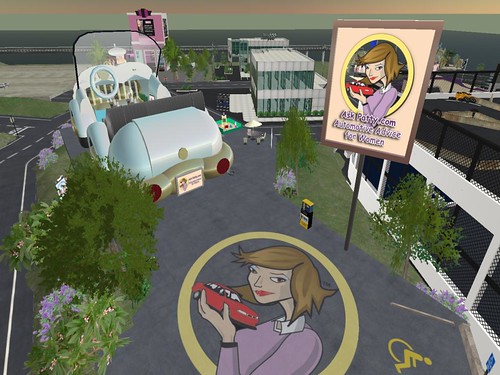
Ask Patty is launching a Second Life venue on Pontiac's Motorati Island. You say you've never heard of AskPatty.com? Well then, shame on you. Go read the Press Release for the requisite details then you *must* go see this build. If you want to join the festivities, the grand opening is May 11th from 4-9PM SLT and if I didn't have a live music gig, I'd definitely be there.


I'll tell you up front that I *love* this build. It's small but appropriate, and I would gush for pages about it, but since most of you didn't even know who Patty was (tsk tsk) I'll just give you a handful of reasons I think it's a brilliant new entry.

1) Tap the Creative Brain Trust
While it's true that the big 3-4 developers have scooped up a lot of the Second Life creative class and have them grinding out large corporate installations, SL is not short of creative genius. Patty Streeter hit pay dirt by selecting the talented Osprey Therian. And, for big bonus points in my book, Patty took the time to recommend Osprey on the SL Universe forums.

2) Smash, Mash, Blend the Brand
I appreciate builds that blend branding with what the Second Life platform provides, and this installation certainly does. The stylish roadster houses an office as well as interactive spark plugs that allow you to access the services that AskPatty.com provides.

3) Spread the Love
AskPatty buttons and t-shirts allow you to take the brand with you. Yes, I know we all hate to follow the little blue box back to the web, but *some* day this won't be as painful.

4) Choose the Right Location
The AskPatty build is located on Motorati which is technically the appropriate alignment. I know, you are asking yourself "do any women actually go to Motorati?" I suspect women who are interested in cars may drop by, but is that the target audience? This may be the achilles heel for Patty and friends, only time will tell.

5) Mix it Up
Don't forget about the power of mixed media. Osprey did a short machinima piece, but I do wish there was more variety of content in the build such as the AskPatty podcast.


Go on, take it for a spin.


Editors note: I've decided to drop the "Second Life Indagatrix" from my post titles as it was confusing several people as well as search engines.
Share Some Grace:

Thursday, April 19, 2007

Second Life Economics vs. Entitlement

I spent so much time thinking about the title of this post that it was making me slightly nuts, so this morning I sat down and tapped out what was at the top of my mind. In my life I've had the good fortune of a few writers and editors trying to teach me how to craft an appropriate title, but for whatever reason, I continue to fail them as a student. Nonetheless, this post is purely my opinion on what I see as a natural turn of events as the Second Life population grows and the attendant market and cultural evolution. Evolution, as it were, that sometimes feels more like a retrograde than forward movement but that's just this one avi's opinion.

While the growth of Second Life has been media-hyped, there are market effects felt in world that are not necessarily understood by those merely reporting. The recent onslaught of new residents has done at least two things: 1) saturated some markets and 2) presented new market and social normality challenges that were not otherwise present when the world was considerably smaller, and therefore more "small townish". These changes came on as quickly as the newbs, and it's left some residents in a quandary about how to stay solvent, if not thrive.

On the Marketplace and Value Chains
If you read my Defining Virtual Worlds post, you'll know that I believe that the marketplace of Second Life, enabled by Linden Lab's brilliant decision to allow content creators rights to their digital creations, is critically important to success. I place it on equal par with the other two points I made, as it's very existence is what motivates some people to participate well beyond the social aspects of the environment. I hesitate to categorize the Second Life platform as a true economy because of a few nuances, such as things like the lack of a central bank and stipends, but let's not debate those here. Regardless, there is a true marketplace, and much of what drives successful businesses in SL is the ability to tap into a market and serve it accordingly.

NOTE:
1) The live music case below was stimulated by a recent dialogue within the Live Music community and assumes that the value chain participants want to profit or stay solvent. The cases where an individual merely wants to participate at his own expense is provided as a counter example in the Second Life Artists discussion.
2) Among other things in Second Life, I'm part artist and part performer but certainly not an economist. I concede that as a human that the following represents my own thinking and observations from that vantage, not as an economic treatise.


Live Music as a Market
Recently, one of the most vocal discussions about marketplace dynamics and social norms has been in the Live Music community. Live Music is certainly not the largest entertainment draw in Second Life, but it does present a valuable and unique opportunity for the marketplace participants which include listeners, venue owners, performers, promoters, distributors and publishers. Just as the real world, a many-person value/supply chain can be complicated to navigate, and if you do not realize what part you play, understand what value you add, know what each contribution is worth to the consumer, and how to play nicely with the other contributors, you will fail. [If you don't believe me, read any article on the success of Toyota or Walmart.]

For the Live Music community, there are sore spots all along the value chain but I'm going to focus solely on Venue Owners and Performers as Publishers/Promoters have been fairly silent. Unfortunately, the case has been generically presented as "should live music be free or not?", the utterance of which is simply an ignorance about how a marketplace thrives so I am not answering that directly.

Music Venue Owners
There are many types of venues in a endless resource market, from pure music venues to casinos, each with their own value proposition. Slim Warrior, performer and proprietor of the Menorca sim, started a free form discussion regarding the inability of music-only venues to stay solvent given the current overhead of paying performers as well as on-going land, streaming server and maintenance fees. The fees Slim outlines are real, but as part of the value chain, do consumers distinguish between venue types and if so, what is the value they place on a "not for profit" or music-only venue, versus a revenue-supported venue (e.g. a casino) and most importantly is there a cost value within that distinction? One way to test is to charge admission, which to the consumer may present itself as "I'm paying to enter this venue" or "I'm paying to hear this performer", or both. Does that matter? It matters only if you plan to have a successful marketing campaign.

Slim's personal initiative started a fire storm of debate and discussion, which highlights an interesting aspect of the Second Life community insomuch as there are not yet standards bodies, unions or organizations from which structured discussion can emerge. Hence, basic human nature leaves us with cliques, collusion as well as soap box theatrics.

Performers
I chose not to use the word "musician" here, because I am making a market judgement that the live music market value proposition in Second Life is as much about performance as it is raw musical "talent". This subtlety regarding value from the market's perspective- not the performer's perspective - may be where this case breaks down the most. Arguments stemmed from Slim's discussions that performers are not making "what they deserve". At one performance on Menorca, a live musician took time out of a set to complain that it was unfair that escorts were making more than live musicians.

This is how Entitlement came to be part of this post's title. In a marketplace, you are "entitled" to what the market will bear, and how you compete against the other market entities. The Second Life market is not the same as the real world market. While some can leverage the aspects of the real world market toward their in world value, the simple argument of " I make this in real life, therefore I should make this in Second Life" is critically flawed, even in the case of escorts.

There have been a number of outspoken performers on this issue. Silas Scarborough chose to use his position as the performer for the Dreams Community Fair American Stroke Association benefit concert to announce his personal perspective regarding live musicians playing casinos and asked musicians to strike until casinos delivered what he called fair and reasonable pay for musicians. He also used in world live music groups as a distribution platform for notecards and t-shirts reiterating his views. Likewise, Flaming Moe, a long time performer in Second Life, scoffed at an offer of $25USD for a single hour of play at AOL Pointe - arguably one of the most successfully promoted corporate venues in world to date, right behind the L Word sims. I won't use any space here debating Silas' or Flaming Moe's points, since if you've understood any of what I'd said in the opening paragraphs, you know my opinion.

A different view to the above has been eloquently presented by Komuso Tokugawa. Komuso started his discussion here, but today I read a follow on comment post from him on the subject, citing a brilliant article by Bob Lefetz . Komuso's comments are on target, from which I must quote:
I think in this changing environment indie musicians [esp indie musicians with dreams of making it “big”] need to seriously start questioning conventional wisdom concepts such as “exposure”, “cd sales”, “promotion”, “marketing” and other so called traditional routes to musical “success” and start devising ways to connect with and communicate authentically with the only people that really matter…the people who are moved by your particular style of sonic manipulation and will ultimately put their hands in their pockets to reward you for doing that…if financial gain happens to be your core objective [or one of them] from being a musician.

If music is art, how are the other "artists" in Second Life managing the same market dilemma? I think the answers can be found in any number of places, but this Reuter's article is packed with an interesting contrast to the above case. From the article:
“My experience is that 99.9 percent of the artists here are not just out to make a buck. They just enjoy having their art seen and if they sell a piece here and there, it’s icing on the cake,” said Sasun Steinbeck, who maintains a list of art galleries for Second Life. “I know for me I get much more thrill out of watching someone have that ‘oooo aaaah’ moment when they see my sculpture than in the ‘cha ching’ sound of making another sale”.
And finally, to my friend DrFran Babcock- an individual that in real life has a "day job" but has embraced Second Life for the opportunity it affords us all. In Dr Fran's Friday podcast about the success of her bird buddies:
"I think of Second Life as my creative and social playground. I would rather not make money, than spend all my time in SL preparing objects for sale ... Poor but happy is what I'll be, and that's a conscious decision."

You are entitled to be happy, you are not entitled to profit simply because the platform allows it. Leverage the endless possibilities that Second Life affords its resident to think creativity about your craft, your "brand", your existence and your business. Allowing yourself to be trapped in the models and attendant expectations of the real world will leave you shallow, unfulfilled and probably the subject of one of my next postings.
Share Some Grace:

Thursday, April 05, 2007

Virtual Worlds 2007 Observations

Last week, the "first" Virtual Worlds conference subtitled "The Future of Marketing and Media" was held in New York. I've been sitting on this post for a week and after much deliberation, I've decided to unleash it in a form that is nothing more than my observations and commentary.

You can find plenty of posts about the "news" of the conference and you can watch a few celebrity interviews, so I won't bore you with additional minutia about suits, overbooking, under planning and poor execution. Those elements are the subject of most of my scribbled conference note expletives, but there are others so let's get going.


I've been working in this space for about a year now and aside from technology, my primary motivation for attending the conference was two-fold:
1) find out what strategies are being employed in this space, and 2) get some *data* regarding results of the much publicised endeavors. The conference was run more like a fire side chat, so I got very little of either despite agenda headliners such as: "Defining you Strategy, What does ROI mean to you?"

Matt Bostwick , Jeffrey Yapp and Steve Youngwood of Viacom's MTV Networks and Nickelodeon provided the most comprehensive information with their aggressive virtual world progenies
Virtual Laguna Beach (VLB) and NICKtropolis in tow. Viacom announced new "niche" worlds in development including Pimp My Ride, LOGOWorld and a nightclub/music project based on Doppleganger's music lounge where the intent is the further blur the lines between TV, the web and a 3D world. They have branded their strategy "4D TV" which in mathematical terms is 4D TV = TV + 3D, a true representation of the blurring lines between pure linear TV and on-line engagement models. To quote Bostwick from CNET's article:
"Our goal is to let them create their own story lines and content. We think this will come full circle when the content flows from inside our worlds onto the screen."
Have I heard that somewhere before?

I found a few tidbits of the Viacom self-reported data below intriguing and if we knew how much they have invested in these properties, we'd have some insight into the 4D equation.
  • For VLB in-game advertising, 99% of the resident population were exposed to ads, and 85% of those chose to interact with the brand element within 2 weeks of deployment
  • Last month, over 92,000 people clicked on "Add a buddy" from virtual MTV
  • NICKtropolis launched in January and has over 2.4 million registered users, of which 1.3 million users have created rooms
  • The Neopets site gets 11 million uniques a month and the "average" person spends 3 hours a week on Neopets
So that was a big media company perspective, but if you want data you look to IBM, right? After all, IBM announced that they are investing $10M over the next year in virtual worlds including an expanded presence in Second Life and their own 3D intranet.
Every time we've moved ahead in IBM, it was because someone was willing to take a chance, put his head on the block, and try something new.” - Thomas J. Watson
It didn't take *that* long for some IBM suits to put their head on the block for virtual worlds. But most people don't know that the IBM onslaught into Second Life was actually led by individuals with a passion and some forward thinking, not a top-down strategy, and that may be the best strategy lesson that was not told. If some of these IBMers, rather than Collin Parris, had addressed the conference I expect the discussion would have been more lively, engaging and not laden with big blue speak, jargon and a lesson on value chains which sounds vaguely like the old IBM strategy, with just a new "D"imension.

IBM had a chance to impress the attendees with their VW expertise when a question was raised as to whether there was anything that small businesses could learn from what the large businesses are doing in virtual worlds but the answer was "No, it's too early to tell". No?!? If you asked that question -- call, Skype, email, Linked In, Twitter or smoke signal me and let's talk. There are plenty of lessons learned to date, even in these primordial times.
"What is reality anyway! It's nothing but a collective hunch." - Jane Wagner, The Search for Signs of Intelligent Life in the Universe
My largest and possibly most depressing discovery from this Virtual Worlds conference, is that collectively we have no definition for the entity we call "virtual worlds". More than once MySpace was touted as "the largest virtual world" which to me is a resounding call for at least a collective consciousness instead of the collective hunches about this emerging platform. I've been working on my own definition which will be the subject of a future post once I've drawn the pretty graphics.


Share Some Grace:

Tuesday, March 27, 2007

Congratulazioni Mario


This post is nothing but gush about the most recent accomplishment of my dear friend Frank Koolhaas in Second Life. Frank, aka Mario Gerosa just had his book entitled "Second Life" published in Italy by Meltemi.

When I first met Frank in late 2006, I was immediately drawn to his exuberance and wonderful Italian charm and I am sure much of this is reflected in his book. Frank and I are one third of the Kuurian Expedition leadership, we are the domestic and international "Consul", as appointed by Poinky Malaprop. Our on-going friendship is one of those classic and cherished conincidences that seem to be so prevalent in Second Life. During one of our first conversations, Frank declared that he was going to write a book and at that time I was certain it would be primarily about his passion - architecture - but in the end, Frank wrote about the cultures and trends of the Second Life experience from art, architecture, sex, business, travel and law as relayed by numerous Second Life residents and their diverse perspectives.

Frank presented the book to the SL community at a Kuurian event on Monday and in true Frank form, even had the publisher in world to participate in the discussion. An English version should be released, although during the presentation to the SL community on Monday the time frame was not specific.

If my Italian was better, I would highlight some of my favorite parts, but so far all I've translated is the section I wrote in the chapter "Piccolo dizionario enciclopedico per il futuro di SL". Go get a copy!
Share Some Grace:

Wednesday, November 08, 2006

Virtual Worlds, Mixed Reality Make HOTLIST

The folks over at Innovation Lab have published their HOTLIST 2006 which "comprises the prevailing tendencies permeating research, product development and service design within the field of information technology."

You can find the hotlist detailed posting here, but I spent some time thinking about how many of these are, can and will be applied within Second Life.

1. Customermade

When customers and users "infiltrate" the product-development work of companies or organisations and begin to design and create their own products and services.

This could be a hot topic for debate within Second Life, but on the surface, I'd say that the underlying premise of Second Life defines Customermade. I am sure some would argue to the contrary. What do you think?

2. Geo-Awareness
The filling station knows you're on your way, and – via the navigating system in your car or your mobile – it will send you an offer on the petrol, and at the same time it will advertise the dish of the day in the station's cafeteria.
This is a tough one, arguably depending upon some real life location based needs. Although, one could easily conceive of a SLURL based integration for a services model, something like a AAA for Second Life.

3. Thing Connection
Thing Connection is the keystone of the 4A concept – Anytime connection, Anywhere connection, Anything connection – by Anyone. Otherwise known as ”An internet of things” – in other words: when things communicate with each other.
Largely missing from Second Life is easy and transparent communication vehicle through the virtual membrane. Some attempts are underway, but this is still largely uptapped.

4. Virtual Worlds - I think we can skip this one.

5. Web Applications The Next Generation
The Web, and not the PC, constitutes the new centre of the universe. This entails a shift from software to web-based applications where the overt and the social will come to play an increasingly substantial part.
Depending on how well Linden labs does with Customerade, largely untapped capabilities for the platform may be uncovered. Notice that NING (referenced in the detailed post) is a service I use here on this blog - it is powering the Second Life photos block in the sidebar.

6. Digitial Product Placement
Digital and virtual advertisement pillars. The digital billboard of the future will be blank space – to be filled in with messages directed at specific target groups. Thus, a major sports event attracting different viewer groups will, simultaneously, be showing ads for the local bakers as well as for an international online bank – and on two different TV stations.
Let them eat soup from the green screen. Can this be the root of the immersionist versus augmentationist debate? Perhaps not, but centainly a central theme in the burgeoning Second Life space.

7. Web Video - YouTube? I'm bored with this one, let's move on.

8. Mixed Reality
The fusion of digital, virtual and physical products is near. The remote control of tomorrow will juggle the programmes; and, at the smallest flick of your wrist, your new telephone will scroll through the menu – and then it can also be used in a virtual game of table tennis .
Some say that active SL Residents have moved too far out of the real world and into Second Life, what if you moved more of Second Life *into* the real world? Ingenious second lifers have already started to investigate haptics technology to extend your Second Life experience. What if you could interact with the world of Second Life in an entirely new way?

9. Expanded Search
Search engines are becoming more than just a match of words and numbers in a colossal database. More "intelligent", meaningful and automatic searches are starting to gain foothold.
For me, this is the largest black hole in the Second Life galaxy. I really like the second411 HUD, but a robust and innovative search model (note, not just engine) will be absolutely required if the world continues to grow.

10. Humanitarian Technology
Profit-generating technologies and humanitarian aid in one! Too good to be true? Probably - but it's nevertheless reality. A perspicacious neo-philanthropy is immanent.
Once you catch your breath, consider the *good* that is being accomplished within Second Life - Dreams Shockproof, Brigadoon, and Support for Healing, to name a few. But clearly, this are mssing the *profit* part of the equation. If you have a good example of profit, philantropy, and Second Life in the same sentence, let me know. While not as much of a black hole as Search, this is still a fertile field.
Share Some Grace:

Monday, October 30, 2006

Supply and Demand - The Land Store is Closed -

On the heels of my virtual exuberance, Linden Labs announces a non trivial price increase for private estates. The land store is now closed until 1PM SL November 1st when the great land rush will recommence for the remaining 150 sims at the old bargain rate. After that, set up costs will increase from $1250 US to a whopping $1675 US and monthly maintenance increases from $195/month US to $295/month US.

The blog post responses are currently at 118 and will be climbing, assuming the community can express it's disdain in a meaningful (and therefore non moderated) way. It should be no surprise that the responses from residents are largely unfavorable, but some are creative including Koz Farina's post of the lyrics of The The's "The Beat(en) Generation". What may be arguably more disturbing than the general unrest is the suspicion that this increase was pre-released to a few select Second Lifers. [I actually read a post about this by Prokofy Neva over the weekend, and am kicking myself for not being able to find it now.] The crux of the issue is whether the land store was closed prior to the rumored "pre announcement" or if there was in fact some unfair advantage. I suspect it was the former.

I have read some speculations that this act will be the *tipping point* for Second Life. Other than a misuse of the concept, the environment is changing so radically it does not lend itself to meaningful analysis even of the tipping point persuasion, but molds rather well to hype and emotionalism. After all, this could *just* be a bad business decision - one we'll read about in HBR next year. On the other hand, it could be the simple result of basic economics - remember that pesky supply and demand curve?


UPDATE: Adam Pasick, I mean Adam Reuters, posted a story announcing that the private estate price increases were, in fact and sadly, leaked to select designers and long time residents. Quoting from the article:

We probably made a mistake there, trying to get feedback. We should just tell everybody everything,” Rosedale (right) told Reuters on Monday in a telephone interview that also included newly appointed Chief Financial Officer John Zdanowski.

And farther along...

Rosedale said the Second Life land store was closed on Friday after word of the impending increases leaked, shortly before any developers or other businesses were notified by the company. However, official confirmation of the increases was not given until Sunday evening, which would have presented a small window to buy sims from other residents.

The post I could not locate is here.
Share Some Grace: